
The Power of Frequency: Sound, Levitation, and Good Vibrations
Scatter sand across a metal plate, introduce a steady vibration, and something remarkable happens: the grains gather into intricate lines, loops, and symmetrical figures. Change the vibration, and a different design emerges, as though an invisible artist has redrawn the surface. These are real physical patterns, not computer-generated effects, and the explanation is every bit as interesting as the spectacle. Physics Instructional Resource Team
Watching that transformation, it is tempting to ask bigger questions. If vibration can organize matter—and sound can even suspend small objects in midair—could the language of “good vibrations” contain something more than a pleasant metaphor? Does changing our mindset help change our circumstances, or can our thoughts literally attract a different future? Exploring the power of frequency means following those questions carefully, without losing either our curiosity or our ability to tell one kind of evidence from another.
These Chladni figures reveal how different vibrations produce different patterns on a particular plate. The frequency labels describe that experimental setup, not a universal code assigning one shape to each number. Physics Instructional Resource Team
What Does Frequency Actually Mean?
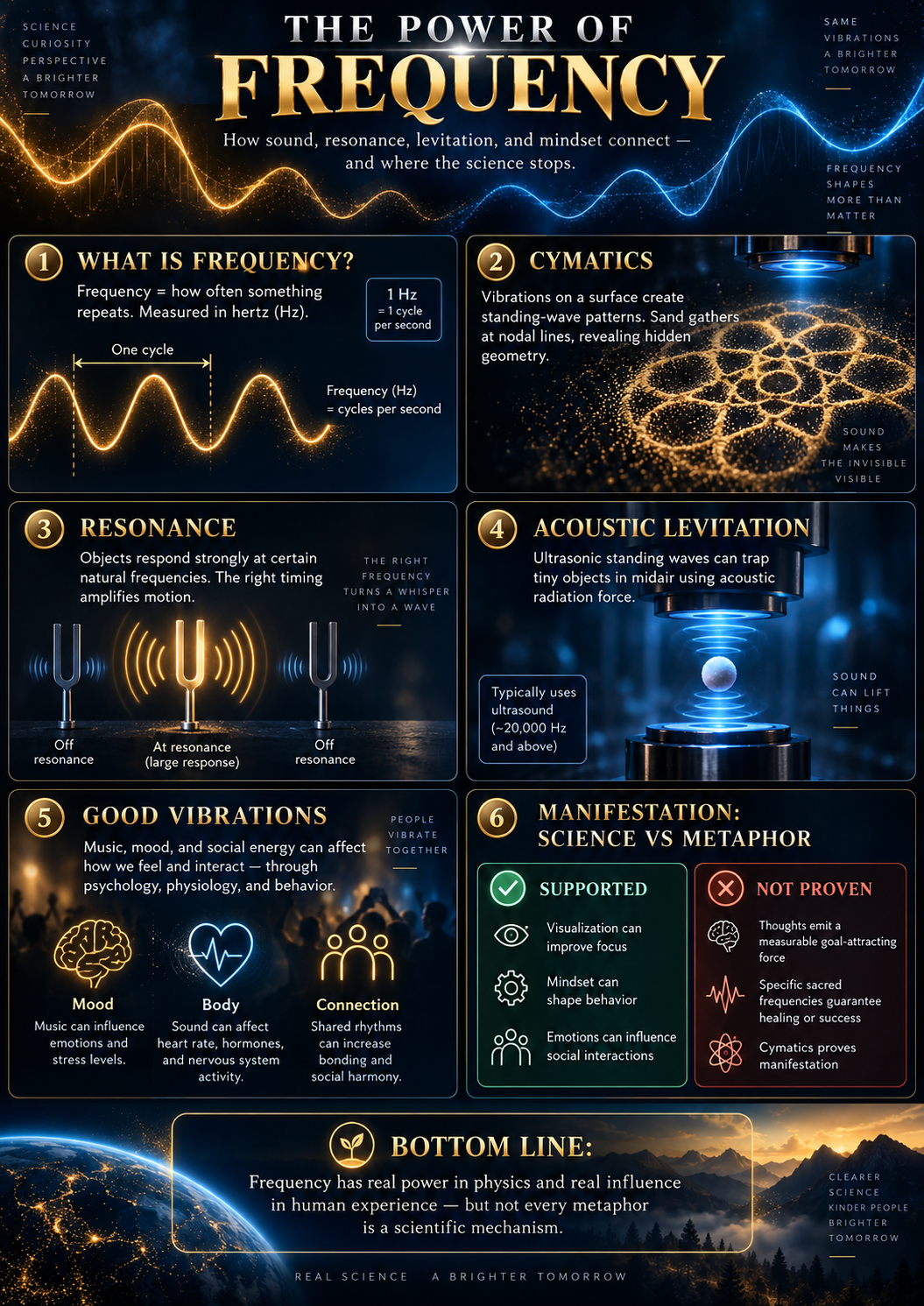
Frequency describes how often something repeats. One hertz, abbreviated Hz, means one cycle per second, so a vibration at 100 Hz repeats 100 times each second. It is a measurement, not a special substance or a ranking of how beneficial something is. Nothing about the definition makes a higher frequency spiritually positive or a lower frequency emotionally negative. NIST
Sound consists of mechanical disturbances traveling through a material such as air, water, or a solid. Frequency helps determine the pitch we hear, while amplitude describes the size of the vibration or pressure change. A tone can have the same frequency while being played softly or loudly, with very different physical effects. That distinction becomes essential when a spectacular demonstration is explained as nothing more than “finding the right frequency.” OpenStax
Resonance adds another ingredient: a system can respond especially strongly when driven near one of its natural frequencies. Think of pushing a swing at an appropriate rhythm rather than at random moments. The timing allows successive pushes to build the motion, but someone still has to supply energy. Resonance makes energy transfer effective; it does not produce unlimited power from nothing. OpenStax
Cymatics: Why Sound Creates Beautiful Geometric Patterns
Cymatics is a term used for making the effects of vibration visible. One classic example is the Chladni plate, associated with physicist Ernst Chladni. In this experiment, a thin plate is vibrated with a bow or mechanical driver while sand reveals its motion. The plate is not moving uniformly: different regions participate differently in a particular vibration mode. Harvard Natural Sciences Demonstrations
The important concept is a standing wave. Interference can produce a pattern whose strongly moving and nearly stationary regions remain in fixed positions, even while the material keeps oscillating. On a vibrating plate, the nearly stationary regions form nodal lines, while antinodes mark areas of stronger motion. Sand is shaken away from the active regions and tends to accumulate along those quieter lines. Harvard Natural Sciences Demonstrations
In other words, the sand is not interpreting the emotional meaning of a sound. It is revealing the mechanics of the surface beneath it. Three details explain much of what makes these demonstrations so striking:
- The pattern belongs to the whole system. Change the plate’s shape, dimensions, or mounting, and you change its possible vibration modes. Even touching the edge can constrain its motion and help select a different pattern. A particular frequency therefore cannot be separated from the object receiving it. ResearchGate
- A frequency change can reveal a different mode. As the driver approaches another suitable resonance, a different arrangement of nodes becomes prominent. That can make the sand reorganize dramatically rather than change smoothly. The apparatus and the way it is driven determine which modes are excited. Physics Instructional Resource Team
- Geometry emerges without a designer drawing each line. Symmetry in the plate and its constraints helps structure the resulting patterns. Their resemblance to flowers, mandalas, or decorative artwork can be beautiful without demonstrating that a sacred message is encoded in the tone. Meaning is an interpretation added to the observation. ResearchGate
That last distinction should not diminish the experience. Someone may find spiritual significance in the way order emerges from motion, just as someone else finds it in a night sky. The problem begins only when that personal interpretation is presented as a laboratory result. Harvard’s Chladni plate demonstration offers a useful reference for the physical experiment behind the imagery.
Acoustic Levitation: When Sound Holds Matter in Midair
The next step sounds like science fiction, but acoustic levitation is established experimental physics. Suitably arranged sound fields can exert forces that hold small objects against gravity without a supporting surface. In common arrangements, opposing ultrasonic waves create standing-wave traps, with small solid particles held near suitable pressure nodes. These nodes describe minimal pressure oscillation, not holes in the air or regions where gravity has disappeared. AIP Publishing
The supporting force is called an acoustic radiation force. Although the sound pressure oscillates rapidly, its interaction with an object can produce a net force over time. The field must provide enough upward force to balance the object’s weight, along with restoring forces that keep it from drifting away. It is levitation through applied force, not the cancellation of gravity. arXiv
Researchers have gone beyond simply keeping a bead in one place. Experiments using ultrasonic arrays have moved millimetre-sized particles through three dimensions by controlling the sound field. In 2018, a University of Bristol acoustic tractor-beam experiment used 40 kHz ultrasound and rapidly changing acoustic vortices to trap a polystyrene sphere approximately two centimetres across. That result expanded what a particular trapping approach could handle; it did not establish that arbitrary heavy objects could be lifted just as easily. arXiv
The practical possibilities are compelling even without that leap. Contactless handling could help researchers manipulate delicate samples or assemble components without gripping them, and published levitators have already held droplets and small electronic parts. But these effects require purpose-built equipment, electrical power, and suitable materials and geometry. The remarkable achievement is precise control, not a mysterious tone that makes everything weightless. AIP Publishing



Hutchison, UFOs, and the Leap to Antigravity
A different story comes from British Columbia experimenter John Hutchison. His website attributes claimed metal levitation and deformation to combinations of high-voltage equipment, Tesla coils, and electromagnetic fields. These are claims about an electrical setup, not a demonstration of sound-wave levitation. His account describes what he says happened, but it does not by itself independently establish an antigravity mechanism. hutchisoneffect.com
The resemblance to UFO imagery is easy to appreciate: something appears to hover without an obvious support. Yet appearance alone cannot establish that two objects share a mechanism, any more than a balloon and a helicopter must fly the same way. Acoustic experiments also use an external apparatus to support an object, rather than showing a vehicle lifting itself. And because sound requires a material medium, an airborne acoustic trap is not an explanation for propulsion through a vacuum. OpenStax
There is nothing wrong with imagining where future wave-control technology might lead. The boundary is between using an experiment to inspire a possibility and using it as evidence that the possibility already exists. A claim about gravity control would need controlled measurements and reproducible results addressing gravity, not simply footage of an object moving. Wonder opens the question; testing determines which answer deserves confidence.
Can Certain Frequencies Improve How We Feel?
Sound can affect emotional experience without possessing mystical properties. In a study involving intensely pleasurable music, researchers at McGill University measured dopamine release associated with listeners’ peak emotional responses. The work also distinguished aspects of anticipation from the experience of peak pleasure itself. That is a genuine connection between sound and the brain, but it concerns responses to music—not proof that one isolated frequency produces a universal emotional state. PubMed
Research into specific tunings is more preliminary. A pilot study involving 12 people with spinal cord injuries compared music using reference pitches of 432 Hz and 440 Hz and reported improved self-reported sleep scores after the 432 Hz condition. Those numbers describe tuning references, not the only frequencies present in the recordings. The authors called for larger studies, and this small experiment cannot establish a universal healing frequency or show that a tuning repairs DNA, attracts prosperity, or benefits everyone. ResearchGate
The distinction matters when interpreting personal experience, too. Finding a recording calming is a valid reason to enjoy it, but the experience alone does not isolate the tuning from the composition, listening conditions, or expectations. To test the tuning itself, those other influences need to be addressed. You do not have to disprove your enjoyment—or adopt an extraordinary explanation—to appreciate what music brings to your life.
What “Good Vibrations” Can Mean Between People
When someone says another person has good energy, they may be describing something socially meaningful rather than physically mysterious. Psychology offers a relevant concept called emotional contagion, in which people’s emotional states influence one another. Research reviewed by Sigal Barsade and colleagues describes effects on group interactions, cooperation, and conflict. The proposed pathways involve social and emotional processes, not evidence that kindness broadcasts an undiscovered attracting wave. Wharton Faculty Platform
Imagine two versions of a conversation with a potential collaborator. In one, you interrupt, assume criticism, and treat every question as a threat; in the other, you listen carefully and explain your ideas with genuine interest. It would be unsurprising for those conversations to develop differently. Calling the second approach “sending good vibes” can capture the experience, but the practical mechanism is communication and behavior.
This offers a grounded interpretation of “what you put out comes back.” What you express can influence the interaction you then experience, although another person remains free to respond however they choose. It is an opportunity to participate constructively, not a guarantee of cooperation or a bargain that obligates the world to reward positivity. Being warm should also not require ignoring boundaries, accepting mistreatment, or pretending a problem does not exist.
There is room for a spiritual interpretation alongside that practical one. Someone might use “being on the right frequency” to mean living consistently with their values or approaching others with goodwill. That can be meaningful without a measurement in hertz. The metaphor becomes less useful when it is treated as a literal explanation that no observation is allowed to challenge.
Manifestation: Can Thoughts Attract a Different Future?
Manifestation combines several ideas that deserve separate treatment. Visualizing a goal, rehearsing an action, and reminding yourself what matters are not identical to claiming that thoughts transmit a frequency that draws matching events into your life. The first set concerns how thinking influences what you do. The stronger cosmic claim proposes an additional mechanism, and successful visualization alone cannot establish it.
Consider someone who pictures running a successful small business. They begin talking to prospective customers, improve their offer, and follow up on inquiries they previously avoided. When an opportunity arrives, they might describe it as something they manifested. That description can have personal meaning, but this hypothetical sequence also contains observable actions that could help explain the outcome without a new force.
What Supporters Point To—and What It Establishes
Stories of uncanny timing deserve to be heard accurately, but they need careful interpretation. A desired event happening after a visualization is not enough to show that the visualization caused it, much less that it worked through a physical frequency. The same distinction applies to the science commonly drawn into the discussion:
- Beautiful patterns show that vibration can organize particles under particular conditions. They do not measure intentions, opportunities, or personal destiny. To use them as evidence for manifestation, an additional experiment would have to demonstrate the missing connection. Resemblance between “creating order” in a plate and “creating order” in a life is an analogy, not that experiment.
- Emotional and behavioral effects can make mindset consequential. A person who rehearses a difficult task may prepare differently, and someone who communicates warmly may receive a different response. Those are plausible routes through which an internal change reaches the outside world. Evidence for these routes does not automatically establish a separate cosmic mechanism. Sage Journals
- Testimonials describe individual experiences, not the full comparison. To assess an attracting force, researchers would need defined outcomes, appropriate comparison groups, and an accounting of unsuccessful predictions as well as successes. Otherwise, preparation, circumstances, and coincidence remain possible explanations. A compelling story can motivate a study without supplying its conclusion.
A three-study investigation involving 1,023 participants found that stronger manifestation beliefs were associated with greater perceived success and stronger expectations of future success. The researchers did not find a corresponding relationship with income or educational attainment. They also reported associations with some financial-risk measures, but the research was correlational, so it does not establish that manifestation beliefs caused those outcomes. The important distinction is between feeling more certain of success and demonstrating that success has increased. Sage Journals
Visualization Works Differently When It Includes the Work
Research offers a useful alternative to simply imagining possession of the reward. In an experiment by Lien Pham and Shelley Taylor, students mentally rehearsed effective studying, imagined receiving a good grade, or completed other comparison conditions. Process-focused simulation improved studying and grades, with improved planning and reduced anxiety helping explain the findings. The result supports a practical role for imagination while keeping the mechanism connected to action. Sage Journals
There is also a caution against assuming every positive fantasy is motivating. Across four experiments, Heather Kappes and Gabriele Oettingen found that indulging in idealized positive futures could reduce indicators of energy compared with other kinds of imagining. That does not make hope harmful or prove all visualization fails. It suggests that mentally enjoying an outcome is different from mobilizing yourself to pursue it. ResearchGate
The useful interpretation of “act as though you already have your goal” is therefore about standards and habits, not pretending the work is complete. Practice the reliability of the professional you want to become, rather than spending as though future income is already guaranteed. Rehearse responding to a setback, not just accepting congratulations. Let the imagined future guide what happens next.
Turning “The Right Frequency” Into Something Practical
One research-based approach, known as mental contrasting, deliberately places a desired future beside the obstacle standing in its way. Combined with an “if–then” plan, it becomes the strategy popularized as WOOP: wish, outcome, obstacle, and plan. It preserves room for an appealing future while requiring attention to present difficulties. The point is not to ban negative thoughts, but to use realistic information in deciding what to do. WOOP my life
For everyday purposes, three questions can translate the frequency metaphor into a concrete practice. They do not require a special recording, device, or belief about the universe. They require enough honesty to connect an intention with something observable:
- What would alignment look like today? Replace “I want success” with a specific action connected to the outcome you value. For a business, that might be finishing one product description or having one useful customer conversation. For learning, it might be completing a practice exercise and reviewing the mistakes. Define the action before judging whether you feel inspired enough to begin.
- What is likely to interrupt me, and what will I do then? Identify an obstacle you can respond to, such as avoiding feedback or getting distracted after opening your laptop. Create a simple response: “If I start browsing instead of working, I will close the extra tabs and do ten minutes of the task.” The aim is to rehearse a response to friction rather than imagine a life without friction. WOOP my life
- What actually changed? Look for work completed, conversations held, skills practiced, or an adjustment that made the task more manageable. Feeling encouraged can be welcome, but it is not the only useful outcome to notice. Equally, a difficult day does not erase a useful action. Review the evidence of progress without treating your mood as a verdict on your future.
Why This Distinction Matters
The question is not whether people should be allowed to find meaning in vibration, geometry, or visualization. They should be free to explore those connections. The concern arises when inspiration becomes a promise: that a frequency must deliver wealth, that doubt prevents recovery, or that a disappointing outcome proves someone thought incorrectly. Those claims deserve scrutiny precisely because they reach beyond an interesting metaphor into consequential decisions.
A humane outlook leaves room for circumstances, other people, uncertainty, and limits on personal control. It does not turn illness, grief, or hardship into evidence of a defective inner vibration. Nor should encouragement require someone to smile through every difficulty. An outlook worth keeping should help you engage with reality, not make you afraid that acknowledging it will attract something worse.
Final Verdict: Keep the Wonder, Follow the Evidence
The power of frequency is real in the physical sense explored here: vibration reveals beautiful patterns, and carefully controlled sound fields can hold and move matter. Research also provides evidence for specific effects of music, emotional interaction, and mental rehearsal. What these findings do not establish is a single universal mechanism connecting a tone, a positive attitude, an antigravity claim, and the arrival of a desired opportunity. Those connections need their own evidence, not borrowed credibility. Physics Instructional Resource Team
You can still find something deeply inspiring in the whole picture. A sand pattern can invite contemplation, a piece of music can become personally meaningful, and an imagined future can help you decide what deserves your effort. None needs to be a supernatural guarantee to matter. Perhaps the most useful meaning of “good vibrations” is not demanding that the universe match your thoughts, but bringing your actions into harmony with the life you hope to build.