
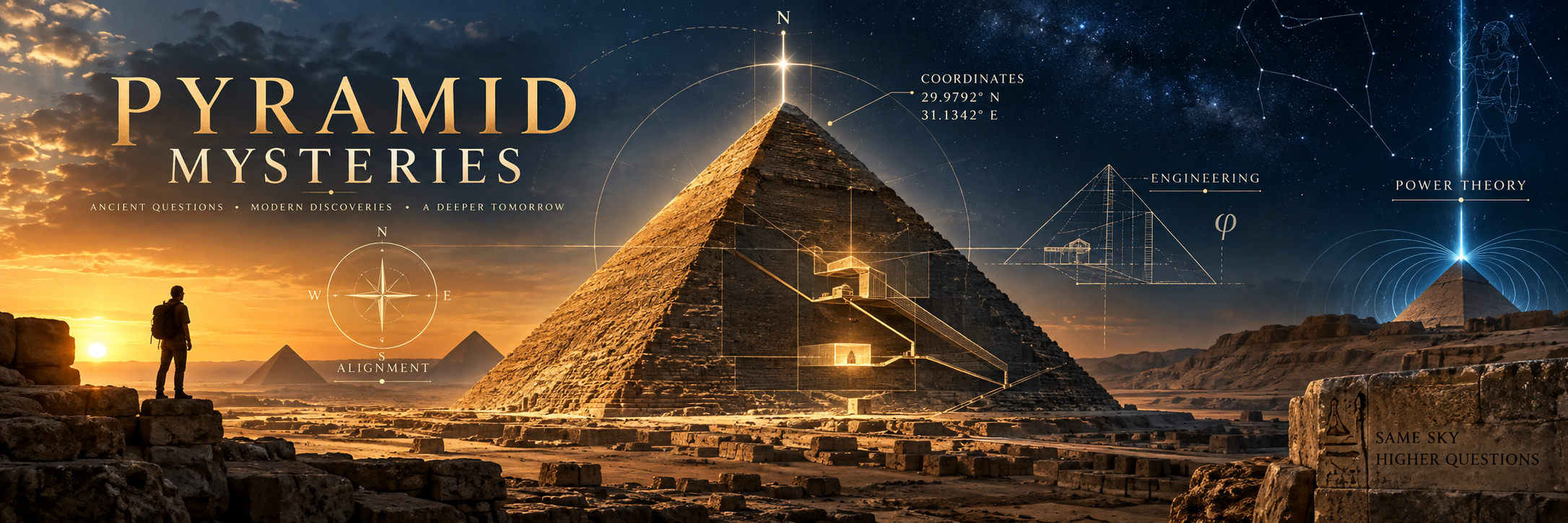
Pyramid Mysteries: Coordinates, Ancient Engineering, and the Power-Plant Theory
What if the Great Pyramid was not simply a monument to a king, but a machine designed to draw energy from the planet? What if its location encoded a scientific constant, while its chambers captured vibrations or atmospheric electricity? These ideas turn an ancient building into something that feels almost futuristic. Their appeal is understandable: a structure this extraordinary seems to demand an equally extraordinary explanation.
Yet the strongest pyramid mysteries begin with a distinction: uncertainty about particular construction methods does not mean uncertainty about everything. Archaeological evidence strongly supports Egyptian royal pyramids as parts of funerary complexes, even though questions remain about their engineering and internal architecture. The Great Pyramid, built for Khufu roughly 4,500 years ago, originally rose about 146.5 metres. Understanding it requires taking both its astonishing scale and its historical setting seriously. Egyptian Monuments
What Were the Egyptian Pyramids Actually Used For?
The description “just a tomb” can make the conventional explanation sound smaller than it really is. Old Kingdom pyramid complexes brought together burial, ritual, kingship and religious ideas about the heavens. They typically included the pyramid, an adjoining mortuary temple, a valley temple and a connecting causeway. The surrounding buildings and cemeteries matter because they place the monument within a recognizable cultural system rather than leaving it as an isolated geometric object. The Metropolitan Museum of Art
Inside Khufu’s pyramid, a stone sarcophagus occupies the room conventionally called the King’s Chamber. That feature fits the funerary interpretation, but it is not the entire argument: the wider architectural tradition and associated royal complex provide additional context. Asking whether every chamber had exactly the purpose assigned to it today is reasonable. Treating unresolved details as evidence that the whole funerary explanation has collapsed is a much larger leap. Egyptian Monuments
A monument can also have several purposes without being an electrical machine. A burial complex may simultaneously express political authority, religious beliefs and mathematical skill. Those functions reinforce rather than exclude one another. The useful question is therefore not whether pyramids meant more than burial, but whether a proposed additional function leaves evidence we can distinguish from the established ones.
Do the Great Pyramid’s Coordinates Encode the Speed of Light?
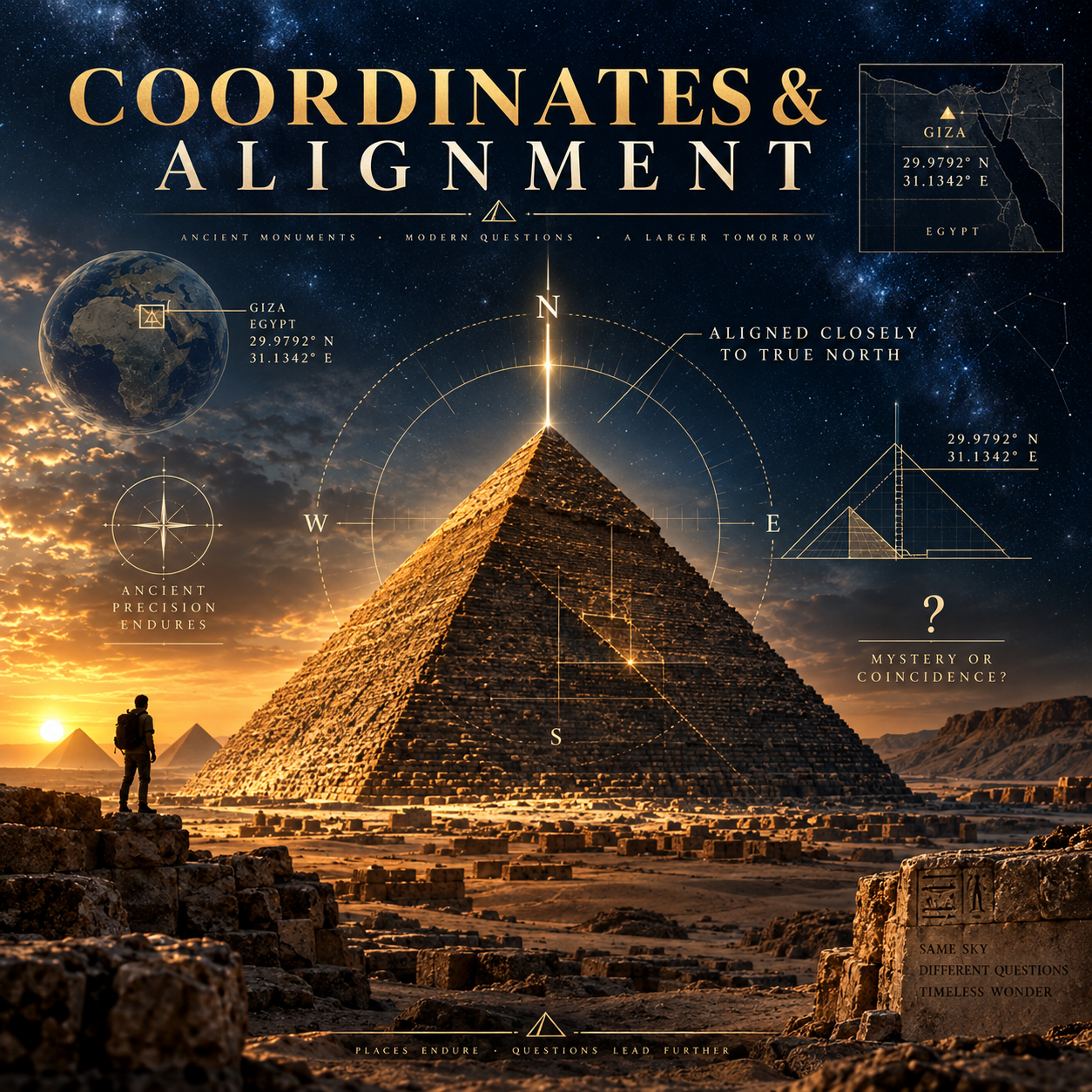
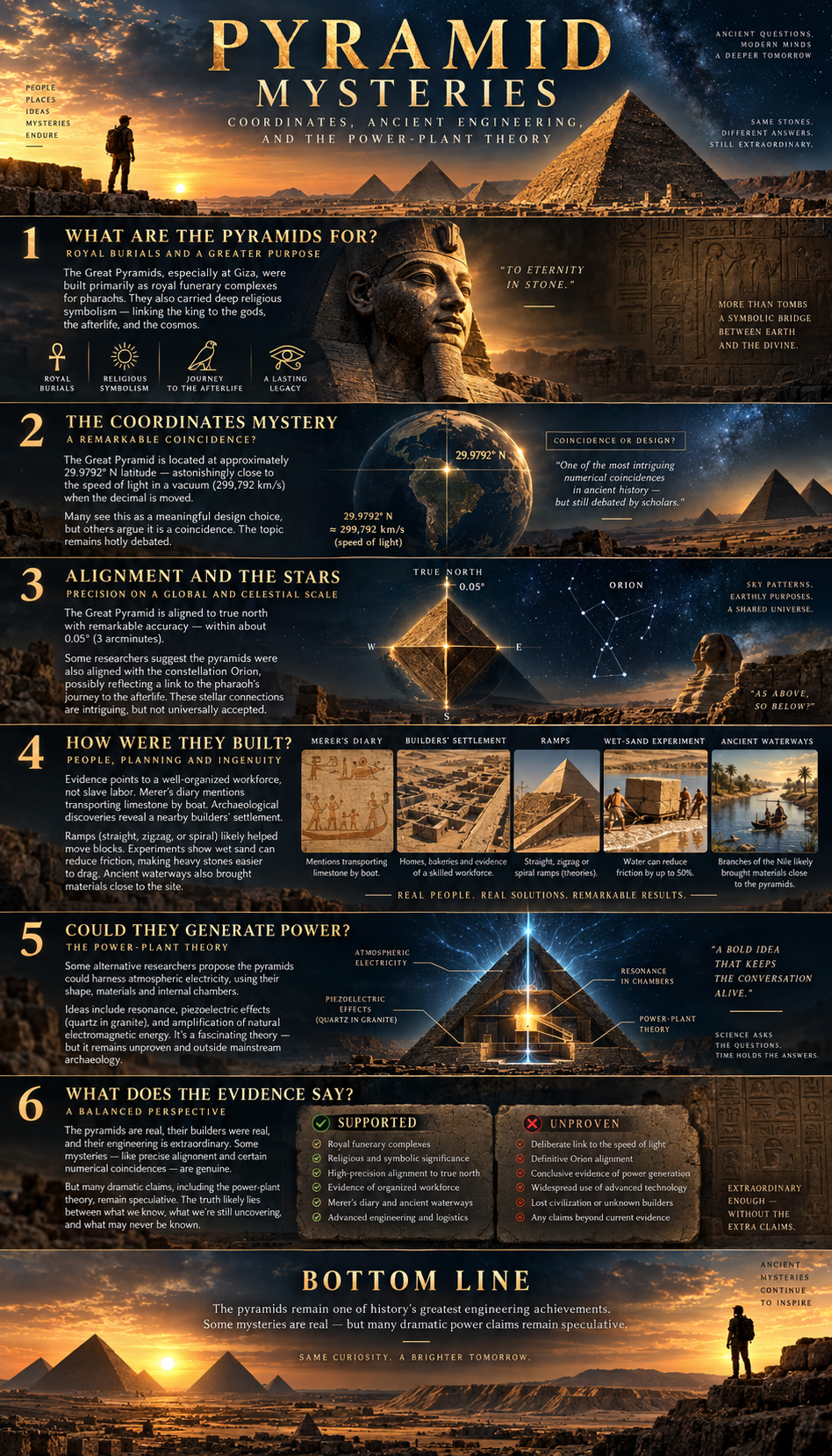
One striking claim compares the latitude 29.9792458° N with the speed of light in a vacuum: 299,792,458 metres per second. Move the decimal point and the digits appear to match. The latitude line really does cross the Great Pyramid, which gives the claim an enticing foundation. But the comparison depends on selecting that particular line through a structure with a substantial footprint. Full Fact
Latitude alone is not a complete location; longitude is also required. The quoted line is not a uniquely identified ancient survey marker, and it passes slightly north of the pyramid’s apex. At seven decimal places, many thousands of different latitude values cross the building. Finding one attractive number within that range is different from demonstrating that the builders selected it. Full Fact
There is another complication: the numerical value of a speed depends on its units. Express light’s speed in miles per second and the digits change, even though light itself does not. The modern metre definition fixes the vacuum speed of light at the familiar numerical value, but that does not supply evidence of an ancient message. An intentional code would require historical support for the chosen units, coordinate convention and reference point—not merely a modern resemblance. NIST
The Alignment With True North Is Genuinely Remarkable
The pyramid’s orientation presents a stronger engineering puzzle than its supposed numerical code. A 2015 study reported that its casing was aligned with the cardinal directions to better than four arcminutes—less than approximately 0.067 degrees. The study examined field tests of several proposed solar and stellar surveying methods and found that multiple approaches could achieve the required accuracy. That establishes plausible ancient techniques, not certainty about which technique Khufu’s surveyors used. Sage Journals
The more speculative Orion correlation theory proposes that the three main Giza pyramids represent the three stars of Orion’s Belt. Robert Bauval and supporters argue for a meaningful resemblance, while critics have challenged aspects of the orientation and astronomical interpretation. This is not equivalent to the measured northward alignment of an individual pyramid. To establish a deliberate stellar map, the proposed correspondence must explain the monuments consistently rather than depend on whichever rotation, scale or date makes the picture most persuasive. Academia
Celestial symbolism itself would not be surprising in this setting. Egyptian royal funerary architecture connected kingship with the gods, the Sun and the stars. But recognizing that cultural relationship does not authenticate every modern diagram superimposed on Giza. A monument can express a cosmic worldview without being an observatory, transmitter or encrypted scientific textbook. The Metropolitan Museum of Art
How Were the Pyramids Built? The Evidence Is More Concrete Than the Myth
Khufu’s pyramid did not appear without architectural predecessors. Earlier Egyptian building projects included Djoser’s stepped pyramid and Sneferu’s pyramids, including the Bent Pyramid with its conspicuous change of slope. Those monuments preserve variations in design that make sense within a developing construction tradition. Interpreting that sequence as accumulated expertise is more grounded than assuming a finished technology appeared without a history. Egyptian Monuments
The strongest evidence is often less cinematic than a hidden chamber, but more revealing about how enormous projects happened. Written records, settlements and experiments answer different parts of the construction problem. Together they establish a practical foundation without pretending that one discovery explains every stone:
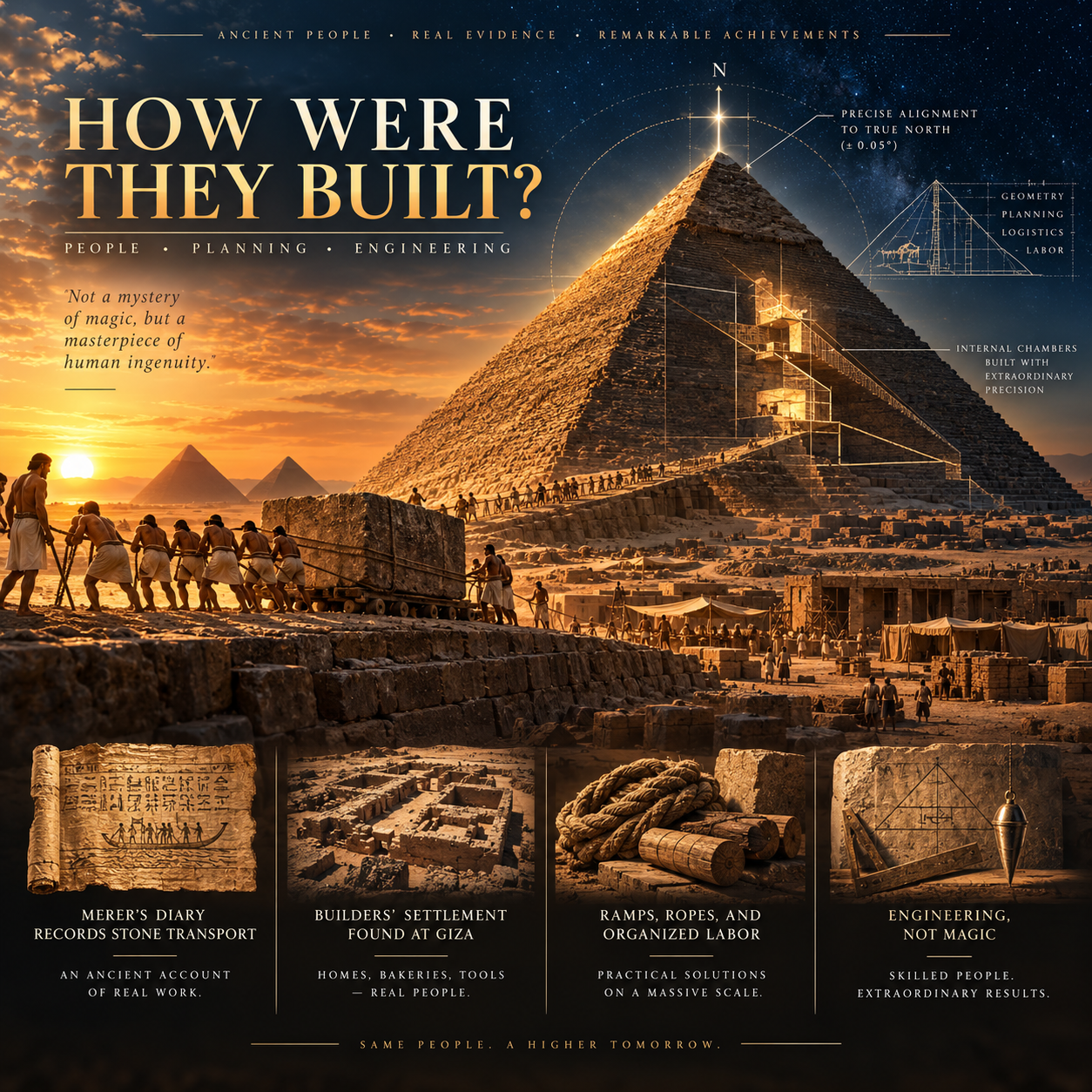
- A supervisor left a transport record. Papyrus documents recovered at Wadi el-Jarf in 2013 include the logbooks of an official named Merer. They describe transporting limestone from Tura to Khufu’s pyramid project by water, recording activities rather than supplying a speculative reconstruction. They do not explain how the highest blocks were raised, but they directly illuminate the supply chain behind the monument. This is evidence of people managing materials, journeys and work. Academia
- The builders left a settlement. Excavations by Ancient Egypt Research Associates uncovered a substantial Giza settlement with bakeries, administrative buildings and other facilities associated with the pyramid-building enterprise. Animal bones, pottery and plant remains help reconstruct daily life and provisioning. These discoveries reveal an organized workforce and supporting infrastructure. They do not tell us every worker’s circumstances, but they make the builders much less anonymous than the mystery narrative suggests. AERA
- Simple techniques can make heavy transport easier. Experiments published in Physical Review Letters in 2014 showed that adding an appropriate amount of water substantially reduced sliding friction on sand. The researchers reported that the improvement could roughly halve the pulling effort under suitable conditions. Too much water reduced the benefit, so this was not a case of “the wetter, the better.” The experiment demonstrates a plausible transport technique, not proof that every block at Giza travelled over wet sand. APS Journals
Ramps also have archaeological support beyond conjectural drawings. At Hatnub, researchers documented an ancient quarry access ramp and post-holes associated with a stone-hauling arrangement from Khufu’s period. That shows the relevance of ramps, ropes and organized pulling to contemporary quarry work. It does not establish that the same configuration ran all the way up the Great Pyramid, where the precise lifting sequence remains debated. EES
The surrounding landscape adds another important clue. A 2024 study used satellite radar, geophysical observations and sediment cores to identify segments of a former Nile branch beside Egypt’s pyramid fields. Its authors proposed that this Ahramat branch helped carry people and construction materials to the monuments. Sites that now look stranded in desert therefore need to be considered in relation to ancient waterways, not just the modern riverbank. Macquarie University
Could Water Have Helped Lift the Stones?
A different 2024 paper, published in PLOS ONE, proposed that water might have assisted construction through a hydraulic lifting mechanism. The researchers interpreted features around Djoser’s Step Pyramid as possible parts of a water-management system, with controlled water entering an internal shaft to help raise building materials. Crucially, this concerns the Step Pyramid at Saqqara, not Khufu’s Great Pyramid at Giza. It is a proposed reconstruction, not the discovery of a complete ancient lift. PLOS
The idea presents useful questions to test: was enough water available, do the relevant structures belong to the right period, and could the proposed arrangement operate reliably? Matching architectural features to an imagined machine is a starting point, not a demonstration that the machine existed. Even successful evidence of water-assisted construction would answer how a pyramid was built, not prove it generated electricity afterward. An inventive construction technique could coexist perfectly well with a funerary purpose.
Could the Great Pyramid Have Been a Power Plant?
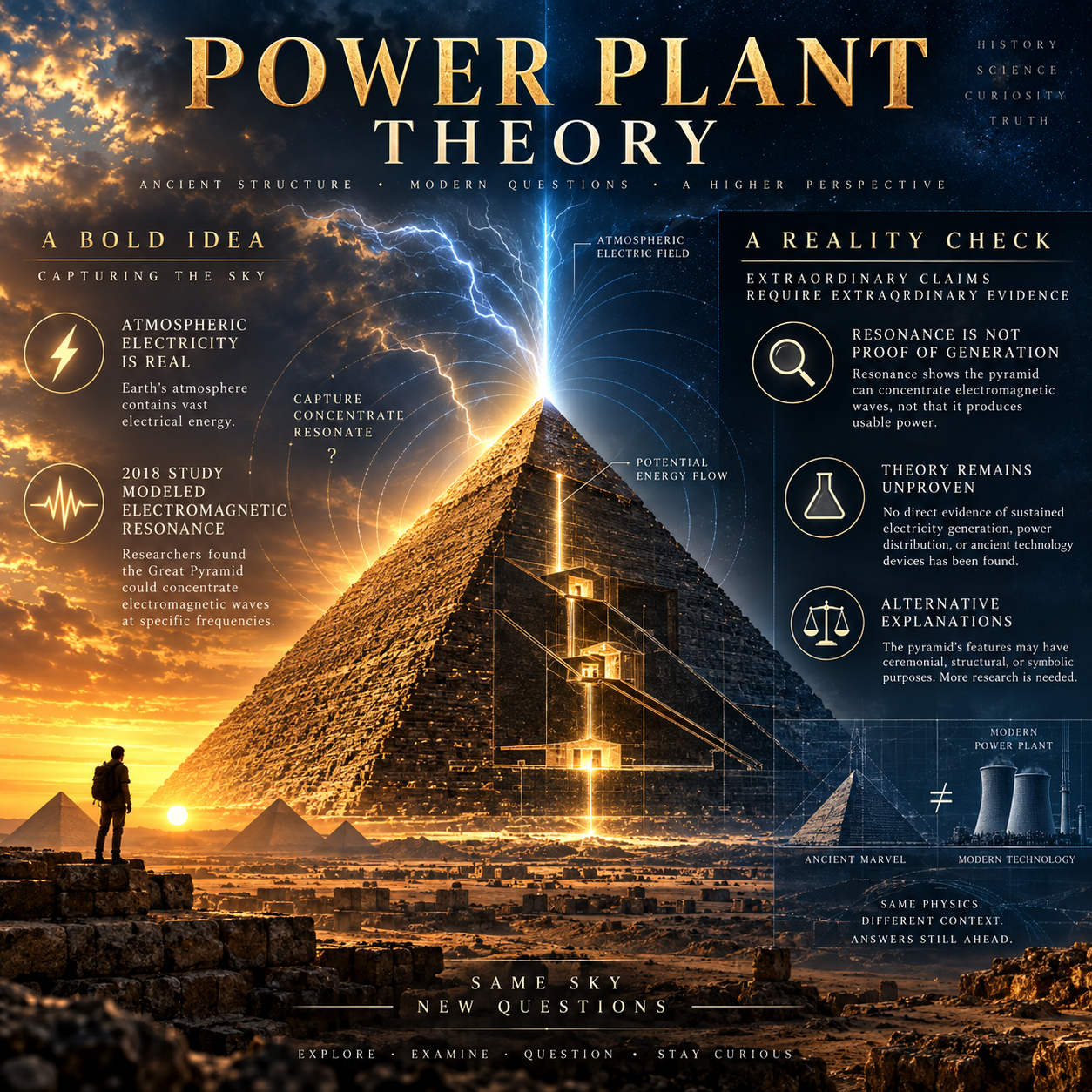
The power-plant theory takes the building’s unusual interior and asks whether architectural features might be components of a machine. In The Giza Power Plant, Christopher Dunn proposes that the structure used acoustic resonance to convert Earth’s vibrations into microwave energy. His interpretation treats the chambers and passages as deliberately arranged parts of an energy-conversion system. That is a specific hypothesis, distinct from simply suggesting that the pyramid collected electricity from the air. Giza Power
Keeping those mechanisms separate is essential. Harvesting atmospheric charge, converting mechanical vibrations and concentrating incoming radio waves involve different sources of energy and different equipment. Evidence that one physical effect exists cannot automatically validate the others. To investigate the power-plant claim fairly, each proposed mechanism needs its own explanation of the input, conversion process and useful output.
Atmospheric Electricity Is Real—but Voltage Is Not Power
There really is an electric field in the atmosphere. Richard Feynman’s physics lectures describe a typical fair-weather potential gradient near flat ground of approximately 100 volts per metre, although conditions vary. That sounds promising until the accompanying limitation appears: air is a poor conductor, so the available current is very small. Feynman explicitly considers why simply placing electrodes in that field does not provide an easy source of electricity for lighting. Feynman Lectures on Physics
Research on the global atmospheric electrical circuit reports fair-weather current densities on the scale of picoamperes per square metre. One picoampere is one trillionth of an ampere, a reminder that an impressive voltage can accompany extremely little charge flow. For a steady electrical supply, power depends on both voltage and current. A pyramid-energy claim must account for the current it can collect and sustain, not just a voltage difference between elevations. Springer Link
A hypothetical example makes the distinction clearer. A source delivering 10,000 volts at one nanoampere supplies only 10 microwatts, or 0.00001 watts. That is an arithmetic illustration, not an estimate of the Great Pyramid’s output. Calculating a real collector’s performance would require its geometry, materials, insulation, operating conditions and actual measurements while supplying power to a device.
This does not mean atmospheric electricity is imaginary or inherently impossible to harvest. It means “the atmosphere contains electricity” is only the beginning of an engineering explanation. A proposed ancient installation still needs evidence of collection, conversion and use. A tall shape and a dramatic voltage calculation cannot substitute for the functioning system.
What About Crystals and Resonance?
Piezoelectricity supplies another genuinely interesting physical ingredient. Materials including quartz can produce electrical charge when subjected to mechanical stress, and engineered devices exploit that effect. But this is a conversion of mechanical energy into electrical energy, not a way to obtain unlimited energy from a crystal. Demonstrating useful generation would require measuring the mechanical input and the electrical output of the proposed arrangement. *NANOMOTION
Resonance has a similar limitation. Driving a system near one of its natural frequencies can build a strong response, but the driving force supplies energy and losses still matter. A chamber’s resonant behaviour may be interesting without proving that it was designed as a generator. A resonator is not automatically a power source, just as an impressive echo is not evidence of an ancient power station. OpenStax
The Electromagnetic Study Behind Some Pyramid-Energy Headlines
A real 2018 paper in the Journal of Applied Physics investigated how a model of the Great Pyramid would respond to externally supplied radio waves. The researchers examined wavelengths of approximately 200–600 metres and found resonant conditions that concentrated electromagnetic energy in particular regions. This was numerical modelling, with assumptions about material properties and structure, rather than a measurement of an ancient generator operating. The waves were electromagnetic, not the mechanical sound waves involved in acoustic resonance. AIP Publishing
The distinction is crucial: concentrating incoming energy is not the same as supplying a civilization with usable electricity. The study did not establish an ancient source, an energy-extraction system or the builders’ intentions. Its physical findings can be interesting independently of the power-plant story. Moving from “this shape interacts with radio waves” to “Egyptians built it to produce power” requires additional evidence the modelling itself does not provide. AIP Publishing
What Would Count as Convincing Evidence?
A fair test should not demand that ancient equipment look exactly like a modern electrical installation. It should demand a traceable mechanism and evidence that people deliberately used it. Three questions would move the discussion beyond suggestive similarities:
- Can the proposed system perform useful work? A reconstruction should identify its energy source and operate under conditions the ancient installation could realistically have experienced. Researchers would need to measure its input, output and losses, including performance while powering something. A brief charge, unexplained fluctuation or externally powered demonstration would not alone establish a sustained ancient generating system.
- Does the archaeological evidence identify that function? A persuasive case might combine purpose-built components, diagnostic residues, wear patterns, contemporary descriptions or devices that used the output. No single type of evidence is mandatory, and missing organic or metal parts would need reasonable consideration. But the interpretation must explain why the surviving evidence fits a power system better than competing architectural or ritual explanations.
- Can independent investigators reproduce the result? Methods, measurements and assumptions should be available for scrutiny rather than depending on one researcher’s access or interpretation. A successful experiment should survive appropriate controls and attempts to identify ordinary alternative explanations. Even then, demonstrating that a design can generate electricity would be separate from demonstrating that ancient Egyptians actually used it that way.
Giants, Aliens and a Lost Civilization: Other Explanations
Invoking giants shifts the construction question rather than resolving it. Larger workers would still need ways to quarry, shape, organize and place the stones accurately, while the hypothesis would introduce a new requirement: evidence of those builders. The excavated settlements and transport records instead document a recognizable human enterprise. Monumental scale is evidence of a difficult task, not evidence that the people performing it had extraordinary bodies. AERA
The same reasoning applies to alien intervention or an otherwise unattested advanced civilization. Such proposals need their own archaeological support, rather than treating gaps in a ramp reconstruction as proof of a substitute explanation. Unrecorded techniques may certainly have existed; a particular lifting method or surveying practice could have been lost. That limited possibility is not equivalent to evidence for vanished industrial technology or extraterrestrial assistance.
Hidden Spaces Show That Real Mysteries Remain
In 2017, the ScanPyramids collaboration reported a void above the Grand Gallery with a minimum length of approximately 30 metres. The finding used cosmic-ray muons—particles whose passage through stone allows researchers to infer internal density differences. Three different detection technologies and independent analyses supported the result. The discovery established a previously unidentified internal space, not its purpose. arXiv
A separate study published in 2023 characterized a corridor behind the pyramid’s northern face, approximately nine metres long, with a cross-section around two metres by two metres. Its dimensions came from measurements rather than a speculative reading of the architecture. Discoveries like these demonstrate why continued investigation is worthwhile. But an unidentified space is not automatically a secret machine room; its function requires further evidence. Nature
Final Verdict: Extraordinary Engineering, Unproven Power Generation
The evidence does not place every explanation on equal footing. Royal funerary architecture has support from monuments, associated buildings and the wider Egyptian cultural record, while transport documents and settlements illuminate the construction enterprise. Internal voids have also been detected with modern instruments, showing how new findings can expand our understanding. Those discoveries leave genuine questions without turning the pyramid’s identity into a complete blank. The Metropolitan Museum of Art
The power-plant theory is most interesting when treated as a claim to test rather than a conclusion to defend. The existence of a physical effect is only the first step; the harder task is demonstrating a functioning system and connecting it to the people who built the monument. That connection cannot be supplied by an intriguing resemblance or an unexplained chamber alone. Without it, the proposal remains speculative.
Perhaps the most remarkable possibility is also the least exotic: that people with very different tools and priorities achieved something we still struggle to reconstruct in full. Their accomplishment does not become ordinary when a transport method or surveying technique is explained. Each answer reveals another layer of skill, planning and ambition. The pyramids do not need to be impossible machines to remain astonishing.