
The Anunnaki: Ancient Gods, Lost Knowledge, and the Mystery of Human Origins
What if the oldest stories about humanity’s origins were not just myths, but distorted memories of something real? What if the ancient people of Mesopotamia were not inventing fantasy gods to explain thunder, crops, kingship, and death, but describing powerful beings whose nature they could only understand through the language of divinity? That question sits at the heart of the Anunnaki mystery, and it is exactly why this ancient topic refuses to die.
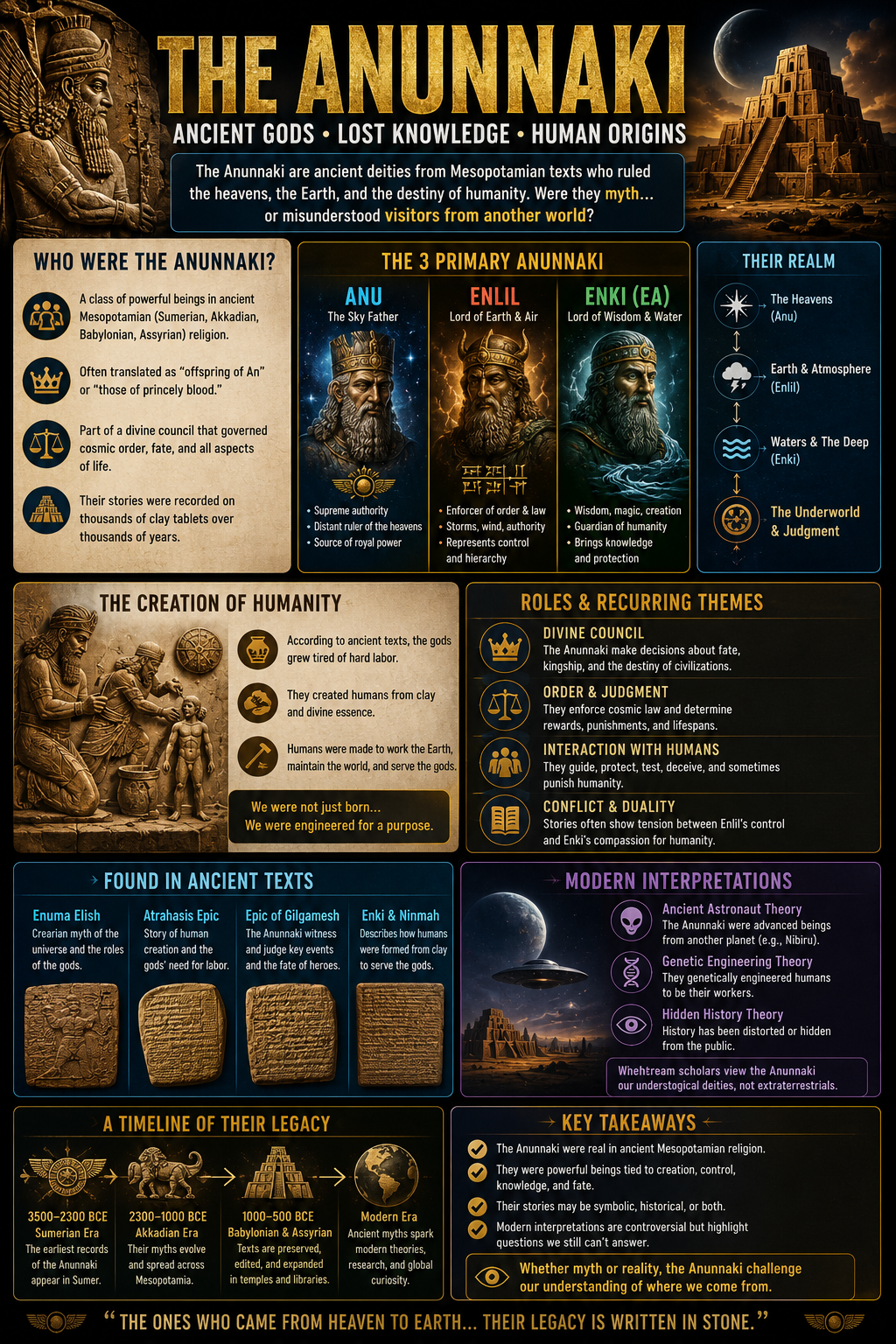
The Anunnaki are not a modern invention. They are not just internet folklore, social media speculation, or recycled science fiction. They appear in real ancient Mesopotamian texts, connected to Sumerian, Akkadian, Babylonian, and Assyrian religious traditions. They were linked with fate, judgment, cosmic order, creation, kingship, and the mysterious relationship between gods and humanity.
The official view is simple: the Anunnaki were gods within an ancient mythological system. But the deeper question is more provocative. Why did some of the world’s earliest civilizations describe humanity as a created worker species? Why do figures like Enki, Enlil, and Anu appear with such authority over human destiny? And why do these stories sound strangely less like vague superstition and more like a coded memory of intervention, hierarchy, knowledge transfer, and control?
What Are the Anunnaki?
The Anunnaki were a class of deities from ancient Mesopotamian religion. The term is commonly linked to Anu, the sky god, and is often interpreted along the lines of “offspring of An” or “princely seed.” Their exact number, function, and meaning shift across time because Mesopotamian religion itself changed across centuries, cities, languages, and empires.
In the oldest context, the Anunnaki were not presented as one neat group with one simple purpose. Sometimes they appear as heavenly beings. Sometimes they are associated with the underworld. Sometimes they act as judges, witnesses, or members of a divine council. They are not minor spirits floating around the edges of mythology. They belong to the machinery of cosmic order.
That alone should make us pause. Many ancient cultures imagined gods, but the Anunnaki are especially fascinating because they are tied to one of the oldest literate civilizations on Earth. These were not campfire stories floating loosely through memory. They were preserved on clay tablets by scribes in a civilization that built cities, tracked the stars, created legal codes, developed mathematics, and left behind some of the earliest writing humanity has ever recovered.
Mesopotamia: The World That Remembered Them
To understand the Anunnaki, we have to return to Mesopotamia, the land between the Tigris and Euphrates rivers. This region gave rise to Sumer, Akkad, Babylon, and Assyria. It was a birthplace of cities, kingship, writing, taxation, astronomy, temples, irrigation systems, and organized religion.
That matters because the Anunnaki did not emerge from a primitive world with no structure. They emerged from one of the most intellectually and administratively advanced cultures of the ancient world. Mesopotamians were not simple people staring at the sky and inventing random monsters. They were record keepers, builders, priests, farmers, astronomers, traders, and legal thinkers.
Their gods were not decorative. They explained power. They explained why kings ruled, why cities rose and fell, why humans worked, why floods destroyed, why rituals mattered, and why the universe seemed ordered by forces beyond human control. The Anunnaki belonged to this system, but the system itself may have been preserving something older than religion: the memory of contact between ordinary humans and beings of overwhelming knowledge.
Anu, Enlil, and Enki: The Three Figures That Matter Most
The Anunnaki mystery becomes much easier to understand when we focus on three major figures: Anu, Enlil, and Enki. Anu is the sky god, the distant high authority. He represents the celestial source of power, the supreme level of the divine hierarchy. In many ways, Anu feels less like a hands-on ruler and more like the symbolic head of a cosmic administration.
Enlil is different. He is closer to command, law, control, storms, rulership, and the enforcement of divine order. In many narratives, Enlil represents authority that can be harsh, structured, and even dangerous to humanity. He is not simply evil, but he often embodies the side of power that prioritizes order over compassion.
Enki, also known as Ea, is the figure who keeps the mystery alive. He is associated with water, wisdom, craft, magic, creation, and protection. In many interpretations, Enki appears as the friend of humanity, the one who understands human suffering and offers knowledge. If Enlil is control, Enki is intelligence. If Enlil is law, Enki is adaptation. If Enlil is hierarchy, Enki is intervention.
The Creation of Humanity: Myth or Memory?
The most provocative Anunnaki-related theme is human creation. Several Mesopotamian myths describe humans being created to relieve the gods of labor. In some stories, the gods grow tired of toil. They need workers. Humanity is fashioned from clay, sometimes connected with divine essence, and given the role of maintaining the world through labor, agriculture, ritual, and service.
On the surface, this is mythology. But read it with fresh eyes. The story does not simply say, “Humans appeared.” It says humans were made for a purpose. It says the gods had a labor problem. It says a new being was engineered into the system to carry the burden. That may be symbolic, but it is also strangely mechanical.
This is where the Anunnaki theory becomes compelling. Ancient people may have used the word “gods” because they had no better language for beings with superior knowledge, superior technology, and control over life itself. A modern person seeing genetic engineering, aircraft, artificial intelligence, or advanced medicine in the ancient world might also reach for divine language if they lacked the technical vocabulary.
The Enki Question
If one figure makes the Anunnaki story feel less like ordinary mythology, it is Enki. He is repeatedly associated with wisdom, water, hidden knowledge, creation, and the protection of humanity. He is not merely a thunder god or a local agricultural deity. He feels like an intelligence figure, a designer, a teacher, a mediator between systems.
In some flood-related traditions, the divine council moves against humanity, but Enki finds a way to preserve human life. That pattern matters. It creates a recurring theme in which humanity is caught between higher powers, with one side leaning toward control and another toward preservation. That is not proof of ancient astronauts, but it is one reason the story feels so alive.
Enki’s role also resembles a familiar archetype: the forbidden knowledge giver. Across world mythology, we see figures who bring knowledge to humanity and are punished, resisted, or feared for it. Prometheus gives fire. The serpent gives knowledge. Enki gives wisdom and protection. Different cultures, different symbols, similar pattern.
Why Supporters Believe the Anunnaki Were Real
Supporters of the Anunnaki theory usually do not rely on one single claim. They build a case from patterns. First, the Anunnaki appear in authentic ancient traditions. Second, Mesopotamian creation stories describe humans as deliberately fashioned beings. Third, the gods are not portrayed as vague emotional forces but as organized authorities with roles, ranks, councils, decisions, conflicts, and responsibilities.
That level of structure is what makes people wonder. These myths often feel like political history disguised as theology. The gods argue, negotiate, assign labor, determine fates, punish rebellion, intervene in disasters, and manage human affairs. The stories contain hierarchy, administration, and technical creation language.
Supporters also point to the sudden rise of civilization in Mesopotamia. Writing, cities, temples, agriculture, law, and astronomy appear with astonishing sophistication. Mainstream history explains this through human development over time, and that explanation has strength. But the Anunnaki interpretation asks a more provocative question: what if civilization did not merely emerge, but was accelerated?
The Ancient Astronaut Interpretation
The most famous modern version of the Anunnaki theory comes from writers who argue that these beings were not supernatural gods, but extraterrestrial or non-human visitors misunderstood by ancient people. In this view, the Anunnaki came from the heavens, influenced early civilization, engineered or modified humanity, and became remembered as gods.
Zecharia Sitchin popularized one of the boldest versions of this theory, linking the Anunnaki to a planet called Nibiru and arguing that humans were genetically engineered as a worker species. Mainstream scholars strongly reject his translations and conclusions, but the cultural impact of his work is undeniable. He gave millions of people a new way to read ancient mythology: not as primitive imagination, but as ancient testimony.
The strongest version of the theory does not require accepting every Sitchin claim. You do not have to believe every detail about Nibiru to find the broader question interesting. The real question is whether ancient myths could preserve misunderstood encounters with advanced beings. That possibility is harder to dismiss with a smirk.
The Skeptical View
A serious article has to admit the obvious: there is no accepted archaeological proof that the Anunnaki were extraterrestrials. No confirmed alien spacecraft has been recovered from Sumer. No cuneiform tablet has been universally accepted by scholars as saying, “We came from another planet and genetically engineered humans.” The ancient texts are religious, symbolic, and poetic, not modern scientific lab reports.
Mainstream scholars argue that the Anunnaki belong to Mesopotamian mythology, not alien history. They point out that ancient cultures often explained nature, kingship, labor, morality, and death through divine stories. From that view, the Anunnaki are not evidence of visitors from the stars but evidence of how early civilizations understood power and existence.
That skeptical view is important. Without it, the topic becomes sloppy. But skepticism should not become arrogance. The fact that ancient people used mythic language does not automatically mean there is no historical memory underneath. Human beings often encode real events into symbolic stories, especially when the events are traumatic, sacred, confusing, or technologically beyond their understanding.
Why the Story Refuses to Die
The Anunnaki narrative persists because it answers a hunger that ordinary explanations often leave untouched. People want to know where we came from. They want to know why civilization began. They want to know why humans seem so brilliant and so broken at the same time. They want to know why ancient cultures obsess over beings descending from the heavens.
The story also fits modern distrust. Many people no longer assume institutions tell the full truth about history, technology, religion, or power. The Anunnaki theory offers a hidden framework: humanity was shaped, managed, or influenced by forces far older and more advanced than official history admits.
That does not make the theory true. But it explains why people feel its pull. It turns ancient myth into a cosmic crime scene. It invites the reader to look again at tablets, temples, flood myths, creation stories, and divine councils, not as dead religion but as possible fragments of a lost record.
Myth as a Technology of Memory
One of the best arguments for taking the Anunnaki seriously is that myth is not the opposite of memory. Myth is often how ancient people preserved meaning before modern categories existed. A myth can be symbolic and still contain historical residue. A story can be religious and still carry information about real social structures, disasters, migrations, or encounters.
If a technologically advanced being appeared to an ancient farmer, how would that farmer describe it? If someone saw flight, genetic manipulation, artificial light, advanced medicine, or destructive power beyond comprehension, would they call it technology? Probably not. They would call it divine.
This is where the Anunnaki mystery becomes more sophisticated. The question is not, “Were ancient people stupid enough to mistake myths for facts?” The better question is, “Are modern people arrogant enough to assume myths contain no memory?” That is the real investigative doorway.
The Psychological and Spiritual Meaning
Even if the Anunnaki were not extraterrestrials, they remain powerful as symbols. They represent humanity’s ancient relationship with authority, labor, knowledge, and rebellion. Enlil and Enki can be read as two forces within civilization itself: control and wisdom, obedience and awakening, hierarchy and liberation.
This is why the Anunnaki are not just interesting to conspiracy researchers. They matter to anyone studying mythology, psychology, religion, politics, or human origins. Their stories are about who gets to create, who gets to rule, who gets to know, and who must serve. Those questions are still alive today.
In that sense, the Anunnaki may be “true” on more than one level. They are historically true as ancient deities. They are psychologically true as archetypes of power. They are culturally true as part of humanity’s oldest memory system. And perhaps, if the hidden-history interpretation is right, they may even point toward a truth about our origins that modern civilization is not ready to fully confront.
Why This Matters Today
The Anunnaki matter today because the questions surrounding them are no longer ancient. We now live in an age of genetic engineering, artificial intelligence, space exploration, surveillance systems, and synthetic life. The idea that a powerful intelligence could design, monitor, or influence another species no longer sounds purely magical. It sounds disturbingly plausible.
Humanity is already becoming the kind of species ancient people might have called divine. We can edit genes, build machines that speak, create artificial worlds, track populations, and send probes beyond Earth. If we continue advancing, we may one day become the “gods” of another world, another species, or another intelligence.
That changes how we read the old stories. The Anunnaki no longer feel like impossible fantasy. They feel like a mirror. Maybe they were gods. Maybe they were symbols. Maybe they were misunderstood visitors. But whatever they were, their stories force us to ask what happens when intelligence becomes powerful enough to create, command, and alter life.
Final Verdict: Were the Anunnaki Real?
The safest answer is yes, but not in the simple way people want. The Anunnaki were real in the historical sense because they appear in authentic ancient Mesopotamian tradition. They were real to the people who built temples, wrote tablets, told creation stories, and understood the universe through divine order.
The extraterrestrial interpretation is not proven. It remains speculative, controversial, and rejected by mainstream scholarship. But the deeper possibility should not be dismissed lazily. Ancient myths may contain more memory than modern people are comfortable admitting, and the Anunnaki stories are far too strange, structured, and persistent to be treated as meaningless fantasy.
Perhaps the truth is layered. The Anunnaki were gods in the language of ancient religion, authorities in the structure of Mesopotamian civilization, archetypes in the human psyche, and possibly echoes of something older that has not been fully understood. That is why the story survives.
If the Anunnaki were only fiction, they are among the most powerful fictions humanity ever created. If they were something more, then the oldest tablets on Earth may not be myths at all. They may be fragments of a forgotten history still waiting to be read correctly.
Encyclopaedia Britannica — Anunnaki
Encyclopaedia Britannica — Mesopotamian Religion: Myths
Reader note: This article explores unusual claims, theories, beliefs, and interpretations. It aims to separate documented history, symbolism, belief, interpretation, and speculation wherever possible. Extraordinary claims are not presented as established fact unless supported by credible evidence.