
Daily Motivation Habits That Actually Work: The 1% Rule for Real Life
Most people fail at motivation because they aim too high and start too big. They wake up one morning, feel a sudden burst of inspiration, and decide their entire life is about to change. They are going to wake up at 5 a.m., work out every day, eat perfectly, build a business, read a book a week, stop wasting time, fix their finances, and become a completely different person by next month.
For a few days, it feels powerful. The new routine has energy behind it. The notebook is fresh, the plan looks clean, and the future version of yourself feels close enough to touch. Then real life gets involved. You sleep badly, work runs late, someone needs you, your energy drops, your mood changes, and suddenly the giant plan feels impossible.
That is where most people think they failed because they lacked motivation. But the deeper problem is not always motivation. The problem is that their system was too fragile for a normal human life. Real motivation has to survive tired days, messy days, distracted days, busy days, and days where you honestly do not feel like becoming your “best self” at all.
What Daily Motivation Habits Actually Are
Daily motivation habits are small repeatable actions that keep you moving even when your emotions are unreliable. They are not dramatic, glamorous, or exciting every day. In fact, the best ones often look almost too small to matter. That is exactly why they work.
Motivation is often treated like a feeling you need before you act. But in real life, action often creates the feeling after the fact. You do one small thing, then you feel slightly more capable. You keep one tiny promise, then you trust yourself a little more. You complete one simple task, then the day feels less chaotic.
This matters because most people are waiting for motivation to arrive before they start. Daily motivation habits reverse that pattern. Instead of waiting to feel ready, you create conditions where action is easy enough to begin. That is the hidden power of the 1% rule.
The 1% Rule: Why Small Progress Works
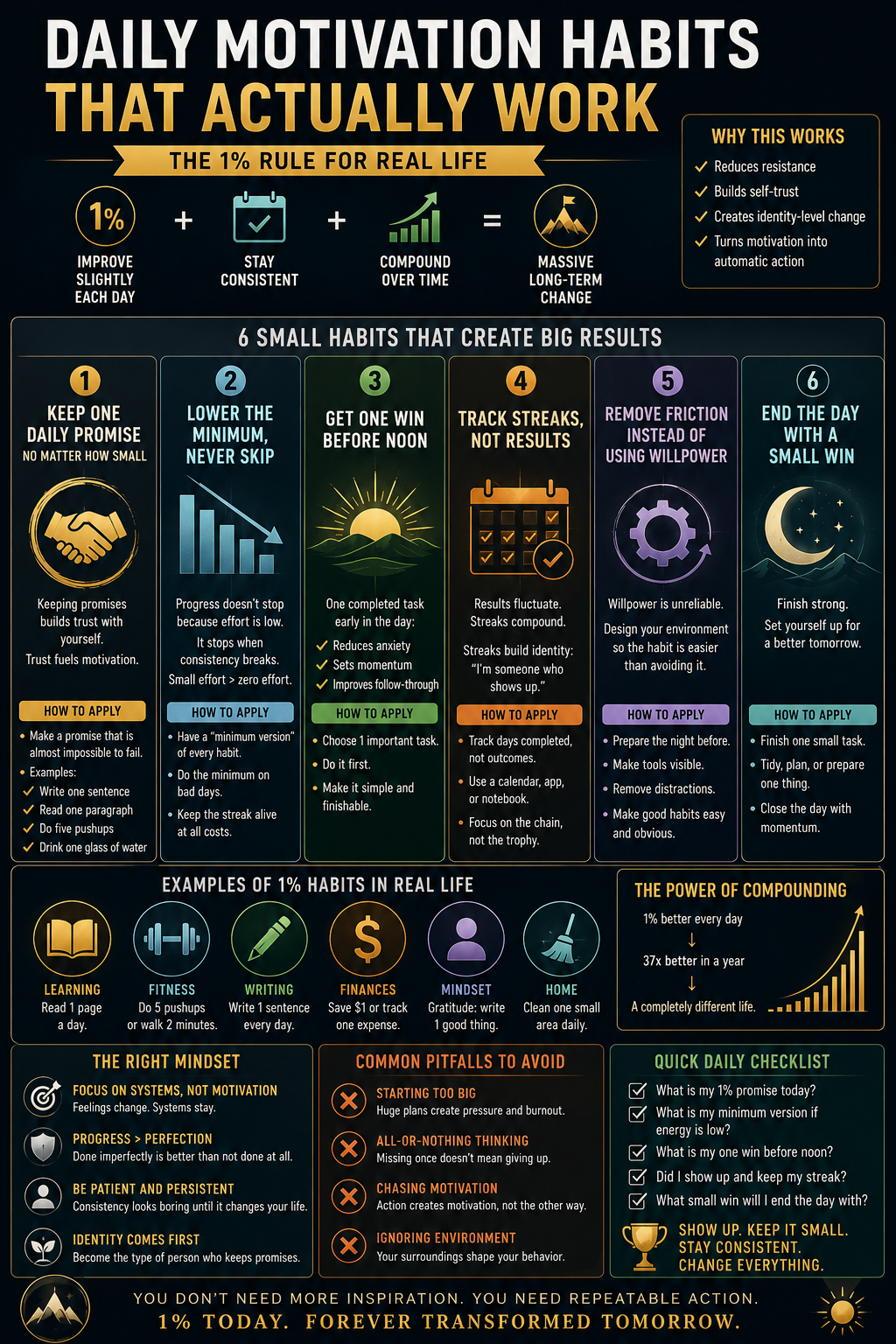
The 1% rule is simple: improve slightly each day. Not dramatically. Not perfectly. Not in a way that impresses anyone watching. Just enough to keep the chain alive and prove to yourself that you are still in motion.
This idea is powerful because most people overestimate what they can do in one intense burst and underestimate what they can build through boring consistency. One workout does not transform your body. One paragraph does not create a book. One saved dollar does not change your finances. But repeated actions compound, and compounding is where real change hides.
The 1% rule also lowers emotional resistance. A huge goal creates pressure. A tiny action creates movement. When the minimum action is small enough, your brain has less room to argue. You are not asking yourself to become a superhero. You are asking yourself to show up for one small moment.
Why People Believe Small Habits Work
People believe in small habits because they match lived experience. Most lasting changes do not happen through one dramatic decision. They happen because repeated actions slowly alter identity. At first, you are someone trying to exercise. Then you become someone who does not miss workouts. At first, you are someone trying to write. Then you become someone who writes daily.
This is why small habits are more than productivity tricks. They build self-trust. Every time you keep a promise to yourself, even a small one, you send your mind a message: I do what I say I will do. That message is quiet, but it matters. It becomes emotional evidence.
The opposite is also true. When you constantly make huge promises and break them, you weaken trust with yourself. You begin to see your own plans as empty noise. That is a dangerous place to be, because once you stop believing yourself, motivation becomes harder to access.
Habit 1: Keep One Daily Promise
The first daily motivation habit is to keep one promise to yourself every day. The promise should be almost impossible to fail. That may sound underwhelming, but it is one of the smartest ways to rebuild consistency if you have fallen into a pattern of starting and stopping.
The promise can be tiny. Write one sentence. Read one paragraph. Do five pushups. Clean one dish. Open the document. Walk for two minutes. The point is not the size of the action. The point is that you complete it and reinforce the identity of someone who follows through.
This is especially important for people who feel stuck. When you are in a rut, giant plans often make you feel worse because they highlight the distance between where you are and where you want to be. A tiny promise gives you a reachable win. It creates a foothold.
Examples of Tiny Daily Promises
- Write one sentence before bed.
- Do five pushups or squats.
- Read one paragraph of a useful book.
- Drink one glass of water in the morning.
- Spend five minutes cleaning one area.
- Open your project file and improve one thing.
- Take a short walk, even if it is only around the block.
These habits look small because they are small. That is the point. A tiny promise kept is better than a heroic promise abandoned.
Habit 2: Lower the Minimum, Never Skip the Habit
The second habit is to lower the minimum instead of skipping completely. This is where most people sabotage themselves. They think if they cannot do the full routine, the day is ruined. They cannot do the full workout, so they do nothing. They cannot write the full article, so they avoid the project. They cannot clean the whole room, so they leave everything untouched.
That all-or-nothing thinking destroys consistency. Real life does not always give you ideal conditions. Some days you will have low energy. Some days you will be interrupted. Some days your brain will feel foggy and your schedule will get wrecked. The habit has to survive those days.
A minimum version keeps the streak alive. If the full workout is thirty minutes, the minimum version is five pushups. If the full study session is one hour, the minimum version is one flashcard. If the full writing session is 1,000 words, the minimum version is one paragraph. You are not lowering your standards forever. You are protecting continuity.
Habit 3: Get One Win Before Noon
Getting one win before noon is powerful because it changes the emotional direction of the day. Many people begin the day in reaction mode. They check their phone, absorb messages, scroll, respond, delay, and drift. By the time they fully wake up mentally, the day already feels slightly out of control.
One early win interrupts that pattern. It gives your brain proof that the day is not lost. The win does not need to be impressive. It just needs to be complete. A finished task creates a different kind of energy than a half-planned intention.
This is why small morning routines work better than complicated ones. You do not need a perfect two-hour morning ritual. You need one action that tells your mind, “I am participating in this day deliberately.” That could be making your bed, taking a walk, writing a short plan, finishing one work task, or studying for ten focused minutes.
Habit 4: Track Streaks, Not Just Results
Results are important, but they are not always visible quickly. If you only measure results, you may quit before the process has time to compound. The scale may not move right away. The website may not get traffic immediately. The business may not make money after the first few attempts. The skill may not look impressive after a week.
Streaks give you something more immediate to measure. They show whether you are becoming the type of person who shows up. That matters because identity usually changes before the obvious result appears. You may not see the final outcome yet, but you can see the chain forming.
Tracking also makes invisible effort visible. A calendar with checked boxes becomes evidence. It reminds you that you are not doing nothing. You are building something slowly. On hard days, that visual proof can keep you going.
Habit 5: Remove Friction Instead of Forcing Willpower
Willpower is overrated because it is unreliable. It changes with sleep, stress, hunger, mood, environment, and decision fatigue. If your whole plan depends on having strong willpower every day, the plan is probably weaker than it looks.
A better strategy is to remove friction. Make the good habit easier to start and the bad habit slightly harder to repeat. Put the book where you drink coffee. Keep the workout clothes visible. Open the document before bed so it is ready in the morning. Put the phone across the room. Prepare the workspace before you need it.
This sounds basic, but it is not trivial. Environment quietly shapes behavior. Most people try to win a daily battle against their surroundings, then blame themselves for losing. A smarter move is to design the surroundings so the right action becomes the path of least resistance.
Habit 6: End the Day With a Small Win
The way you end the day matters because it affects how you begin tomorrow. A chaotic ending creates a chaotic start. If you go to bed feeling defeated, scattered, and behind, tomorrow begins with emotional debt. You wake up already carrying yesterday’s unfinished tension.
Ending with a small win gives the day a cleaner finish. You might prepare your clothes, write tomorrow’s top priority, clean one surface, send one message, or set up your workspace. The action does not have to be large. It simply needs to create closure.
This is also useful psychologically. Many people judge the day by how it ends. Even if the day was messy, one final deliberate action tells your mind, “I did not completely give up.” That matters more than people realize.
The Skeptical View: Is the 1% Rule Too Simple?
The 1% rule can sound too simple, and the skepticism is fair. Some people turn small habits into a cliché and pretend that tiny actions alone will solve everything. They will not. If your life needs major change, small habits must eventually connect to serious action, better systems, and real decisions.
There is also a danger of using tiny habits as a hiding place. If you do five pushups every day but never increase your training, your fitness will eventually plateau. If you write one sentence every day but never build the article, the project may never become real. Small habits are a starting engine, not the entire vehicle.
But that does not make them useless. The point of small habits is not to stay small forever. The point is to create consistency, reduce resistance, and build trust. Once the habit is stable, you can scale it. Start tiny, but do not stay timid.
Why Daily Motivation Habits Work Long-Term
Daily motivation habits work long-term because they do not rely on emotional intensity. Intensity is exciting, but it is fragile. It burns hot, then disappears. Consistency is quieter, but it is more dependable.
These habits also scale with your energy. On a great day, you can do more. On a bad day, you can do the minimum and keep the identity alive. That flexibility is critical because rigid systems often break under pressure. A flexible system bends and survives.
The deeper benefit is identity. You are not just completing tasks. You are becoming someone who keeps promises, starts quickly, recovers faster, and does not abandon the whole plan because one day went badly. That identity is worth building.
Connect This to Real Motivation
Real motivation is not the emotional high you feel after watching an inspiring video. That feeling can help, but it rarely lasts. Real motivation is the trust that action is still possible even when you do not feel inspired. It is built through proof, not hype.
This is why small daily wins matter. They turn motivation into something practical. You stop needing the perfect mood and start relying on a repeatable process. You stop waiting for confidence and start collecting evidence that you are capable.
If you already have a post called “Real Motivation: How to Build Discipline Through Small Daily Wins,” this article should link to it naturally here. That post can explain the deeper mindset. This one gives readers the daily operating system.
Why This Matters Today
Daily motivation habits matter today because modern life is designed to fragment attention. Phones, notifications, short videos, news cycles, work pressure, family demands, and endless options make consistency harder than it used to be. People are not just lazy. Many are overstimulated, overwhelmed, and mentally scattered.
That is why giant self-improvement plans often fail. They demand a level of focus that most people cannot sustain in a noisy environment. Smaller habits work because they respect reality. They do not require a perfect life. They fit inside an imperfect one.
This is not about becoming a productivity robot. It is about staying connected to your direction. A small daily promise can become an anchor. A morning win can calm anxiety. A simple streak can remind you that your life is still being shaped by your choices.
Final Verdict: One Percent Today Is Enough
You do not need more inspiration. You need fewer promises, smaller actions, and more consistent execution. That may not sound glamorous, but it is how real change usually happens. The people who improve their lives are not always the most motivated. They are often the ones who build systems that keep working after motivation fades.
The 1% rule works because it turns growth into something survivable. You do not have to transform your entire life today. You only have to move the chain forward. Keep one promise. Get one win. Lower the minimum when needed. Track the streak. Remove friction. End the day with something complete.
Over time, these small actions stop feeling small. They become evidence. Evidence becomes self-trust. Self-trust becomes momentum. Momentum becomes identity.
One percent today is enough. Not because it is all you are capable of, but because it keeps you in the game long enough to become capable of more.
American Psychological Association — Motivation Definition
James Clear — How to Build a New Habit: This Is Your Strategy Guide