
What Causes Paranormal Experiences? Ghosts, Hidden Dimensions, and the Science of the Unexplained
Imagine scrolling through your phone on an October evening when a security-camera clip stops your thumb. In an apparently empty bar, a bottle suddenly moves, a dark shape crosses the background, and something flickers in a mirror. You replay it, then lean closer, trying to find the hand, the wire, or the ordinary explanation you missed. The unsettling part is how quickly a familiar room starts to feel unfamiliar. With Halloween a week away, the question practically asks itself: what causes paranormal experiences, and could there be a logical explanation stranger than the story we first imagine?
A convincing experience, its physical cause, and the meaning someone attaches to it are three separate questions. Keeping them separate lets us explore haunted walls, extra dimensions, mysterious scents, and ringing ears without pretending the answers are already settled. The most interesting investigation starts where certainty ends, then asks what evidence would actually move us forward.

What counts as a paranormal experience?
A paranormal experience is an event someone interprets as involving something beyond familiar natural explanations. That might mean an apparition, an object apparently moving without contact, an unexplained scent, or an overwhelming feeling that another person is nearby. The label describes an interpretation; it does not identify a single mechanism that links every report. A strange image in a video and a strange sensation in a quiet bedroom may require completely different investigations. Treating them as one enormous mystery can hide the details that would help explain either.
Why these stories get under our skin
A ghost story becomes compelling when it connects an ordinary detail with a much larger possibility. A familiar perfume can suggest someone we miss; an old staircase can make us wonder who climbed it before us. The attraction is partly the possibility that people and places retain more of their history than we can normally perceive. Halloween gives those questions a welcoming setting, but their emotional pull extends well beyond October. Underneath the spooky entertainment sits a serious question about whether experience ends where our everyday understanding does.
There is also a difference between discovering an explanation and accepting that an explanation is possible. Suggesting a reflection could produce a strange image does not demonstrate that a reflection produced this particular image. Equally, failing to identify a reflection does not establish a spirit. An honest investigation leaves room for a third outcome: the available information cannot distinguish the possibilities. That answer can feel unsatisfying, but it is more useful than a confident story built around missing details.
The evidence supporters find persuasive
Before examining the theories, it helps to understand why certain reports feel persuasive. Evidence can strengthen one part of an account without settling the whole thing. The following examples show where an observation might matter and where the next question begins.
- Multiple witnesses: If several people independently describe the same event, that deserves closer attention than one vague recollection. The useful detail is whether they recorded their observations before comparing stories, because later agreement may not be independent confirmation. Shared experience can strengthen the account while leaving its cause unresolved.
- A repeatable location: A sound or appearance reported repeatedly in the same corridor suggests something worth investigating at that location. Supporters may interpret repetition as a haunting or a recorded event. An investigator would also ask what repeatedly occurs there, including lighting changes, activity in adjoining rooms, or movement of the building itself.
- Apparently meaningful details: A scent associated with a deceased relative, or a noise occurring after a question, can feel personally significant. To evaluate a communication claim, we need more than a meaningful coincidence. A useful test would specify beforehand what information counts as a response and how that information could be checked independently.
- Recorded physical activity: A clear recording can help establish the timing and visible movement of an object. It becomes more informative when the original file, surrounding footage, and other camera angles are available. Even then, documenting movement is one step; identifying the force responsible and any intelligence behind it are additional steps.
Can stone walls record memories?
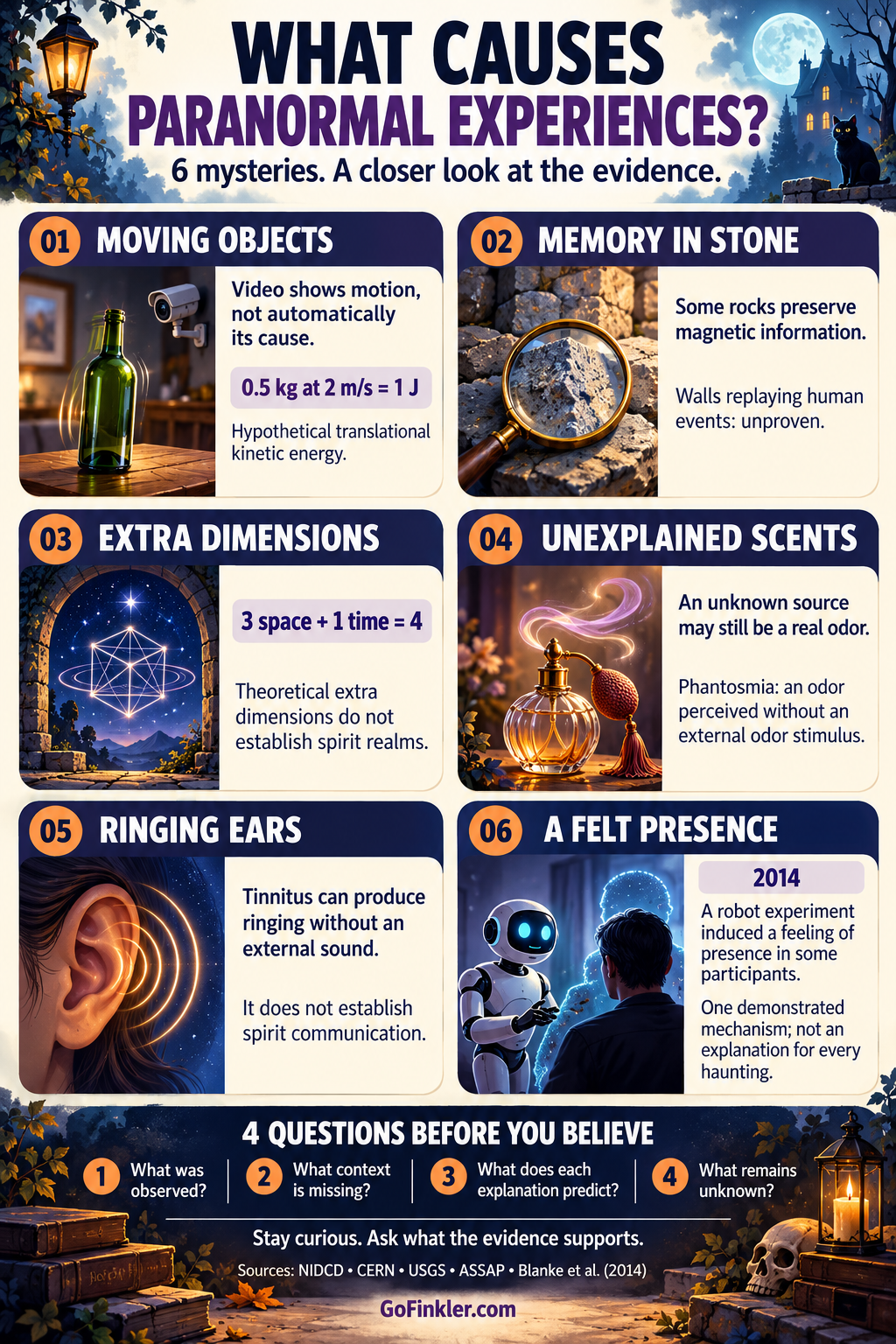
The Stone Tape hypothesis proposes that a place somehow records an event and later replays it, producing what witnesses interpret as a haunting. It is an appealing way to imagine footsteps following an old route or an apparition repeating the same action. However, a discussion published by the Association for the Scientific Study of Anomalous Phenomena acknowledges that a convincing recording mechanism or medium has not been demonstrated. That limitation matters because an analogy to a recording is only the beginning of an explanation.
Materials really can preserve information about the past, which makes the analogy especially tempting. Magnetic minerals in rocks can retain records of Earth’s magnetic field, and scientists measure those records to investigate geological history. The US Geological Survey’s paleomagnetics research is a concrete example of this kind of physical memory. Preserving a magnetic orientation, however, does not demonstrate that a wall can capture a person’s appearance, emotions, or conversation.
To explain a haunting, the proposal needs a way to encode information, preserve it, and turn it back into something visible or audible. It also needs to explain why one event would be recorded while years of ordinary activity apparently disappear. If the supposed playback moves a modern object, another problem appears: the theory must explain a new transfer of energy and momentum. These are productive questions because answers could make the idea testable. Until then, the wall-memory explanation remains an intriguing proposal with major missing parts.
Could ghosts come from another dimension?
Extra dimensions belong to serious theoretical physics, but the word “dimension” needs careful handling. Familiar spacetime has three spatial dimensions and one time dimension, while string-theory frameworks involve additional dimensions. Ten-dimensional superstring models and eleven-dimensional M-theory are theoretical constructions, not maps of confirmed spiritual worlds. CERN’s explanation of extra dimensions describes why physicists investigate these possibilities and what evidence they might seek. Establishing an extra dimension would still leave separate questions about whether anything inhabits it and how it interacts with us.
The number twelve also has a legitimate mathematical context, so it is not simply an invented internet number. F-theory uses an auxiliary geometric description often called twelve-dimensional, whose extra structure is more subtle than two additional directions a person could enter. That does not establish twelve observable realms or a hierarchy of spiritual levels. Using a mathematical framework to explain a haunting would require evidence connecting the framework to the actual event.
A useful thought experiment imagines creatures confined to a perfectly flat world. A sphere passing through their plane would appear as a point that grows into a circle, shrinks, and vanishes. From our perspective, the changing shape follows ordinary geometry; from their restricted perspective, it could seem extraordinary. This illustrates how limited observation can produce mystery, but it supplies no evidence that an apparition is a higher-dimensional visitor. The analogy becomes a scientific explanation only when it produces predictions that observations can test.
Strange smells, ringing ears, and sensed presences
When a scent seems to arrive from nowhere
An unexpected smell can feel more intimate than a distant shadow, especially when it resembles a familiar perfume or tobacco. Ordinary smelling begins with odor molecules activating receptors in the nose, which send signals to the brain. An unidentified source does not mean those molecules are absent; it means their origin has not been established. Phantosmia is different: it is the perception of an odor without an external odor stimulus. These possibilities should not be collapsed into one explanation simply because the experience feels uncanny.
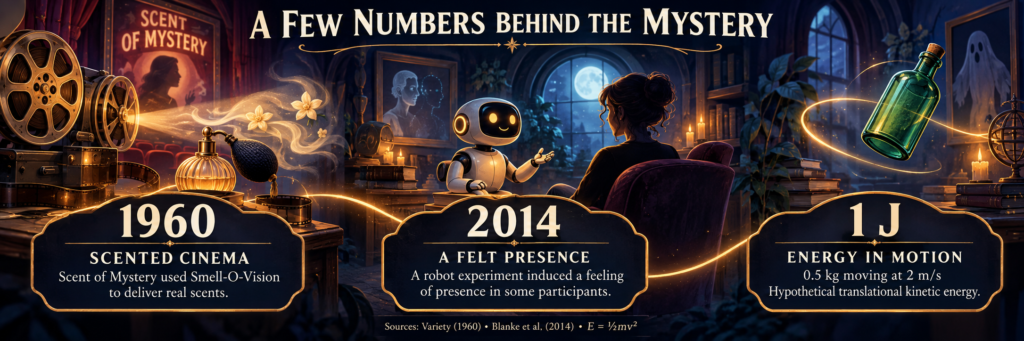
The history of Smell-O-Vision provides a surprisingly useful comparison. For the 1960 film Scent of Mystery, an engineered system delivered fragrances through tubing to audience seats, with releases coordinated to the film. A contemporary Variety review reported that some balcony viewers received scents after the relevant action, while others noticed a telltale hiss. The experience depended on physical delivery, timing, and the viewer’s position, all things an investigator could examine. If a haunted room supposedly replays a scent, asking what supplies the odor and how it reaches the observer is equally reasonable.
Is ringing in the ears a message?
Ringing, buzzing, or hissing perceived without an external sound source is commonly called tinnitus. One leading explanation involves changes in input from the inner ear altering activity in the brain’s sound-processing networks. Tinnitus has associations with hearing loss and noise exposure, while earwax, infections, certain medications, and other conditions can also contribute. The precise mechanisms are not completely understood, and the cause is not always identified. The NIDCD’s tinnitus guide explains these possibilities without treating every case as identical.
The interpretation that ringing carries communication from another realm is a spiritual claim, not a conclusion established by the sound itself. A communication hypothesis would need to show that the sound conveys independently verifiable information, rather than meaning assigned afterward. Readers experiencing persistent or troublesome ringing should seek a medical or hearing assessment, and ringing accompanied by sudden hearing loss needs urgent care. Personal meaning and an appropriate health assessment can coexist without assuming that uncertainty proves a supernatural source.
The laboratory experiment that produced a presence
In 2014, Olaf Blanke and colleagues reported an experiment that makes the boundary between sensation and interpretation especially interesting. A robotic setup created conflicts between participants’ movements and the touch they received, producing a feeling in some participants that another person was nearby. The study showed that a compelling sense of presence can arise from disrupted processing of signals about one’s own body. It did not establish the cause of every haunting, and it did not explain objects moving across rooms. Its value lies in demonstrating a mechanism for one specific kind of uncanny experience.
What mathematics can tell us about a flying bottle
A moving bottle presents a different problem from a felt presence because physical motion can, in principle, be measured. Investigators would want to know its position, speed, direction, support, and contact with surrounding objects before the apparent launch. A fall, a slide, a bounce, and a sideways push make different demands on an explanation. Without a reliable frame rate, scale, and useful camera angle, however, a dramatic-looking trajectory may resist accurate reconstruction. Mathematics helps most when the measurements deserve our confidence.
Consider a purely hypothetical half-kilogram bottle moving at two metres per second. Its translational kinetic energy, calculated as E = ½mv², would be one joule, ignoring rotation. That number describes motion; it does not identify what produced it. Gravity could supply energy during a fall, while a push or impact could transfer energy from elsewhere. A paranormal proposal would still need to account for the observed motion and show why the evidence favors it over those alternatives.
A shadow and reflection can add useful information, but they are not automatically two extra witnesses. The bottle’s movement may generate both, making all three observations consequences of the same event. Separately, surveillance-camera processing can introduce motion blur and ghosting artifacts, as manufacturer Axis documents in its image-quality guidance. Those effects may help explain a strange-looking shape, but they do not by themselves propel a physical bottle. A careful analysis has to account for each feature without letting one explanation do more work than it can.
Why this matters when a mystery goes viral
A short clip can reach us without its original file, the minutes before the event, or any account of what happened afterward. That missing context matters whether the uploader is sincere, mistaken, or deliberately staging something. A plausible ordinary explanation is worth testing, but proposing one is not the same as demonstrating it. Likewise, a video that resists explanation from our limited viewpoint does not automatically establish a new force or intelligence. The responsible conclusion may be that the record is incomplete.
Probability adds another useful question: how differently would competing explanations predict the evidence? A vague shadow provides little discrimination when lighting, a person outside the frame, processing, and deliberate staging could all produce something similar. A repeatable event recorded under conditions designed to rule out specific alternatives would be much more informative. We do not need invented percentages for the probability of ghosts to apply that logic. We need observations that help separate explanations, rather than simply intensify the feeling of mystery.
Four questions to ask before sharing a haunting
- Describe the observation before naming the cause. Write down that a bottle changed position, a dark patch crossed the frame, or someone noticed a scent. Calling it a spirit at the outset quietly adds a conclusion that still needs evidence, and can steer every later question toward defending that first impression.
- Look for the fullest available record. Seek the original upload, continuous footage around the event, and other angles rather than relying only on a cropped replay. Missing information should reduce confidence in a verdict, even when the clip is impressive, because what lies outside the frame may be essential to understanding what lies inside it.
- Ask each explanation to make a useful prediction. A proposed vibration, reflection, hidden mechanism, or unusual sensory response should suggest something that could be checked. The same standard applies to a paranormal explanation; an account that can accommodate every possible outcome gives us very little help distinguishing what actually happened.
- Allow a meaningful experience to remain unresolved. Someone can feel comforted, frightened, or deeply moved without having established the event’s physical cause. Respecting that person does not require endorsing every interpretation, and asking for evidence does not require dismissing the experience; the conversation improves when both forms of respect are present.
Final verdict: curiosity works best with standards
So, what causes paranormal experiences? The evidence supports several mechanisms for particular experiences, including sensory processing effects and camera artifacts, while individual reports can remain unresolved because the necessary information is missing. Stone Tape recordings and higher-dimensional visitors have not been established as explanations for hauntings. Their appeal is understandable, but the gap between an evocative possibility and a demonstrated mechanism is substantial. Readers can decide how convincing a specific account seems while keeping that gap in view.
Halloween is a good time to enjoy the feeling that an ordinary room might contain an extraordinary story. It is also a good time to ask better questions about the stories we share. Look closely at the bottle, consider what the camera can reveal, and take a person’s account seriously enough to examine it carefully. The mystery becomes more interesting when we know which parts are observed, which are inferred, and which are still waiting for evidence.