
How to Calm Your Mind, Reduce Stress, and Sleep Better Naturally
The Medicine You Carry Everywhere
Most people spend their entire lives breathing, yet few ever learn how to use breath as a tool.
That sounds strange at first. Breathing is automatic. It happens whether you think about it or not. But while breathing may be automatic, how you breathe can strongly influence your stress levels, sleep quality, focus, emotions, and even how your body responds to fear.
When people panic, the breath changes. When they feel peaceful, the breath changes. When they are angry, anxious, calm, exhausted, inspired, or deeply asleep, the breath shifts with them. Breath is not just a symptom of your state—it can also become a lever that changes your state.
This is why breathwork has existed for thousands of years in meditation traditions, martial disciplines, prayer practices, and healing systems. Today, athletes, therapists, military trainers, and sleep experts are rediscovering what many ancient traditions already understood: the breath is powerful.


The Power of Breathing: The Simple Human Hack Most People Ignore
Most people spend their entire lives breathing, yet very few ever learn how to use breath as a tool. That sounds strange at first because breathing is automatic. You do not need a course, a certification, a smartwatch, or a wellness retreat to keep breathing. Your body handles it for you while you work, sleep, drive, argue, worry, exercise, and scroll through your phone at midnight.
But there is a hidden detail most people miss: breathing may be automatic, but it is not completely out of your control. You can change its speed, depth, rhythm, and pattern within seconds. That means breath sits in a rare category of human functions — partly automatic, partly voluntary. You cannot directly command your heart to slow down, but you can often influence it through the way you breathe.
That is why breathing techniques have survived for thousands of years in meditation, prayer, martial arts, yoga, military training, athletic performance, and modern therapy. People may disagree about the spiritual claims, the ancient explanations, or the more dramatic wellness marketing, but the practical observation remains difficult to ignore. When your breath changes, your state often changes with it.
What Is Breathwork?
Breathwork is the intentional use of breathing patterns to influence the body and mind. It can be as simple as taking ten slow breaths before reacting to a stressful message, or as structured as following a timed pattern such as 4-7-8 breathing or box breathing. Some forms are designed to calm the nervous system, while others are more energizing, meditative, or performance-focused. The main idea is that breath becomes something you use deliberately instead of something you barely notice.
At its best, breathwork is not mystical fluff or complicated self-help theater. It is practical self-regulation. The body is constantly reading signals from breathing, posture, muscle tension, heart rate, and environment. When breathing becomes fast and shallow, the body often interprets that as stress or threat. When breathing becomes slower, steadier, and more controlled, the body may receive a different message: we are not in immediate danger.
That does not mean breathing solves everything. A few slow exhales will not magically fix chronic anxiety, trauma, insomnia, poor diet, financial stress, or a chaotic life. But breath can change the state from which you face those problems. That alone makes it worth taking seriously.
Here is a quick visual guide to the major breathing methods covered in this article. These images are meant to help readers see breathwork as a set of practical tools rather than one vague wellness idea.
Why Breathing Affects Stress So Quickly
One reason breathing is so fascinating is that it seems almost too simple to matter. Stress feels complex. Anxiety feels complex. Anger, panic, exhaustion, and overstimulation feel like problems that should require something bigger than breathing. Yet many people notice the same thing: when they slow the breath, especially the exhale, something starts to shift.
When stress rises, the body often moves into a more alert survival mode. Breathing becomes faster. The chest tightens. The shoulders creep upward. The jaw clenches. Thoughts begin racing, and the mind starts scanning for danger, failure, embarrassment, or conflict. This response can be useful if you are facing an actual threat, but modern life triggers it constantly through emails, deadlines, bills, traffic, arguments, and bad news.
Slow breathing acts like an interruption pattern. It gives the mind a simple task and gives the body a calmer rhythm to follow. Instead of spiraling through thoughts, you count. Instead of feeding tension with shallow chest breathing, you lengthen the breath. Instead of reacting immediately, you create a pause. That pause is where composure starts to return.
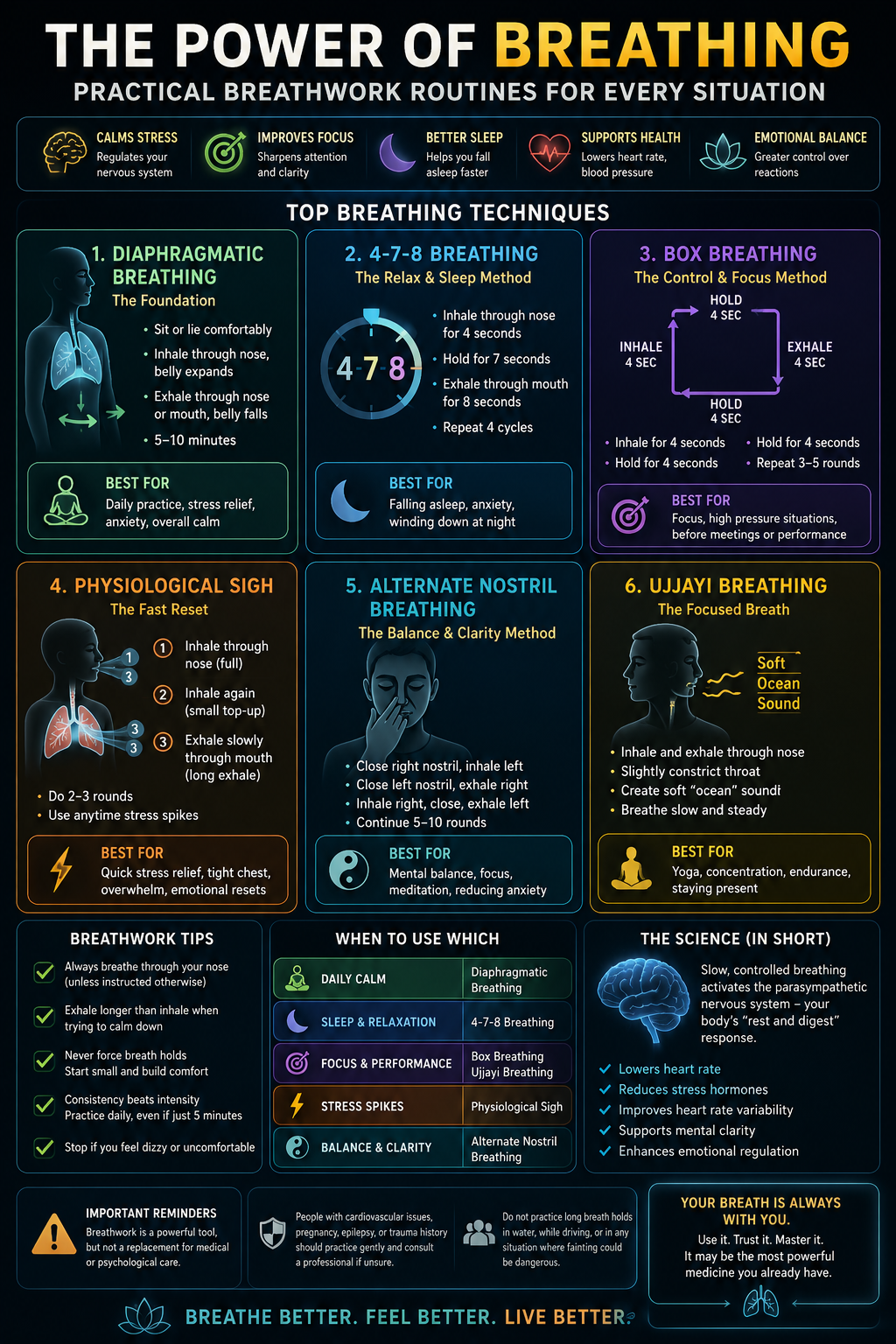
Diaphragmatic Breathing: The Foundation Most People Skip
Diaphragmatic breathing, often called belly breathing, is one of the most important techniques because it teaches the body to breathe lower and more fully. Many stressed people breathe mostly through the upper chest. Their shoulders move more than their abdomen, and every breath feels slightly tense. Over time, this can make calm breathing feel unfamiliar, even though it is one of the most natural things the body can do.
The diaphragm is the large muscle under the lungs that helps draw air in and push air out. When diaphragmatic breathing works properly, the belly gently expands on the inhale and softens on the exhale. This does not mean forcing your stomach outward in an exaggerated way. It means allowing the lower ribs and abdomen to move instead of trapping the breath in the upper chest.
A simple way to practice is to place one hand on your chest and one hand on your belly. Inhale gently through the nose and see if the lower hand moves more than the upper hand. Then exhale slowly and allow the body to soften. If this feels awkward at first, that is normal. Many people are not bad at breathing because they are broken; they are bad at breathing because they have spent years living tense.
4-7-8 Breathing: The Sleep and Anxiety Downshift
The 4-7-8 breathing method is one of the most popular breathwork patterns because it is simple, memorable, and calming. The basic rhythm is to inhale for 4 seconds, hold for 7 seconds, and exhale for 8 seconds. The long exhale is the key feature. It slows the rhythm down and gives the nervous system a chance to move away from urgency.
This technique is often used before sleep, during anxious moments, or when the mind will not stop looping. The counting gives the brain something concrete to focus on, which helps interrupt repetitive thoughts. The breath hold adds stillness, while the extended exhale encourages the body to let go of tension. For many people, it works best not because it knocks them out like a sleeping pill, but because it creates a repeatable bedtime ritual.
Beginners should not force the counts. If 4-7-8 feels uncomfortable, shorten it while keeping the same general pattern. You might try inhaling for 3, holding for 5, and exhaling for 6. The point is not to win a breath-holding contest. The point is to breathe in a way that feels controlled, sustainable, and calming.
Box Breathing: Control Under Pressure
Box breathing is often associated with high-pressure performance because it is steady, symmetrical, and easy to remember. The classic pattern is simple: inhale for 4 seconds, hold for 4 seconds, exhale for 4 seconds, and hold again for 4 seconds. The rhythm forms a mental “box,” with each side equal in length. That structure is part of what makes it useful.
Unlike 4-7-8 breathing, which leans more toward relaxation and sleep, box breathing is excellent for composure. It can help before a difficult conversation, during work stress, before public speaking, or in any moment where you need to stop reacting emotionally. The equal timing gives the mind a stable track to follow. It is not dramatic, but that is exactly why it works well in normal life.
The best part is that box breathing is discreet. You can do it in a parked car, at your desk, before a meeting, or while standing in a lineup. Nobody needs to know. In a world where people often feel pulled around by pressure, this tiny private practice can give you a sense of control again.
The Physiological Sigh: The Fast Reset
The physiological sigh is one of the quickest breathing resets because it mimics something the body naturally does. The pattern is usually a deep inhale, a second small inhale before fully exhaling, and then a long slow breath out. You may have done this naturally after crying, during relief, or after intense stress. The body sometimes uses this pattern on its own to rebalance breathing.
The reason people like this technique is that it feels immediate. When tension is high, a normal slow breathing routine can feel like too much effort. The physiological sigh gives you a fast way to dump some pressure. You take in air, top it up slightly, then release it in a long exhale. The effect can feel like a pressure valve opening.
This method is especially useful when you feel physically activated — tight chest, restless energy, frustration, or the sense that you need to calm down quickly. Try two or three rounds, then return to normal nasal breathing. Do not overdo it. The goal is a reset, not hyperventilation.
Alternate Nostril Breathing: Balance and Attention
Alternate nostril breathing comes from yogic breathing traditions and is often used to create a sense of balance, focus, and calm. The common version involves gently closing one nostril, inhaling through the other, switching sides, and exhaling through the opposite nostril. Then the pattern continues in reverse. It sounds unusual if you have never tried it, but many people find it surprisingly grounding.
Part of its value comes from the attention required. You cannot easily doom-scroll, mentally spiral, and alternate nostrils at the same time. The technique forces the mind into the body. It gives your attention a job that is physical, rhythmic, and quiet. That alone can reduce mental noise.
This is not the best method for every situation. If your nose is congested, if you are in public, or if you want something subtle, box breathing may be better. But as a home practice before meditation, reading, sleep, or focused work, alternate nostril breathing can be a strong tool. It feels less like forcing calm and more like gently organizing your attention.
Ujjayi Breathing: The Focused Breath
Ujjayi breathing is another yogic technique, often used during yoga practice. It involves breathing through the nose while slightly narrowing the throat, creating a soft ocean-like sound. The breath becomes audible, steady, and textured. This gives the mind something to follow and helps keep breathing controlled during movement or concentration.
The value of Ujjayi breathing is not only relaxation. It can also support focus and endurance because it gives breathing a deliberate rhythm. In physical practice, people use it to stay steady instead of rushing, holding tension, or breathing randomly. Outside yoga, it can be useful when you need to concentrate, slow down, and stay connected to the body.
The skeptical point is that Ujjayi does not need to be wrapped in exaggerated claims. You do not have to believe it unlocks hidden powers to benefit from it. A steady breath, a gentle sound, and a controlled rhythm can be enough. Sometimes the simple explanation is still useful.
4-8-4 Breathing: A Simple Calm-Down Pattern
The 4-8-4 breathing method is another easy pattern for people who like structure. It usually involves inhaling for 4 seconds, holding for 8 seconds, and exhaling for 4 seconds. The longer hold creates stillness, while the controlled inhale and exhale keep the breath organized. Some people find this helpful before stressful conversations or during moments when they need to slow down and regain control.
However, this one should be adjusted carefully. Breath holds can feel calming for some people and uncomfortable for others. If the 8-second hold creates strain, shorten it. Breathwork should not feel like punishment. If a method makes you tense, dizzy, or panicky, it is not the right version for that moment.
A more beginner-friendly version might be 4-4-6 breathing, where the exhale is longer than the inhale. Many people respond well to longer exhales because they feel less forced than long holds. The best breathing method is not always the most impressive one. It is the one you will actually use.
Why Emptying the Lungs Matters
Many people make one major mistake when trying to breathe better: they focus only on taking a bigger inhale. When they feel anxious or tense, they try to suck in more air. But sometimes the problem is not that they need more air. Sometimes the problem is that they have not fully exhaled.
Shallow breathing can leave people feeling like their breath is stuck. They inhale into a tense chest, exhale only a little, then inhale again before the body has really reset. This can create the sensation of air hunger, even when oxygen is not actually the issue. The result is an uncomfortable cycle: the person feels they cannot get enough air, so they keep trying to inhale more.
A better move is often to exhale slowly and completely first. Let the breath out until the lungs feel comfortably empty, then allow the inhale to arrive naturally. This can feel like clearing stale air before taking in fresh air. It is simple, but once you feel the difference, you understand why exhalation matters so much.
Breathwork, Meditation, and Spiritual Traditions
Breath has always had a special place in meditation and spiritual traditions because it is both ordinary and mysterious. It is physical, yet closely tied to emotion and awareness. It happens in the present moment, which makes it a natural anchor for mindfulness. You cannot breathe yesterday, and you cannot breathe tomorrow. You can only breathe now.
This is why so many practices begin with simply observing the breath. You sit, notice the inhale, notice the exhale, and return whenever the mind wanders. Nothing flashy happens at first. But over time, the practice teaches a powerful skill: returning. The mind leaves, and you return. Stress rises, and you return. A thought grabs you, and you return.
The fascinating part is that breath does not require belief. A religious person can use it in prayer. A skeptical person can use it as nervous system training. An athlete can use it for performance. A tired parent can use it to avoid snapping. Breath belongs to everyone.
Why People Believe Breathwork Works
People believe in breathwork because they can often feel the effect quickly. That does not mean every claim is true, but it does explain why the practice spreads. You do not need a laboratory to notice that your breathing changes when you panic. You do not need a guru to notice that a long sigh can release tension. You do not need perfect scientific certainty to understand that a calm breath can support a calmer state.
Supporters often point to several everyday observations. Angry people breathe differently than peaceful people. Sleeping people breathe differently than panicking people. Athletes train their breathing because performance depends on oxygen, rhythm, and control. Speakers breathe before going on stage because the breath influences voice, pacing, and confidence.
There is also the ancient factor. Breath practices appear in traditions across the world, which suggests that human beings have noticed this connection for a very long time. Of course, ancient does not automatically mean correct. Plenty of old ideas are wrong. But when an ancient practice lines up with modern experience and emerging physiology, it deserves a fair look.
The Skeptical View: Is Breathwork Overhyped?
Yes, breathwork is sometimes overhyped. Some people market breathing as if it can cure everything, unlock superhuman abilities, erase trauma, replace therapy, or solve every health problem. That is where skepticism is necessary. Breathing is powerful, but it is not magic. Turning it into magic actually weakens the case for it.
There are also safety concerns with intense methods. Aggressive hyperventilation, long breath holds, and advanced practices should be treated carefully, especially for people with medical conditions, panic disorders, cardiovascular concerns, pregnancy, epilepsy, or trauma histories. Breath retention should never be practiced in water, while driving, or in situations where fainting would be dangerous. Even gentle breathing can feel uncomfortable for some people if they push too hard.
The balanced view is simple: breathwork is a useful tool, not a miracle cure. It can support calm, focus, sleep routines, emotional regulation, and body awareness. It may help people interrupt stress before it takes over. But serious symptoms deserve serious support, and breathing techniques should complement good medical and mental health care rather than replace it.
How to Use Breathing in Real Life
The best breathwork practice is the one you remember when life gets messy. It is easy to breathe calmly while reading an article about breathing. The real test is whether you use it before sending the angry text, before eating from stress, before spiraling at night, or before giving up on a difficult task. Breath becomes powerful when it moves from “interesting idea” to automatic tool.
A practical daily routine could be simple. Use diaphragmatic breathing in the morning before checking your phone. Use box breathing before work or stressful conversations. Use a physiological sigh when tension spikes. Use 4-7-8 breathing at night when your mind will not settle. Use alternate nostril breathing or Ujjayi breathing when you want to prepare for meditation, reading, or focused work.
You do not need to do all of these every day. That would turn breathwork into another chore. Instead, treat the methods like tools in a small kit. Different situations call for different tools, and part of the skill is learning which one works best for you.
Simple Breathwork Tool Kit
- For quick stress: physiological sigh, 2 or 3 rounds.
- For focus under pressure: box breathing, 3 to 5 rounds.
- For sleep: 4-7-8 breathing, 4 gentle cycles.
- For general calm: diaphragmatic breathing, 5 minutes.
- For meditation: natural breath awareness, 5 to 10 minutes.
- For balance and attention: alternate nostril breathing, 3 to 5 minutes.
Common Mistakes Beginners Make
The biggest beginner mistake is trying too hard. People hear that breathing is powerful, so they turn it into a performance. They inhale too much, hold too long, tense their shoulders, and chase dramatic sensations. Then they wonder why they feel lightheaded or frustrated. Good breathwork usually feels steady, controlled, and sustainable.
Another mistake is waiting until everything is already falling apart. Breathwork can help during stress, but it works better when practiced during calm moments too. That way, the pattern becomes familiar before you need it. You are training the body to recognize the route back to steadiness.
People also quit too early because the results feel subtle. But subtle does not mean useless. A little more calm before sleep, a little more control during anger, a little more focus before work, and a little more awareness during stress can compound. Most life-changing habits do not feel dramatic every time you do them. They work because you keep returning to them.
Why The Power of Breathing Matters Today
Modern life is almost perfectly designed to scramble the nervous system. We wake up to alarms, check messages before our feet hit the floor, absorb bad news all day, juggle work pressure, compare ourselves online, and then wonder why sleep does not come easily. The problem is not only that people are busy. It is that many people never fully come down.
Breathing matters today because it gives people a private reset button in a world that constantly pulls their attention outward. You can use it without buying anything. You can use it before anyone notices you are stressed. You can use it in the middle of real life, not only in perfect conditions. That makes it unusually practical.
There is also something empowering about realizing that calm is not always something you have to wait for. Sometimes you can participate in creating it. Not perfectly, not instantly, and not every time. But enough to matter.
The Hidden Power Was Always There
The power of breathing is easy to dismiss because it is so ordinary. Breath has no branding. It does not look impressive. It does not require a subscription, a device, or a dramatic lifestyle change. It is always there, quietly keeping you alive while you chase more complicated solutions.
But hidden inside that ordinary process is a remarkable lever. Breath can help calm stress, sharpen attention, soften anger, prepare the body for sleep, and bring the mind back to the present. It is not a cure-all, and the exaggerated claims should be questioned. Still, the practical value is real enough to earn a place in everyday life.
The next time your mind is racing, do not immediately reach for distraction. Pause. Exhale slowly. Take one deliberate breath, then another. You may find that one of the most useful tools for changing your state was never outside you at all.