
Reality Transurfing: Letting Go Without Giving Up
Many people reach a strange point in life where effort alone no longer seems to work. They try harder, plan more carefully, set goals, visualize outcomes, and push themselves to stay disciplined. On paper, they are doing everything right. Yet instead of momentum, they feel resistance, as if the harder they grip the future, the more life quietly pulls it away.
That paradox sits at the center of Reality Transurfing, a philosophy popularized by Vadim Zeland. It asks a simple but uncomfortable question: what if wanting something too much is part of what makes it harder to receive? Not because desire is bad, and not because effort is useless, but because emotional pressure can distort your actions, tighten your mind, and turn a healthy goal into a psychological burden.
Reality Transurfing is often placed in the same general world as manifestation, the law of attraction, parallel realities, and conscious creation. But the most useful part of the idea is not the mystical language. The useful part is practical: you can care deeply about your direction without turning the outcome into a life-or-death emotional demand. You can act seriously without carrying the heavy strain of desperation.
What Is Reality Transurfing?
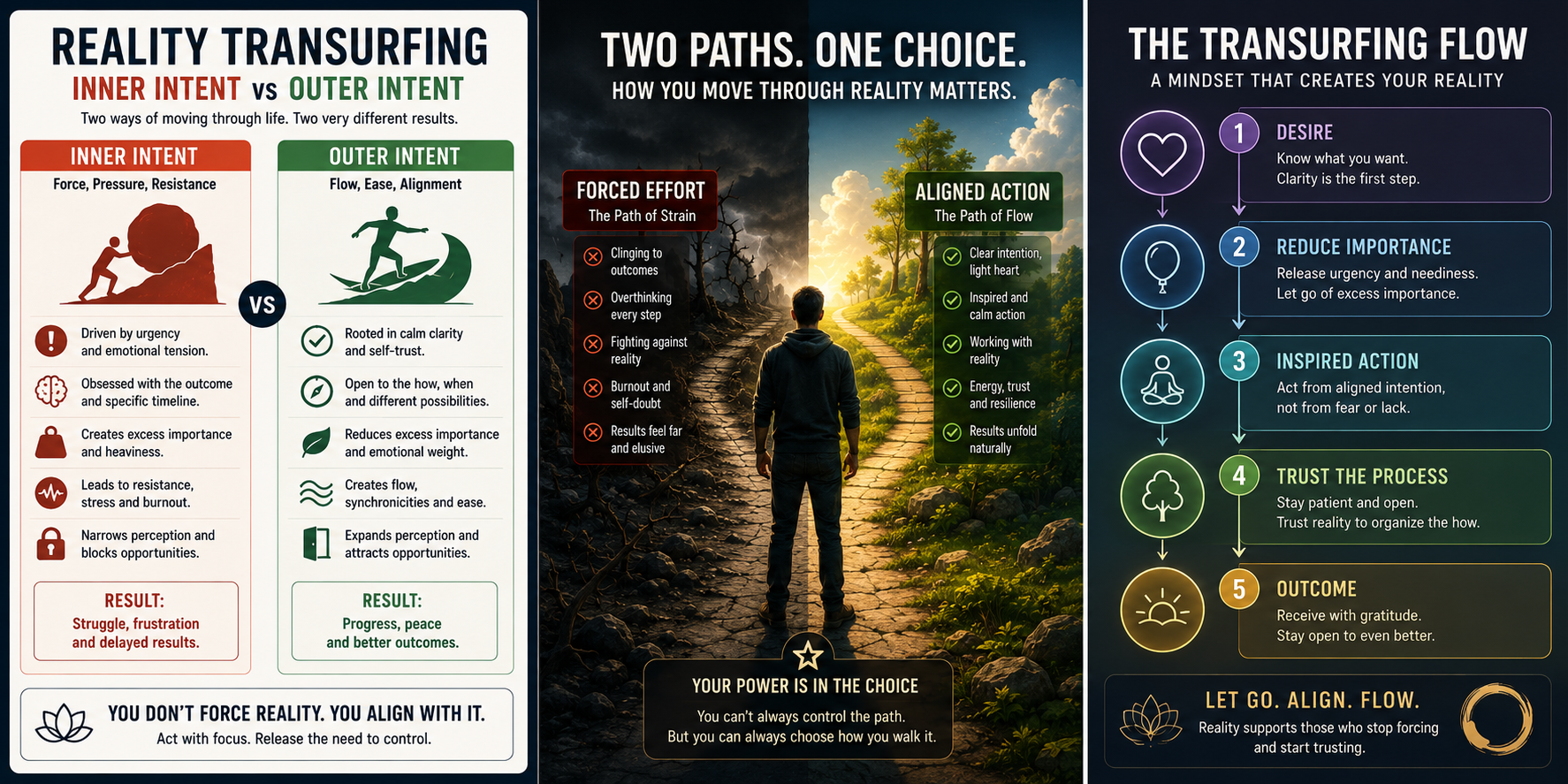
Reality Transurfing is a model of personal reality, attention, choice, and outcome creation. In simple terms, it suggests that life contains many possible paths, and your attention, beliefs, emotional state, and actions influence which path becomes your lived experience. Instead of forcing reality through raw pressure, Transurfing teaches that you move more effectively by aligning with the version of life you want while reducing inner tension.
That may sound abstract, but the everyday version is easy to recognize. Everyone has experienced times when they wanted something so badly that they began acting awkwardly, anxiously, or desperately. A job interview becomes harder because you need it too much. A relationship becomes strained because you fear losing it. A business idea becomes exhausting because every small setback feels like proof that your future is collapsing.
Transurfing does not say to stop caring. That is an important distinction. It says to stop making the outcome so emotionally inflated that you can no longer move clearly. The goal still matters, but the panic around the goal does not help. In fact, according to the Transurfing model, that panic creates excess importance, and excess importance creates resistance.
Why Reality Transurfing Fascinates People
Reality Transurfing fascinates people because it explains a feeling many people have but struggle to name. Sometimes effort works. Sometimes it does not. Sometimes a person chases something intensely and only creates more stress, while another person seems calmer, less attached, and somehow more effective. That difference can feel mysterious, but it may not be magic. It may be the difference between clean action and strained action.
People are drawn to Transurfing because it offers a third path between passive wishful thinking and exhausting control. The passive person says, “If it is meant for me, it will happen,” and then does very little. The forceful person says, “I must make this happen no matter what,” and burns themselves out trying to dominate every variable. Transurfing says something more subtle: choose your direction clearly, act consistently, reduce excess importance, and allow reality room to organize.
That idea feels spiritual, but it also feels psychologically realistic. Anxiety narrows perception. Desperation reduces creativity. Obsession can make people miss easier opportunities because they are locked onto one rigid path. When the emotional grip loosens, the mind often becomes more flexible, and flexibility is a serious advantage in real life.
Inner Intent: The Pressure That Makes Everything Heavy
In Reality Transurfing, inner intent is the forceful, effort-heavy drive most people know very well. It is the part of you that says, “This has to work. I need this to happen. If I fail, everything falls apart.” Inner intent is fueled by urgency, fear, pressure, and attachment to a specific outcome on a specific timeline.
At first, inner intent can feel like motivation. It pushes you to work, plan, improve, and take action. But over time, it often mutates into strain. You no longer act from clarity; you act from fear. You no longer pursue the goal because it matters; you pursue it because you feel incomplete without it.
This is where many people sabotage themselves. They overthink, overcorrect, force conversations, rush decisions, and treat every delay as disaster. The problem is not that they lack desire. The problem is that desire has become so loaded with importance that it distorts their behavior.
Excess Importance: The Hidden Trap
Excess importance is one of the most useful ideas in Reality Transurfing. It describes what happens when you inflate a goal, person, event, identity, fear, or outcome until it becomes emotionally oversized. The thing itself may be normal, but your relationship to it becomes heavy. You make it mean too much.
This shows up everywhere. A person does not just want a job; they make the job proof of their worth. They do not just want a relationship; they make the relationship proof they are lovable. They do not just want a business to succeed; they make the business proof they are not a failure. Once that happens, the outcome becomes loaded with emotional survival.
The Transurfing claim is that excess importance creates balancing forces. Whether you understand that metaphysically or psychologically, the practical result is familiar. When something feels too important, people often become tense, reactive, and less natural. They may push too hard, avoid risks, cling to bad options, or panic at small setbacks.
Outer Intent: Action Without Force
Outer intent is one of the more unusual Transurfing concepts, but it becomes clearer if you think of it as calm alignment rather than passive hope. Outer intent is not giving up. It is not sitting around waiting for life to hand you what you want. It is action without emotional violence.
With outer intent, you still show up. You still do the work. You still make decisions, take opportunities, and move toward your desired reality. The difference is that you stop demanding that reality obey your exact emotional timeline. You act as if the outcome is possible, perhaps even natural, while accepting that the path may unfold differently than your mind expects.
This is a powerful shift. The desperate person tries to force one door open. The aligned person walks toward the destination while staying awake to other doors. That does not mean every door is good or every delay is a sign. It simply means your nervous system is not so locked into control that you become blind to possibility.
Letting Go Without Becoming Passive
The phrase “let go” is often misunderstood. Some people hear it and think it means stop caring. Others think it means stop working. That is not what makes the idea useful. Letting go, in the Reality Transurfing sense, means releasing emotional over-attachment while keeping responsibility.
You still care. You still act. You still take practical steps. You still improve your skills, communicate clearly, manage your life, and make real-world decisions. What you release is the desperate inner demand that says, “This must happen exactly this way, exactly when I want, or I am not okay.”
A good way to summarize the idea is this: do the work as if it matters, but hold the outcome as if you can survive either way. That does not weaken you. It stabilizes you. When you are not emotionally enslaved by one outcome, you usually make better decisions.
An Old Idea Wearing New Clothes
Although Reality Transurfing uses modern language, its central insight is not entirely new. Many old wisdom traditions warn against grasping, obsession, and emotional dependence on outcomes. The language changes, but the pattern stays familiar: act with integrity, focus on what is yours to do, and stop trying to control what is beyond your control.
Stoicism teaches a similar principle. The Stoic approach is not to avoid effort, but to separate what depends on you from what does not. Your choices, judgments, discipline, and character belong more directly to you. Other people’s reactions, timing, luck, and final outcomes do not. Peace comes from placing effort where it belongs.
Taoism also carries a similar idea through the concept of wu wei, often translated as effortless action or non-forcing. It does not mean laziness. It means acting in alignment with the flow of reality rather than fighting everything with ego-driven pressure. In that sense, Reality Transurfing may be less of a brand-new doctrine and more of a modern packaging of a very old human lesson.
The Jim Carrey Example
A famous modern example often brought into manifestation discussions is Jim Carrey writing himself a check for ten million dollars for acting services rendered before he became a major star. The story is usually presented as proof of visualization. But the more interesting part is not the check itself. It is the combination of clear intention, continued action, and emotional posture.
Carrey did not simply write a check and sit around waiting for the universe to deliver. He kept working, auditioning, failing, performing, improving, and moving. The check represented a possible future, but his behavior still had to support that future. That is the part many people conveniently skip.
This example fits the Transurfing idea because it shows the difference between vision and desperation. A vision gives direction. Desperation creates strain. The goal is not to pretend success is guaranteed while doing nothing. The goal is to act like the future is possible without collapsing emotionally if it takes longer than expected.
How to Practice Reality Transurfing in Real Life
The practical version of Reality Transurfing begins with noticing where you are gripping too hard. Ask yourself what feels heavy right now. Is it a goal, a person, a timeline, a business idea, a relationship, a financial outcome, or a version of yourself you are trying to become? The thing you cannot stop obsessing over is often the thing carrying excess importance.
Once you identify it, the next step is not to abandon it. The step is to reduce the emotional charge around it. Remind yourself that the outcome matters, but your entire identity does not depend on it. This gives you space to act better. It brings the goal back down to human size.
A simple daily practice might look like this:
- Choose one clear direction.
- Identify the next practical action.
- Notice where urgency or fear is taking over.
- Reduce the importance by reminding yourself you can adapt.
- Take the action calmly.
- Release the demand for immediate results.
This is not glamorous, but it is useful. Reality Transurfing becomes more powerful when it stops being an abstract philosophy and becomes a way of moving through the day.
Identity Versus Timeline
One of the most practical ways to apply Reality Transurfing is to separate identity from timeline. Identity asks, “Who am I becoming?” Timeline asks, “When must this happen?” Most people accidentally attach their identity to the timeline, which creates unnecessary pressure.
For example, someone building a business might say, “If this does not work in three months, I am a failure.” That is a dangerous equation. The better identity-based version is, “I am becoming someone who builds useful things, studies feedback, and keeps improving.” That identity can survive delays. It can survive experiments. It can survive imperfect results.
Timelines matter for planning, but they should not become emotional cages. Hold the direction firmly, but hold the timing lightly. This allows you to keep moving without turning every missed deadline into a personal collapse.
The Inner Screen
Reality Transurfing often uses the idea of the inner screen: the internal movie you keep replaying about yourself and your future. Most people think they are reacting to reality, but often they are reacting to the internal film they are running. If the film says failure is inevitable, they act differently. If the film says things are opening up, they notice different opportunities.
This does not mean thoughts magically override reality. That is too simplistic. But your internal expectations do shape perception, emotion, and behavior. A person who expects rejection may speak less confidently, avoid chances, or interpret neutral events as negative. A person who expects possibility may take better action and stay alert to openings.
The inner screen matters because it becomes a rehearsal space. If you constantly rehearse failure, panic, and disappointment, your body learns that state. If you rehearse calm action, trust, and adaptability, your body can learn that too. The practice is not about lying to yourself. It is about choosing the mental film that helps you act wisely.
The Skeptical View
A balanced article has to admit something important: Reality Transurfing is not established science. Its claims about parallel realities, reality selection, and energetic balancing forces are speculative. There is no accepted scientific proof that thoughts literally move a person between alternative lifelines in the way Transurfing language can suggest.
Some critics also argue that these systems can become vague. If something works, believers say the method succeeded. If something does not work, they may say the person had too much importance, not enough alignment, or hidden resistance. That kind of logic can become impossible to test.
But dismissing the entire model would be too easy. Even if someone rejects the metaphysical claims, the psychological lessons remain useful. Reducing desperation improves judgment. Lowering emotional attachment can reduce anxiety. Focusing attention changes behavior. Acting calmly while releasing control is a practical skill in almost every area of life.
What Reality Transurfing Gets Right
Reality Transurfing gets one major thing right: force is not the same as power. Many people confuse strain with seriousness. They think if they are worried, tense, and constantly thinking about the goal, they must be committed. But worry is not commitment. Tension is not strategy. Obsession is not discipline.
Real power often feels calmer. A skilled athlete does not perform best while panicking. A good speaker does not improve by obsessing over every possible mistake. A strong business owner does not win by treating every setback as catastrophe. The best action usually comes from alertness, not desperation.
This is the real-world usefulness of Transurfing. It teaches people to remove unnecessary emotional static. When the static drops, action becomes cleaner. You can still work hard, but the work no longer feels like a fight against existence itself.
Why Reality Transurfing Matters Today
Reality Transurfing matters today because modern life trains people to live in constant urgency. Everyone is chasing metrics, timelines, approval, money, status, growth, healing, productivity, and identity upgrades. The result is that even self-improvement can start to feel like anxiety wearing a motivational mask.
People do not only want goals anymore. They want proof they are not falling behind. That pressure turns ordinary ambition into emotional survival. Reality Transurfing speaks directly to that wound because it says: you can move toward a better life without making every step feel like a final judgment.
This matters for entrepreneurs, creators, workers, students, parents, and anyone trying to build something meaningful. You still need action. You still need skill. You still need discipline. But you also need enough inner space to think clearly, adapt, and enjoy the path while it unfolds.
Final Verdict: Is Reality Transurfing Worth Taking Seriously?
Reality Transurfing is not something you need to accept as literal truth in order to benefit from it. The metaphysical side is fascinating but unproven. The idea that reality contains many possible lifelines and that attention helps select among them is intriguing, but it should be held as a model rather than treated as verified fact.
The practical side, however, is genuinely valuable. Inner intent describes the pressure that makes people desperate. Excess importance explains why goals become heavy. Outer intent offers a way to act without forcing. The entire system points toward one powerful lesson: do not confuse caring with clinging.
The smartest approach is to treat Reality Transurfing as a thought experiment and a practical mental tool. Use what helps. Question what sounds exaggerated. Stay open without becoming gullible. Stay skeptical without becoming closed.
In the end, the best summary may be the simplest: do the work as if it matters, hold the outcome lightly, and stop adding strain that never helped in the first place. That is not giving up. That is learning how to move through life with less friction and more power.
Vadim Zeland Official Site — Reality Transurfing
Reader note: This article explores unusual claims, theories, beliefs, and interpretations. It aims to separate documented history, symbolism, belief, interpretation, and speculation wherever possible. Extraordinary claims are not presented as established fact unless supported by credible evidence.
Hold the direction firmly but hold the timing lightly. This is important, no use in tearing yourself down if you didn’t accomplish X in Y amount of time.