
Little People of Streams, Mountains, and Hidden Places
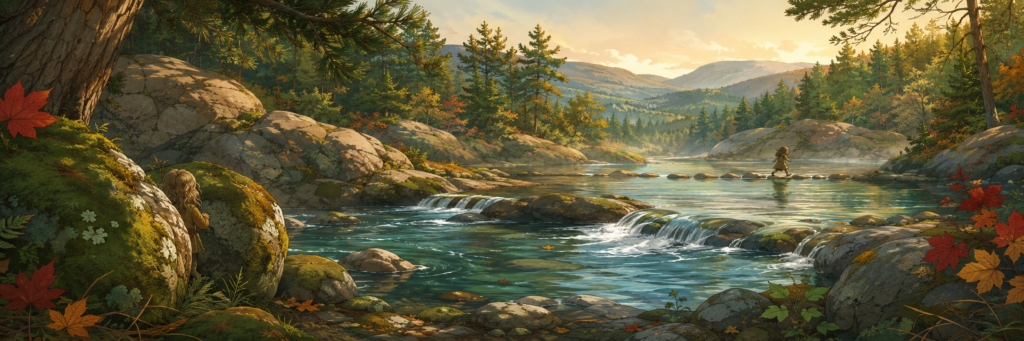
Years ago, my family owned a cottage near Saint-Pierre-de-Wakefield, roughly an hour north of Gatineau, Quebec. The property stood in a rugged landscape of forested hills, exposed rock, and secluded waterways, with a stream passing directly through it. My father spent considerable time there alone, and he described seeing extremely short, long-haired figures near the stream. They did not sound like ordinary children, hikers, or the helpful household spirits commonly found in European fairy tales.
When my father told my mother about the experience, she searched the early internet for anything resembling what he had seen. With far fewer resources available than we have today, the closest term she could find was probably “brownies,” the small supernatural helpers of Scottish folklore. Further research, however, points in a different and considerably more intriguing direction. Stories of small, elusive, humanlike beings associated with riverbanks, waterfalls, rocky hills, caves, and mountains appear in several distinct cultural traditions.
These beings are often described as existing alongside humanity without fully belonging to the ordinary human world. They are not necessarily ghosts, nor are they always portrayed as animals, miniature humans, or imaginary storybook characters. In many traditions, they are more like hidden neighbours of the landscape—capable of appearing physically, yet normally concealed from human perception. The question is not simply whether every story is literally true, but why the same cluster of features continues to appear in such distant places.
At a Glance
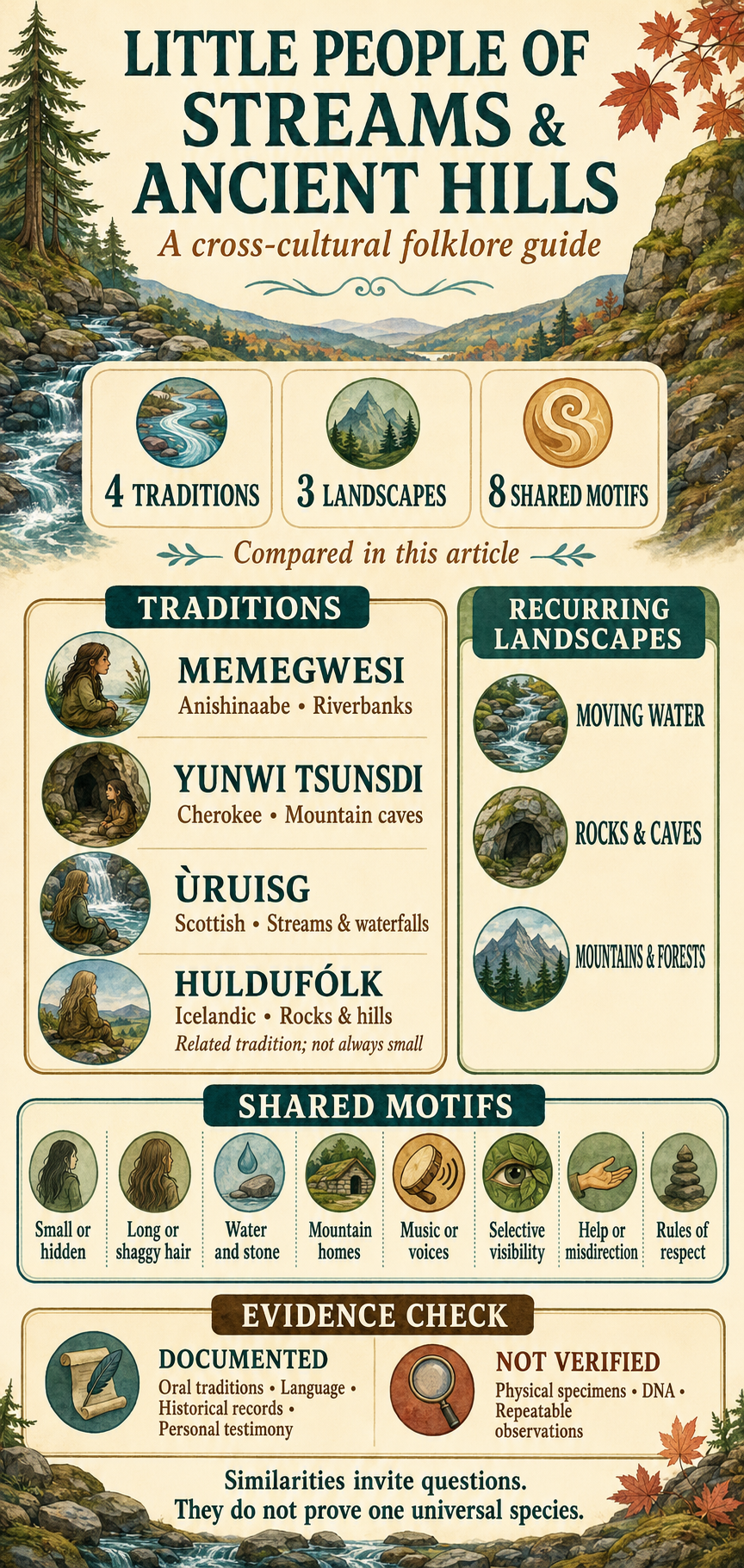
The folklore does not establish that one universal race of Little People exists. It does, however, reveal several recurring patterns worth examining:
- Small humanlike beings are repeatedly associated with riverbanks, streams, waterfalls, caves, cliffs, and mountains.
- Long hair, hairy faces, unusual clothing, and wild appearances occur in several recorded descriptions.
- The beings often reveal themselves selectively rather than remaining constantly visible.
- Respectful people may receive help, while intrusive or disrespectful visitors may become confused, frightened, or lost.
- Many traditions describe them as living communities rather than the spirits of deceased humans.
- There is no authenticated physical specimen or repeatable scientific evidence proving their existence.
- Personal accounts remain culturally and psychologically meaningful even when their cause cannot be verified.
A Strange Encounter in the Gatineau Hills
The setting of my father’s experience deserves attention. Saint-Pierre-de-Wakefield lies in the Gatineau Hills, a landscape of forest, lakes, streams, exposed stone, and sharp changes in elevation. Although people sometimes casually connect these hills with the Appalachians, they are geologically part of the southern Canadian Shield and Laurentian landscape. The National Capital Commission identifies the nearby Eardley Escarpment as the dividing line between the Canadian Shield and the St. Lawrence Lowlands.
This is ancient terrain, shaped by geological upheaval, erosion, and glaciation long before the modern forests appeared. Streams travel through depressions in the rock, vanish beneath vegetation, and emerge into pools and narrow channels. Sound behaves unpredictably in such places, especially when water, wind, trees, and uneven ground combine. It is an environment capable of feeling deeply alive even before anything unusual occurs.
The broader National Capital Region is also situated on the traditional territory of the Algonquin Nation. That does not mean a particular Algonquin tradition can automatically be assigned to whatever my father saw. It does mean that an investigation should look beyond imported European fairy terminology and consider the living Indigenous cultures connected to the land. Once that is done, the resemblance to certain Anishinaabe traditions becomes difficult to overlook.
Little People Are Not Necessarily Ghosts
The word “spirit” can create confusion because it often suggests the soul of a deceased person. Many Little People traditions describe something quite different. These beings may eat, dance, raise families, inhabit settlements, protect particular places, and interact with people under unusual circumstances. They appear to belong to nature while possessing intelligence, personality, and social organization.
Calling all of them “fairies” creates a similar problem. Fairy is a convenient English comparison, but it carries centuries of European imagery that may not belong in an Indigenous cultural context. Likewise, calling them cryptids can reduce a spiritual tradition to a hunt for an undiscovered animal. The most accurate approach is to use each culture’s own name and acknowledge that apparent similarities do not erase important differences.
Nevertheless, one idea recurs: the landscape contains more forms of personhood than human beings ordinarily recognize. A mountain is not merely a pile of stone, and a stream is not simply water passing over gravel. These places can have memory, agency, danger, and unseen inhabitants. That worldview closely expresses the sense that the Little People are “not of this world,” yet somehow deeply embedded within it.
Memegwesi: The Riverbank Connection
One of the closest documented parallels to my father’s description is the memegwesi of Anishinaabe tradition. The University of Minnesota’s Ojibwe People’s Dictionary gives the remarkably specific definition “a hairy-faced bank-dwelling dwarf spirit.” Even in that short description, three important elements appear together: small stature, abundant hair, and residence along a bank.
Memegwesi stories vary by community and should not be flattened into one standardized internet legend. In broader Anishinaabe accounts, they may be associated with waterways, rocky shores, cliffs, medicines, sacred places, and markings on stone. They are often portrayed as elusive and capable of avoiding ordinary observation. Some traditions describe encounters as helpful or protective, while others emphasize the importance of caution and respect.
The linguistic connection must also be handled carefully. Memegwesi is documented in Ojibwe, which belongs to the wider Anishinaabe cultural and linguistic world. It should not be assumed that every Algonquin community uses the identical word or tells identical stories. The resemblance is therefore not an identification of what my father encountered, but it is a meaningful regional comparison.
A short, hairy or long-haired figure beside moving water in Anishinaabe territory is far closer to this tradition than to a domestic Scottish brownie. Location matters in folklore. A being repeatedly connected with riverbanks belongs to a different symbolic and spiritual environment than one said to sweep a farmhouse after everyone has gone to sleep.
The Cherokee Little People of the Appalachians
Farther south, the ancient Appalachian Mountains contain another prominent tradition. The Cherokee name Yunwi Tsunsdi is commonly translated as “Little People.” Contemporary Cherokee cultural material describes them as small humanoid nature spirits who normally remain invisible but may sometimes reveal themselves in miniature, child-sized form.
Ethnographer James Mooney recorded Cherokee accounts in the late nineteenth century and published them in Myths of the Cherokee. In those accounts, the Yunwi Tsunsdi lived in rock caves along mountainsides. They were described as barely reaching a man’s knee, beautifully formed, and possessing extraordinarily long hair that nearly reached the ground. They were also associated with drumming, dancing, mysterious music, powerful abilities, and the protection of people lost in the mountains.
That description is especially striking when compared with an eyewitness report involving very short people with long hair in mountainous terrain. It does not prove that the Gatineau and Cherokee accounts describe the same phenomenon. It does show that the combination of diminutive stature, long hair, rock, wilderness, and selective visibility was recorded well before social media began rapidly blending legends together.
Cherokee tradition also includes the Nunnehi, immortal spirit people connected with mountains, hidden settlements, caves, and elevated places. Nunnehi and Yunwi Tsunsdi are sometimes merged in modern retellings, but they are not interchangeable names. The Yunwi Tsunsdi are specifically the Little People, while Nunnehi traditions describe a broader hidden population whose members are not always miniature.
The Scottish Ùruisg of Streams and Waterfalls
Across the Atlantic, Scottish folklore offers a surprisingly close water-related parallel. The ùruisg, anglicized as urisk, was distinguished by folklorist John Gregorson Campbell from the household brownie. While brownies belonged around houses, barns, and farms, the ùruisg inhabited the outdoor wilderness—particularly streams, waterfalls, lonely pools, and rocks.
Descriptions vary, but the ùruisg could appear hirsute, shaggy, long-haired, or partly human and partly animal. Some accounts gave it long teeth or claws, while others portrayed a solitary figure sitting on a rock at dusk and watching travellers pass. During warmer months it remained in wild places, although certain stories brought it closer to farms or mills during winter.
The ùruisg demonstrates why the original brownie identification was understandable but incomplete. Older online summaries frequently placed brownies, hobgoblins, fairies, and wild nature beings together. Yet a long-haired figure beside a forest stream fits the ùruisg tradition far more closely than it fits the familiar domestic brownie.
Hidden Neighbours Inside Mountains and Rocks
Not every relevant being is described as extremely small. Icelandic stories of the huldufólk, or Hidden People, speak of humanlike beings living within hills, cliffs, boulders, and lava formations. They maintain homes and communities in a world that occupies the same landscape as humanity but is usually concealed from it.
The huldufólk are useful to this investigation because they express the idea of an adjacent reality rather than a distant supernatural realm. A hill may look like an ordinary geological formation to one observer and the exterior of an inhabited place to another. Stories warn that damaging certain stones or disturbing hidden dwellings may bring consequences. Whether interpreted literally or symbolically, the message is that the visible landscape does not reveal everything it contains.
This pattern also appears in stories of mysterious music coming from hills, voices emerging from rocks, and travellers being unable to relocate an entrance after briefly discovering it. Hiddenness is not merely the result of small size. The beings seem able to control when, where, and to whom they become perceptible.
The Common Features Across These Traditions
When these traditions are placed beside one another, several similarities become apparent:
| Recurring feature | How it appears in the stories |
|---|---|
| Small or concealed bodies | The beings are miniature, knee-high, easily hidden, or invisible unless they choose to appear. |
| Unusually long hair | Hair may reach toward the ground or create a shaggy, wild, partly nonhuman appearance. |
| Streams and riverbanks | Waterways function as homes, meeting places, travel routes, or boundaries. |
| Rocks and caves | Openings in hillsides and formations of stone conceal dwellings or entire communities. |
| Mountains and old forests | Encounters occur away from settlements in places where visibility and navigation are difficult. |
| Music and unusual sounds | Drumming, singing, voices, or movement may be heard without an identifiable source. |
| Selective visibility | A person receives a brief glimpse, but the figure disappears or cannot be found again. |
| Rules of respect | Help may follow humility, while pursuit, ridicule, intrusion, or destruction invites trouble. |
These commonalities are intriguing, but similarity alone is not proof of a single hidden species. Human beings everywhere share certain psychological tendencies and encounter comparable natural conditions. Independent cultures can develop similar narratives around caves, dangerous water, unexplained sounds, and glimpses of animals or strangers. Stories can also travel between populations, particularly after migration and colonization.
Still, the resemblance is not meaningless. The comparison becomes more interesting when multiple uncommon features occur together, such as very small stature, long hair, rocky mountain habitat, and a close association with flowing water. At minimum, these traditions show that the image of hidden humanlike neighbours has remarkable endurance.
Why Moving Water Feels Like a Doorway
In folklore and spiritual practice, a liminal place is a threshold between categories: land and water, safety and danger, settlement and wilderness, or the visible and unseen. A stream is never entirely fixed. Its surface changes from moment to moment, while its current carries material and sound from places beyond the observer’s view.
Water also distorts perception. Reflections create figures that vanish when the observer changes position, while mist and spray soften outlines. Continuous noise can mask footsteps, animal calls, and the direction from which a sound originated. Vegetation along a riverbank repeatedly conceals and reveals movement, sometimes allowing only a fraction of a second to interpret what passed between the trees.
These natural properties help explain why waterways attract supernatural stories without proving that every encounter was an illusion. Symbolically, water is also life-giving and dangerous. A hidden being near a stream can function as a guardian, a warning, a guide, or an embodiment of the water’s unpredictable character.
The statement that moving water attracts spirits belongs to spiritual belief rather than established science. No controlled evidence demonstrates that a flowing stream increases supernatural activity. What can be established is that streams are repeatedly treated as spiritually powerful locations, and that their physical conditions produce exactly the fleeting, ambiguous experiences from which legends can grow.
Why Little People Belong to Mountains
Mountains create another kind of threshold. Caves lead into darkness, ridgelines separate watersheds, and steep terrain turns a short distance into an invisible world. Echoes produce sounds without obvious sources, while cliffs and dense trees allow a person or animal to disappear almost instantly.
Ancient hills also evoke deep time. The Canadian Shield beneath the Gatineau landscape is vastly older than human civilization, while the Appalachians are the eroded remains of mountains that were once much taller. People standing in these landscapes often experience awe: the psychological combination of wonder, beauty, smallness, and uncertainty. Stories give personality to that experience by imagining older inhabitants who know the land better than we do.
Little People are especially suited to this environment because their scale mirrors the concealed openings in rock, gaps beneath roots, and narrow paths followed by water. They are close enough to humanity to be recognizable but different enough to represent the wilderness beyond human control. Their size is therefore not necessarily a sign of weakness; many traditions give them unusual strength, knowledge, or spiritual power.
What Evidence Actually Exists?
The available evidence falls into three very different categories:
- Documented cultural evidence: Indigenous languages, oral histories, historical ethnographies, place-based traditions, and European folklore collections confirm that people genuinely told—and continue to tell—these stories.
- Personal testimony: Witnesses report seeing small figures, hearing unexplained voices or music, or experiencing disorientation in the associated landscapes.
- Physical evidence: No authenticated body, DNA sample, habitation, tool assemblage, or clear sequence of independently verified recordings has demonstrated the existence of a nonhuman population of Little People.
An eyewitness account is evidence that someone experienced something; it is not automatically proof of the witness’s interpretation. Memory can preserve important details while changing others, especially when an event is discussed repeatedly over many years. Poor light, peripheral vision, distance, expectation, fatigue, and unfamiliar animals can all contribute to misidentification. These possibilities deserve consideration without accusing an observer of dishonesty.
The spiritual interpretation is different from a biological cryptid hypothesis. If these beings are thought to become visible only under certain conditions, move between levels of reality, or influence perception, conventional searches may never capture them. That idea preserves the mystery but also makes the claim difficult or impossible to test. It should therefore be presented as metaphysical speculation rather than scientific evidence.
The most balanced conclusion is neither “every story proves Little People exist” nor “every witness imagined it.” Human perception is imperfect, but people also encounter events they cannot readily explain. The unknown remains unknown until adequate evidence supports a specific conclusion.
How to Approach an Unusual Encounter
Anyone who sees something strange near a stream or in mountainous terrain should begin with physical safety. Fast water, unstable rocks, sudden drop-offs, and the temptation to pursue a disappearing figure create genuine hazards. An unexplained sighting is not worth a serious fall or becoming lost after dark.
If circumstances allow, record the time, weather, light, distance, duration, movement, colour, and surrounding sounds before discussing possible explanations. Avoid chasing the figure, entering caves, trespassing, removing objects, or disturbing rock formations. Photographs and video are useful, but preserving an exact description before memory is influenced by other stories can be even more valuable.
Cultural respect matters as well. Sacred Indigenous traditions should not be converted into monster-hunting entertainment, and offerings should not be left at culturally significant places without guidance from the appropriate community. Exact locations may also deserve privacy when public attention could damage an ecosystem, archaeological site, or sacred landscape.
The Mystery Living Beside the Stream
My father’s experience cannot now be conclusively identified. It may have involved an animal, an unusual combination of light and movement, unfamiliar people passing through the property, or something for which we do not have a conventional explanation. The passage of time makes certainty even less likely.
Yet the story becomes more—not less—interesting when placed in its proper context. A description of very short, long-haired figures beside a stream in the Gatineau Hills resembles an Anishinaabe riverbank tradition, a Cherokee account of long-haired Little People in mountain caves, and a Scottish nature being associated with streams and waterfalls. None of those parallels proves that the same entity appeared in Quebec, but together they reveal a deep and persistent human awareness of hidden life within the landscape.
Perhaps Little People are spiritual guardians, inhabitants of an adjacent reality, memories encoded in cultural tradition, or enduring symbols of nature’s refusal to be completely understood. Perhaps some encounters arise when water, darkness, isolation, and human perception briefly combine to produce something extraordinary. Whatever the answer, streams and ancient hills continue to feel like boundaries—places where the familiar world grows thin and another possibility seems to move just beyond the trees.
- Ojibwe People’s Dictionary: Memegwesi — Explore the University of Minnesota’s linguistic documentation of this Anishinaabe riverbank spirit.
- Visit Cherokee: Cherokee Culture — Learn how the Eastern Band of Cherokee Indians presents the Yunwi Tsunsdi and other cultural traditions.
I genuinely believe that creatures like this exist and running water acts as a portal between worlds. The creatures are just from another dimension is all.