
Did Giants Once Walk the Earth? Evidence vs. Legend
For thousands of years, civilizations separated by oceans, languages, and entire eras have told stories about giants. The Hebrew Bible describes the Nephilim and formidable warriors such as Goliath. The Book of Enoch expands this into a disturbing account of rebellious Watchers whose offspring terrorized humanity. Greek mythology speaks of Titans and Gigantes, while Norse traditions describe the powerful jötnar who existed before the familiar order of gods and humans.
Then there are the physical claims. Throughout the nineteenth and early twentieth centuries, American newspapers published reports of enormous skeletons being removed from caves, burial grounds, and Indigenous earthworks. Some allegedly measured seven or eight feet tall; others were said to be ten feet or more. The remains were frequently described as having unusual skulls, massive jaws, double rows of teeth, or six fingers—and many stories concluded with the bones being sent to a museum, university, or the Smithsonian Institution, never to be seen again.
Were all these accounts exaggerations, mistaken measurements, and hoaxes? Or could a genuine mystery be buried beneath the layers of folklore and sensational reporting? The responsible answer is more interesting than either blind belief or automatic dismissal.
Quick Answer: Is There Proof That Ancient Giants Existed?
The answer depends entirely on what we mean by a “giant.”
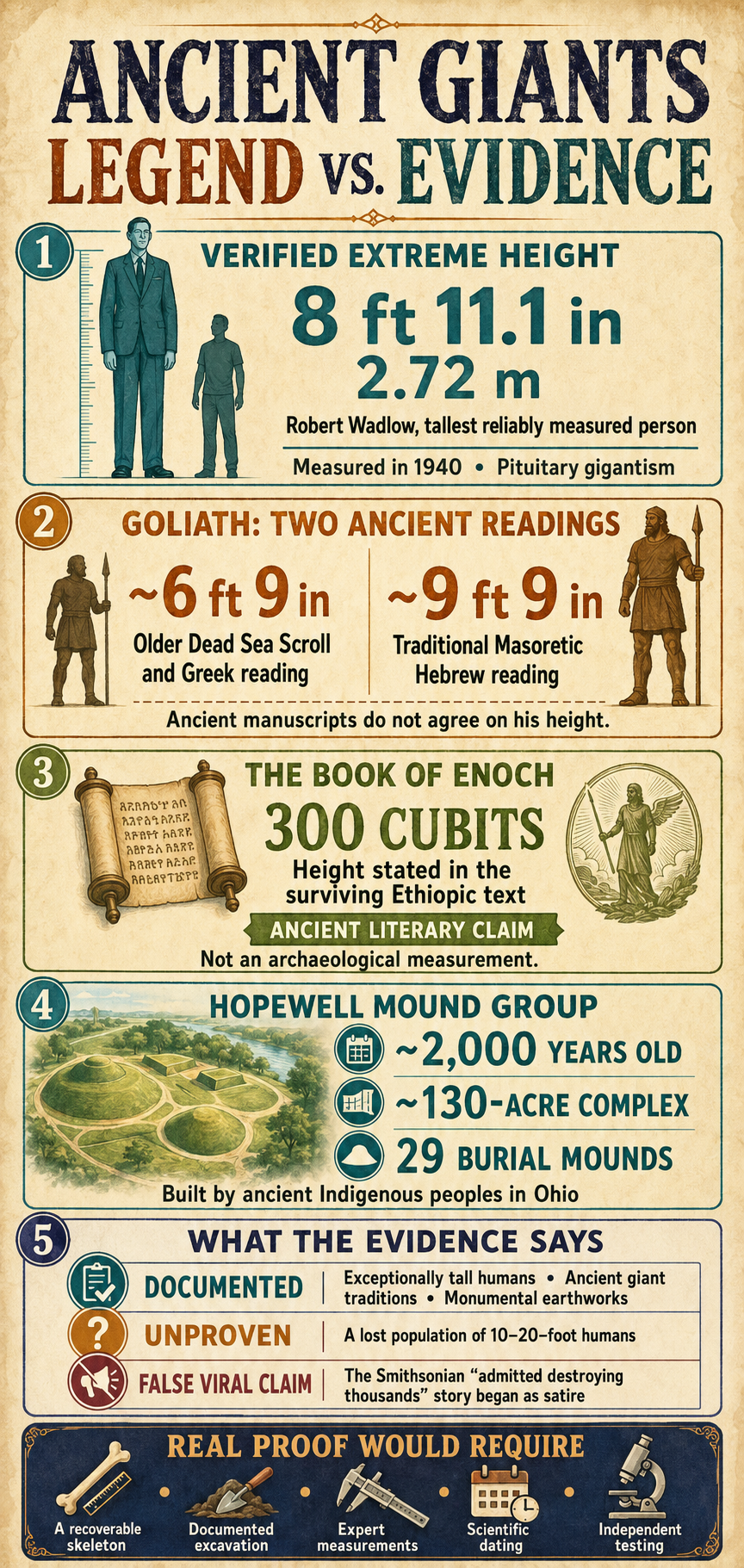
There is unquestionable proof that exceptionally tall human beings can exist. Robert Wadlow, the tallest reliably measured person in modern history, reached 8 feet 11.1 inches, or 2.72 metres. His extraordinary growth resulted from a disorder of the pituitary gland that caused excessive production of human growth hormone. Therefore, an ancient individual standing seven, eight, or possibly close to nine feet tall is biologically possible.
What has not been established is the existence of an ancient population of ten-, twelve-, or twenty-foot humans. No enormous human skeleton with a thoroughly documented excavation, secure chain of custody, independent anatomical examination, and reliable scientific dating has been made available for study.
The evidence currently falls into four different categories:
- Ancient religious and mythological traditions describing giant beings
- Historical newspaper stories and early excavation reports
- Documented individuals with gigantism or exceptional natural height
- Modern claims involving missing skeletons, altered photographs, and institutional cover-ups
These categories should not be treated as equally strong evidence. A verified skeleton and an anonymous newspaper story may both be intriguing, but they do not carry the same evidential weight.
What Did Ancient People Mean by “Giants”?
The modern imagination tends to picture a giant as an oversized human who could look into a second-storey window. Ancient texts were not always that precise. Words translated as “giant” could describe someone of unusual height, a legendary warrior, an ancestral people, a supernatural being, or an enemy remembered as overwhelmingly powerful.
That distinction matters. A six-foot-nine warrior living among people who were substantially shorter on average would have appeared enormous. His physical presence, armour, reputation, and battlefield victories could gradually transform him into something more than human in the stories told about him.
Ancient writers also used physical size symbolically. Giants often represented uncontrolled violence, pride, chaos, or the dangerous world that existed before divine or human order was established. A text can preserve historical memories while also using exaggeration and symbolism. Those possibilities are not mutually exclusive.
The Nephilim and the Book of Enoch
The most influential biblical reference appears in Genesis 6:1–4. It describes the “sons of God” taking human women as wives and mentions the Nephilim being on the Earth “in those days—and also afterward.” The passage is remarkably brief, leaving major questions unanswered. Who were the sons of God? Were the Nephilim their offspring? Were they physically enormous, spiritually corrupted, or simply powerful warriors?
The Hebrew word Nephilim is rare and its precise meaning remains disputed. It has commonly been translated as “giants,” particularly through the influence of older English Bible translations, although interpretations such as “fallen ones” have also become popular. Genesis later connects the Nephilim with the Anakim in the report of the spies sent into Canaan, who claim that they felt like grasshoppers in comparison.
The Book of Enoch, or 1 Enoch, turns the brief Genesis passage into an elaborate cosmic rebellion. In its Book of the Watchers, heavenly beings descend to Earth, take human wives, and produce destructive giant offspring. The Watchers also reveal forbidden knowledge involving weapons, sorcery, ornamentation, and celestial mysteries. Their interference corrupts both humanity and the natural order, helping to explain why divine judgment and the Flood become necessary.
The surviving Ethiopic text contains an astonishing measurement of 300 cubits for the giants. If converted literally, that would make them hundreds of feet tall. Such a body would be physically impossible under normal earthly conditions, and scholars have long debated whether the number reflects literary hyperbole, textual corruption, or problems that arose as the work moved through different languages and manuscript traditions.
That does not make the Book of Enoch unimportant. Aramaic fragments discovered among the Dead Sea Scrolls demonstrate that Enochic literature is genuinely ancient and was influential in Second Temple Judaism. The complete work is preserved in Geʽez and remains part of the scriptural tradition of the Ethiopian Orthodox Tewahedo Church, although most Jewish and Christian traditions do not include it in their biblical canon.
Enoch therefore provides strong evidence that belief in primordial giants was established in ancient Jewish thought. It does not, by itself, provide archaeological proof that the beings it describes existed as literal biological organisms. Its real power lies in how it transforms the giants into consequences of a forbidden crossing between the heavenly and human worlds.
Goliath and the Problem of Changing Measurements
Goliath appears to offer a more realistic example, but even his height depends on which ancient manuscript is consulted. The traditional Masoretic Hebrew text describes him as six cubits and a span, often calculated at approximately nine feet nine inches. Some older textual witnesses, including a Dead Sea Scroll manuscript of Samuel and major versions of the Greek Septuagint, instead give four cubits and a span—approximately six feet nine inches.
Either measurement would have made Goliath an intimidating warrior in his historical setting. The disagreement also demonstrates why ancient measurements cannot always be accepted without examining the manuscript history behind them.
A very tall warrior could be historical even if details of his stature grew during centuries of transmission. Alternatively, the larger reading may preserve an older tradition that some manuscripts reduced. The surviving evidence does not let us reconstruct Goliath’s medical chart, but it warns against treating one familiar English translation as a precise modern measurement.
The Giant Skeleton Reports From American Mounds
The American giant-skeleton stories are especially compelling because they do not come only from ancient mythology. Hundreds of reports appeared in local newspapers during the nineteenth and early twentieth centuries. Farmers, labourers, amateur antiquarians, and occasionally government-linked investigators claimed to discover large human bones in caves, stone chambers, and burial mounds throughout the Ohio and Mississippi river valleys.
The earthworks themselves are real and extraordinary. Hopewell, Adena, Mississippian, and other Indigenous cultures constructed immense ceremonial spaces, burial mounds, geometric enclosures, and platform mounds. Some sites required advanced planning, large cooperative workforces, extensive trade networks, and sophisticated knowledge of the surrounding landscape and celestial cycles.
Unfortunately, early excavations were often destructive. People tunnelled into mounds looking for valuables, removed ancestral remains without modern documentation, and displayed human bones as curiosities. Measurements might be taken after a skeleton had collapsed, shifted, deteriorated, or become separated. A row of displaced bones could easily produce an exaggerated estimate of total height.
The Criel Mound in West Virginia shows how a story can change as it is repeated. A large central skeleton was discovered surrounded by ten other burials arranged in a spoke-like pattern. Later versions sometimes claimed the central figure stood seven feet four inches or even seven feet six inches. An account from someone involved in the excavation gave the more specific measurement of six feet eight and three-quarter inches, while official documentation warned that pressure and movement within the burial could have exaggerated the apparent length.
That individual may still have been unusually tall and socially important. The burial arrangement is genuinely fascinating. But a tall person at the centre of an elaborate mortuary structure is not proof of a separate race of supernatural giants.
The Strange Case of the “Horned Giants”
Another revealing episode occurred in Pennsylvania’s Susquehanna Valley. A 1916 newspaper story reported the excavation of 68 skeletons averaging approximately seven feet tall, some supposedly possessing horn-like projections extending from their skulls. The investigators named in the article included recognized figures connected with archaeology and historical research, giving the report an appearance of authority.
Later investigation of excavation records found a much less sensational explanation. Deer antlers had apparently been placed above one of the burials. A comment about “horns” was misunderstood—or deliberately turned into a joke—and the story grew into the discovery of horned human skulls. The researchers’ surviving notes did not describe a race of horned giants.
This case illustrates a recurring pattern. The sensational version travels widely, while the correction receives little attention. A century later, the original headline can be rediscovered online without the quieter follow-up, making a resolved mistake appear to be an unsolved archaeological mystery.
Why the Old Newspaper Stories Still Matter
It would be a mistake to say that every giant report was fabricated. Many clippings are authentic historical documents, and some Smithsonian-era reports really did describe large or unusually built individuals. The question is not whether the words were printed; the question is whether the measurements and interpretations can be independently verified.
Nineteenth-century newspapers routinely reprinted stories from distant publications, sometimes without contacting the original witnesses. Competitive papers also wanted material that was dramatic, strange, and likely to sell copies. Giant skeletons, sea monsters, underground cities, and mysterious ancient civilizations were perfect subjects.
Several explanations can account for individual reports:
- A genuinely tall human being was discovered and later exaggerated.
- A skeleton was incorrectly reconstructed from scattered bones.
- Large animal or fossil bones were mistaken for human remains.
- The reporter misunderstood technical information.
- A newspaper copied an unverified story from another publication.
- A promoter manufactured a discovery to attract visitors or sell tickets.
- Human remains deteriorated, were reburied, repatriated, lost, or absorbed into poorly catalogued collections.
The existence of numerous reports is worth studying, but repetition does not automatically create independent confirmation. Fifty newspapers reprinting one original story still represent one unverified source.
Did the Smithsonian Hide or Destroy the Evidence?
The Smithsonian occupies a central position in the modern giant narrative. Old stories frequently end with remains being “sent to the Smithsonian,” after which the trail disappears. This creates a powerful impression: discoveries were common until a major institution obtained the evidence and removed it from public view.
There are legitimate reasons to criticize early collecting practices. Museums accumulated enormous quantities of Indigenous human remains, excavation records were inconsistent, and objects could be transferred, mislabelled, stored, or separated from their original documentation. The history of archaeology includes grave robbing, cultural prejudice, institutional arrogance, and serious mistreatment of Indigenous communities. Skepticism toward old institutions did not arise from nothing.
However, the widely circulated claim that the Smithsonian admitted destroying thousands of giant skeletons after a United States Supreme Court ruling is false. That story originated on a website that described its material as satirical and fictional. The supposed court case has no supporting record, and images accompanying modern versions of the claim were digitally altered or taken from artistic competitions.
A genuine institutional conspiracy would also have to reach far beyond one museum. Archaeologists, construction crews, universities, medical laboratories, local governments, private collectors, and museums around the world continue to discover and examine human remains. A reproducible ten-foot human skeleton would be one of the most important biological discoveries in history. Suppressing every specimen, photograph, scan, field record, and independent analysis across generations would be extraordinarily difficult.
Were the Pyramids Built by Giants?
The enormous scale of ancient architecture naturally inspires giant-builder theories. If a structure seems impossible for ordinary humans, imagining larger or technologically superior builders can feel like a logical solution. Yet the size of a building does not reveal the size of the people who constructed it.
At Giza, archaeologists have discovered worker settlements, food-production areas, tools, work-crew graffiti, cemeteries, and evidence of a highly organized labour system. The Diary of Merer, a papyrus logbook from the reign of Khufu, records a crew transporting limestone by boat from the Tura quarries toward Giza. This is not a complete instruction manual for building the Great Pyramid, but it places ordinary Egyptian administrators and workers directly within the construction network.
Questions remain about the exact combinations of ramps, sledges, levers, waterways, and labour organization used during different phases. Those gaps are genuine and worth investigating. But an unresolved engineering detail is not positive evidence for giants.
Ancient people had generations of accumulated experience, centralized resources, skilled craftspeople, and the ability to mobilize large workforces. Attributing their achievements to giants can unintentionally erase the ingenuity of the human societies whose tools, settlements, writings, and remains are actually present at the sites.
The Strongest Case for a Historical Core
The most defensible giant theory is not that 20-foot beings constructed the ancient world. It is that rare, exceptionally tall individuals existed in ancient populations and became the foundation for larger legends.
Modern history proves that human beings can approach nine feet in height, although such extreme growth often brings severe health problems. An ancient person standing seven or eight feet tall would have dominated the physical and psychological landscape of a smaller community. If that individual were also a ruler, warrior, or member of an elite lineage, stories about them could grow for centuries.
The ancient giant traditions might therefore preserve several ingredients at once:
- Memories of exceptionally tall individuals
- Encounters with physically imposing rival populations
- Fossil bones mistakenly interpreted as human ancestors
- Symbolic stories about chaos, violence, and divine rebellion
- Deliberate exaggeration used to magnify legendary heroes and enemies
This middle position does not explain every tradition, but it fits the evidence better than either extreme. It allows for historical people behind some stories without pretending that mythology functions like an anatomical report.
How to Evaluate the Next Giant Discovery
A legitimate discovery should become stronger as more information is released. A weak claim usually becomes vaguer, changes location, relies on dramatic photographs, or ends with the evidence conveniently disappearing.
Before accepting a giant-skeleton story, look for:
- A documented excavation context: Who found the remains, where were they located, and were qualified specialists present?
- A recoverable specimen: Is the skeleton catalogued in a known collection where independent researchers can examine it?
- An osteological report: Were the bones measured individually by a trained biological anthropologist instead of being arranged on the ground and estimated?
- Scientific dating: Is there reliable radiocarbon dating or another method connecting the remains to the claimed period?
- Unaltered images and scans: Are there original high-resolution photographs, radiographs, CT scans, or three-dimensional models?
- Independent confirmation: Have specialists from more than one institution reached similar conclusions?
- A clear distinction between height and ancestry: Even an authentic eight-foot skeleton would demonstrate an extraordinary individual—not automatically a lost civilization or supernatural bloodline.
These requirements are not designed to make alternative theories impossible. They are what would allow a discovery to survive criticism and permanently change our understanding of human history.
So, Did Giants Once Walk the Earth?
Exceptionally tall people unquestionably have walked the Earth. Some ancient societies probably encountered individuals who would still be considered giants today, and those encounters may survive inside religious traditions, heroic legends, and local histories. The possibility of an undiscovered unusually tall ancient individual is entirely reasonable.
The evidence for a lost population of enormous humans is far weaker. The most dramatic skeletons lack secure specimens, reliable measurements, or independent scientific analysis. Some famous examples collapse into misidentification, exaggeration, poor excavation, or outright fabrication when their origins are traced.
Yet the giant question remains valuable because it exposes something deeper about history. Institutions can make mistakes, accepted interpretations can change, and ancient texts sometimes preserve memories that scholars initially overlook. At the same time, rejecting an official explanation does not automatically make the most exciting alternative true.
The honest conclusion is neither “giants have been completely proven” nor “every giant tradition is meaningless.” There is a fascinating historical core surrounded by layers of mythology, sensational journalism, genuine archaeological loss, and modern conspiracy culture. Until a well-documented extraordinary skeleton can be independently studied, the race of ancient giants remains an intriguing possibility in storytelling—but an unproven claim in archaeology.
- Giant Claims, Biblical Traditions, and the Smithsonian — This peer-reviewed study examines Nephilim traditions, giant-skeleton media, altered evidence, and Smithsonian cover-up narratives.
- Harvard University Digital Giza Project — Explore archaeological records, research material, and digital reconstructions relating to the Giza pyramids and surrounding settlements.
Ye I don’t believe giants existed. The human body starts piling up health problems the bigger people get. Random super tall people or villages with very tall genetics is more likely. Actually I think there is a village in China where almost everyone is under 5 feet. There’s no reason the same could have happened for very tall people.