
The Secret Book of John: A Journey Into the Hidden Gnostic Creation Story
Among the ancient writings that disappeared from mainstream Christianity, few are as ambitious, strange, or thought-provoking as the Secret Book of John. Also known as the Apocryphon of John or the Secret Revelation of John, it presents an alternative account of creation, humanity, evil, spiritual imprisonment, and salvation. It does not merely add a few forgotten sayings of Jesus to the familiar biblical story. It reconstructs the entire spiritual universe.
In this text, the physical world is not created directly by the highest God. Humanity possesses a spark that originated beyond the visible cosmos. The creator who declares himself to be the only god is portrayed as ignorant of a greater divine reality above him. Jesus appears not primarily to establish an institution, but to awaken John to knowledge that has supposedly been concealed from ordinary human beings.
That understandably makes the Secret Book of John sound like the ultimate “forbidden book.” The real history, however, is more interesting than the conspiracy theories. It was an influential expression of early Gnostic Christianity, survived in several ancient manuscripts, and preserves one of the most complete alternative interpretations of Genesis known from the ancient world.
The Secret Book of John at a Glance
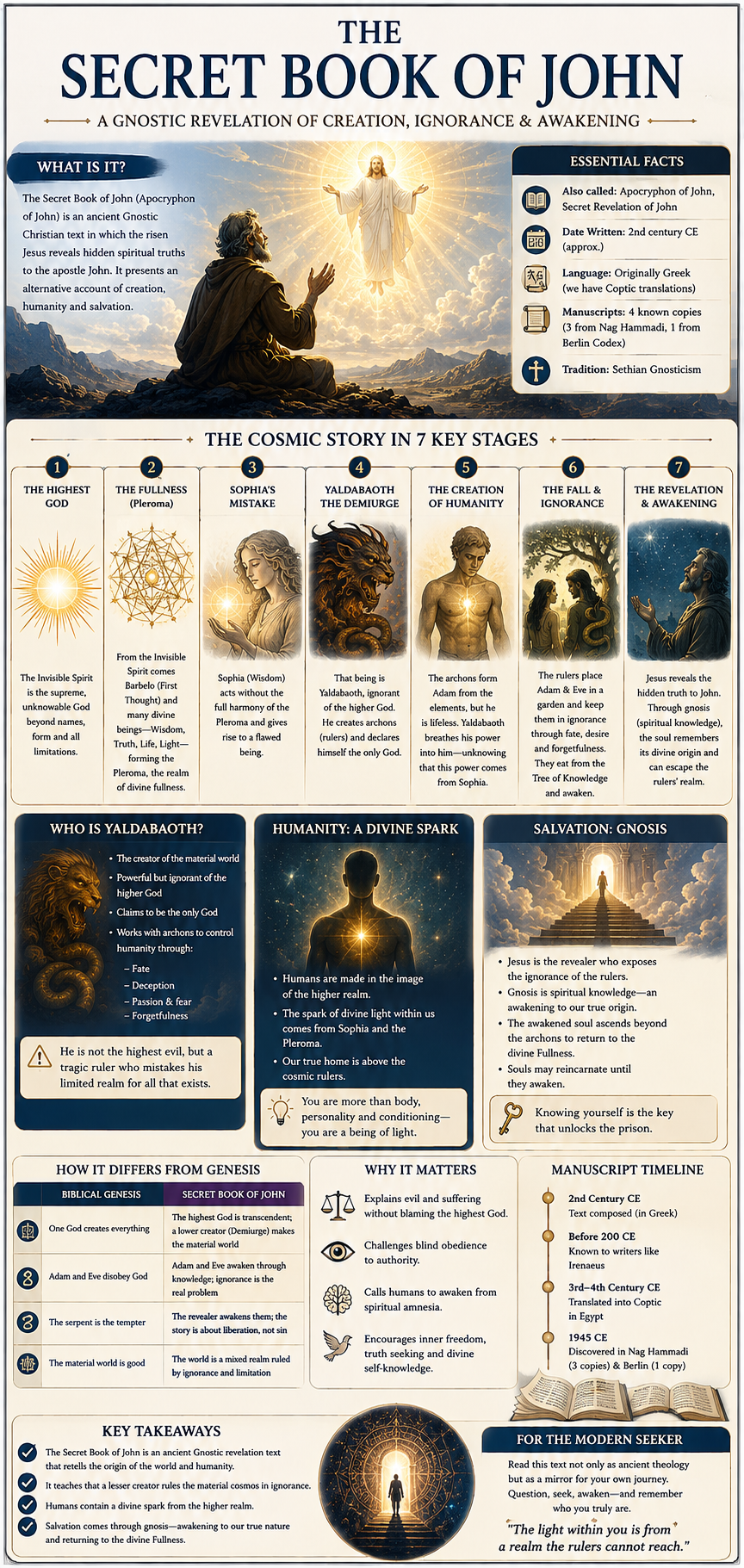
The Secret Book of John can be summarized as an ancient revelation dialogue in which the risen Jesus explains the hidden structure of reality to the apostle John.
Its central teachings include:
- The highest God is an invisible, unknowable Spirit beyond ordinary description.
- A divine realm of spiritual beings, powers, and qualities emanates from this supreme source.
- Sophia, whose name means “Wisdom,” produces a being without the proper harmony of the divine realm.
- That being, called Yaldabaoth, becomes the creator or Demiurge of the material cosmos.
- Yaldabaoth and his rulers attempt to control humanity through ignorance, imitation, fate, and forgetfulness.
- Human beings nevertheless contain spiritual power originating in the higher divine realm.
- Salvation comes through gnosis, an awakening knowledge of one’s true origin and relationship with the divine.
The work is normally associated with the tradition scholars call Sethian Gnosticism, although categories such as “Gnostic” and “Sethian” are modern scholarly tools rather than perfectly defined names for a single organized religion. The text combines Christian revelation, Jewish interpretation of Genesis, philosophical concepts, mystical speculation, and an elaborate mythology of spiritual beings.
What Is the Secret Book of John?
The word apocryphon comes from a Greek term meaning something hidden, concealed, or secret. In this context, it refers to a writing presented as containing teachings that were not publicly revealed. The title therefore does not necessarily mean that authorities physically locked the book away. It means that the work claims to communicate deeper mysteries intended for those prepared to receive them.
The Secret Book of John is written as a pseudepigraphical work. Pseudepigraphy was the ancient practice of writing in the name of an honoured figure from the past, often to place a teaching within that person’s spiritual or intellectual tradition. The text attributes its revelation to John, the son of Zebedee, but historians do not regard the apostle John as its actual author.
Most scholars place its composition sometime during the second century, although the text probably developed through more than one stage. A form of its mythology appears to have been known to the Christian writer Irenaeus of Lyons before the end of the second century. The surviving manuscripts, however, are later Coptic translations of an earlier Greek work that is now lost.
This distinction matters. The surviving physical books are not original copies written shortly after the lifetime of Jesus. They are later manuscripts preserving a substantially older composition. As with many ancient works, scholars must compare surviving versions, translation choices, damaged passages, editorial additions, and quotations found in other writers to reconstruct its history.
How the Text Survived
The Secret Book of John is unusually well preserved compared with many other alternative Christian writings. Four Coptic manuscript witnesses survive: three from the Nag Hammadi collection and one from the Berlin Codex, generally known as Papyrus Berolinensis 8502. Two represent a shorter form of the text, while two preserve a longer version containing additional material.
The Berlin Codex became known to scholars before the Nag Hammadi discovery, although its contents were not published promptly. The three Nag Hammadi copies were found among a collection of papyrus codices discovered near Nag Hammadi in Upper Egypt in December 1945. These codices contained dozens of ancient religious and philosophical writings translated into Coptic, many of which had previously been known only through hostile descriptions written by their opponents.
The multiple copies tell us something important. Ancient books had to be copied individually by hand, requiring materials, literacy, labour, and access to an existing manuscript. The presence of several versions suggests that the Secret Book of John was valued and transmitted repeatedly within at least some ancient communities.
The versions are not identical. Scholars recognize both shorter and longer recensions, meaning distinguishable editions of the work. This suggests that the text was not produced once in a final, unchanging form. It grew, circulated, and was edited as different readers attempted to preserve, clarify, or expand its teachings.
The Revelation Begins With a Crisis of Faith
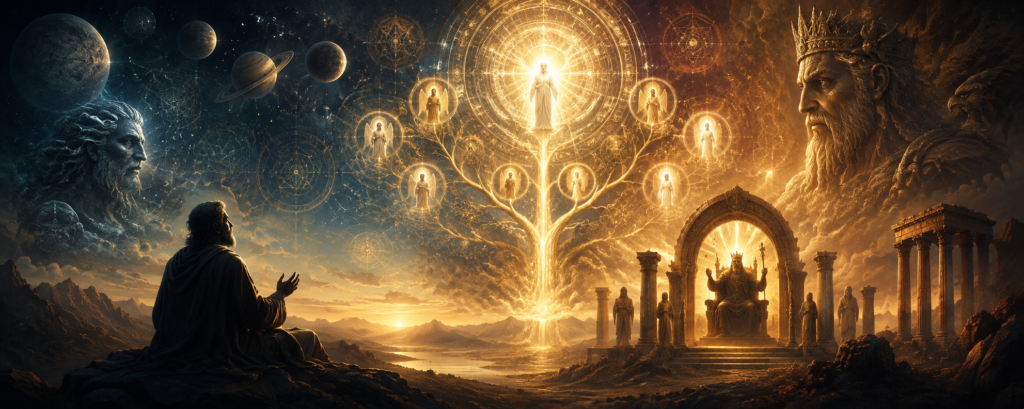
The story opens after the crucifixion of Jesus. John encounters a man who challenges him and mocksingly questions the teacher he followed. Troubled by the encounter, John withdraws to a mountainous or deserted place, grieving and questioning what Jesus’ mission truly meant.
At this moment of confusion, the heavens open and the Saviour appears. His form changes as John looks at him. He seems young and old, singular and multiple, human and luminous. The effect is deliberately disorienting: John is being shown that the true revealer cannot be contained within an ordinary physical form.
Jesus reassures John and begins explaining the realities that exist beyond the visible world. The remainder of the text becomes a vast revelation about the supreme God, the generation of divine beings, the origin of the material cosmos, the creation of Adam and Eve, and the spiritual forces competing for humanity.
The narrative frame is psychologically significant. John receives revelation only after his assumptions have collapsed. His certainty has been replaced by confusion, and confusion creates the opening through which a deeper explanation can enter. For ancient readers, John’s crisis may have reflected their own struggle to understand suffering, injustice, religious conflict, and the apparent distance between a perfect God and an imperfect world.
The Invisible Spirit Beyond All Description
At the summit of the Secret Book of John’s spiritual universe is the Invisible Spirit. This ultimate reality is not simply a powerful supernatural person living somewhere above the clouds. It exists beyond ordinary categories, limitations, names, measurements, opposites, and physical characteristics.
The text describes the supreme source through a form of theology called apophatic theology, or negative theology. Instead of defining God by saying exactly what God is, it explains what cannot properly be said about the divine. The Invisible Spirit is not limited, measurable, changeable, material, or dependent upon anything else.
This approach has parallels in several ancient philosophical and mystical traditions. The ultimate source of reality is considered so far beyond human language that every description risks reducing it to something smaller. The text therefore surrounds the highest God with expressions of silence, immeasurability, perfection, light, and incorruptibility.
From this unknowable source emerges Barbelo, often described as the First Thought, Forethought, or first emanation of the Invisible Spirit. Barbelo is presented using both masculine and feminine imagery and becomes central to the unfolding divine realm. Through Barbelo appear further divine qualities and beings, including foreknowledge, incorruptibility, eternal life, truth, and the self-generated divine figure often called Autogenes or Christ.
These beings inhabit the Pleroma, a term meaning fullness. The Pleroma is not merely another physical location. It is the harmonious fullness of divine reality, contrasted with the fractured and unstable world that will emerge below.
Sophia’s Mistake and the Birth of Yaldabaoth
The great disruption begins with Sophia, the divine figure whose name means Wisdom. Sophia attempts to bring forth something independently, without the cooperation or harmonious consent that characterizes the higher realm. Her action produces an incomplete and distorted being.
That being is Yaldabaoth, one of the most memorable figures in Gnostic literature. He is sometimes described with imagery resembling a lion-faced serpent. Sophia recognizes that her offspring is unlike the beings of the divine fullness, so she conceals him away from the higher realm.
Yaldabaoth possesses power inherited from his mother, but he does not understand where that power came from. Unaware of the reality above him, he creates subordinate rulers known as archons, a Greek term meaning rulers or authorities. With their assistance, he organizes the heavens and the material cosmos.
Yaldabaoth then makes his defining declaration: he claims to be God and believes that no other god exists. In the logic of the Secret Book of John, this statement does not demonstrate his supremacy. It exposes his ignorance. A truly omniscient being would know about the divine realm above, while Yaldabaoth’s boast reveals that he cannot see beyond the boundaries of his own creation.
The text therefore offers a striking answer to the problem of evil. The perfect and transcendent God did not directly design a world filled with suffering, death, conflict, and confusion. The material system was organized by a limited creator who possesses power but lacks full knowledge of the divine.
The Demiurge and the Rulers of the World
The word Demiurge originally referred to a craftsman or maker. In Plato’s Timaeus, the Demiurge is a largely benevolent cosmic organizer. Several Gnostic systems transformed the idea, presenting the creator of the material world as ignorant, arrogant, defective, or openly hostile.
Yaldabaoth is not the equivalent of the ultimate devil in every respect. He creates and governs, establishes authorities, and imposes order. His fundamental problem is that his order is based on imitation and ignorance. He mistakes a partial realm for the whole of reality and demands recognition as its supreme ruler.
The archons assist him in administering the cosmos. Depending on how the text is interpreted, they may symbolize spiritual powers, cosmic forces, oppressive authorities, planetary fate, psychological limitations, or some combination of these. Ancient readers may have understood them more literally than many modern readers do.
The Secret Book of John portrays their system as one of control through fate, deception, bodily limitation, and forgetfulness. Human beings are kept from recognizing the source of the light within them. The prison is therefore not made only of matter. It is also made of ignorance.
The Creation of Adam
The rulers eventually perceive an image of the divine human reflected from the world above. They decide to create a being based upon what they have seen, declaring that they will make a human according to the image and likeness they observed.
They construct Adam’s body piece by piece, assigning different powers to its various parts. The longer version of the text includes an extensive catalogue of spiritual authorities connected with the human body. Yet when the rulers finish their creation, Adam remains lifeless and unable to rise.
The higher realm then uses the rulers’ arrogance against them. Yaldabaoth is encouraged to breathe his spiritual power into Adam. Because that power ultimately came from Sophia, a portion of the higher light enters the human being.
Adam immediately reveals an intelligence greater than that of his makers. Alarmed by his superiority, the rulers cast him into the lower material condition and attempt to keep him unaware of his origin. Humanity is therefore portrayed as a strange mixture: formed within the rulers’ world but animated by a power that exceeds it.
This is one of the text’s most enduring ideas. Human beings may appear weak, confused, and trapped within systems they did not create, but their deepest identity does not belong entirely to those systems. Something within them comes from beyond the authority of the world’s apparent rulers.
Adam, Eve, and the Garden Retold
The Secret Book of John repeatedly revisits the opening chapters of Genesis, sometimes directly rejecting the traditional interpretation with statements equivalent to “It did not happen as Moses said.” Its goal is not simply to deny Genesis, however. It treats the familiar story as an outer narrative concealing a deeper spiritual conflict.
The rulers place Adam in paradise, but this paradise is not presented as an entirely benevolent garden. Its beauty conceals manipulation, limitation, and spiritual sleep. Adam is offered delights while being prevented from understanding his actual condition.
A divine power associated with Epinoia, meaning insight or awakened thought, assists humanity from within. Eve’s emergence is connected with an attempt to recover spiritual power from Adam, but the plan of the rulers does not succeed as intended. The higher spiritual presence continues working through Eve, making her far more than the passive or gullible figure she became in some later interpretations.
The treatment of the Tree of Knowledge and the serpent is complex and varies in emphasis across translations and passages. The Tree of Knowledge is associated with illuminating insight, but the serpent is not presented as a straightforward hero in every part of the account. The revealer awakens Adam and Eve toward knowledge, while the lower powers also manipulate desire, reproduction, and bodily attachment for their own purposes.
What remains clear is that the text reverses much of the conventional moral map. The desire to know is not humanity’s fundamental crime. Ignorance is the deeper danger. The rulers fear knowledge because knowledge allows human beings to recognize the limitations of those who claim authority over them.
Why the World Feels Wrong
The mythology of the Secret Book of John attempts to answer a difficult spiritual question: If the highest reality is perfect and good, why does human existence feel so fractured?
Its answer is that the visible world is separated from the fullness of its divine source. Creation contains traces of beauty, intelligence, and higher light, but it is administered by powers that do not fully understand what they possess. The result is a world that can inspire wonder while also producing suffering, injustice, fear, competition, decay, and death.
This is more nuanced than simply saying that everything physical is evil. Different Gnostic texts treat matter differently, and modern summaries sometimes exaggerate their hostility toward the body. In the Secret Book of John, the central problem is not merely that humans have bodies. It is that spiritual consciousness has become trapped in ignorance, forgetfulness, imitation, and domination.
The myth externalizes a feeling many people still recognize: the suspicion that society’s loudest authorities may not understand the greater reality they claim to control. Yaldabaoth is powerful, but power does not make him wise. He commands obedience, but confidence does not make him correct.
Salvation Through Gnosis
The Greek word gnosis means knowledge, but the salvation described here is not achieved by memorizing secret names or collecting obscure facts. Gnosis is transformative recognition. It is the discovery of where one came from, what forces shaped one’s present condition, and what part of the self remains connected to the divine fullness.
Jesus functions primarily as a revealer. He exposes the ignorance of the rulers and reminds humanity of its spiritual origin. Salvation is therefore described as awakening from sleep, recovering sight, overcoming forgetfulness, and becoming free from the powers that falsely define human identity.
The text also discusses the possible destinations of souls. Souls that awaken and strengthen themselves through spiritual knowledge can escape the rulers’ system. Other souls may be returned to bodily existence until they attain knowledge, while those who deliberately reject truth after fully encountering it receive a darker fate. Scholars have therefore discussed whether the work teaches a form of reincarnation or repeated embodiment.
The longer version concludes with a poetic revelation involving divine Forethought descending into the darkness. This saving presence enters the rulers’ world repeatedly, awakens the forgotten spiritual seed, and leads it through a ritual or symbolic passage associated with the Five Seals.
Is the Secret Book of John Like the Book of Enoch?
The Secret Book of John and the Book of Enoch are often grouped together because both are ancient writings attributed to famous biblical figures and both describe hidden spiritual realities. Beyond that surface resemblance, however, they are very different works.
The Book of Enoch is a collection of Jewish apocalyptic traditions associated with the patriarch Enoch. Important portions originated before Christianity, and fragments of several Enochic works were found among the Dead Sea Scrolls. Its major subjects include the Watchers, rebellious angels, divine judgment, heavenly journeys, cosmic order, and the approaching defeat of wickedness.
The Secret Book of John is a later Christian Gnostic revelation placed in the mouth of the risen Jesus. Its central concern is not the descent of the Watchers but the origin of the creator, the structure of the divine fullness, the spiritual power within humanity, and the hidden meaning of Genesis.
A simple comparison looks like this:
- The Book of Enoch: Expands stories surrounding Enoch, angels, judgment, and the world before the Flood.
- The Secret Book of John: Reinterprets creation, Adam and Eve, the biblical creator, and spiritual salvation.
- Enoch’s central threat: Rebellious angels and the corruption they spread.
- John’s central threat: Ignorant cosmic rulers who keep humanity spiritually asleep.
- Enoch’s emphasis: Apocalyptic judgment and the restoration of divine justice.
- John’s emphasis: Gnosis, awakening, and escape from false authority.
Both works show that ancient Jewish and Christian thought was considerably more diverse than a modern reader might assume. But the Secret Book of John belongs to a different historical environment and presents a far more radical reconstruction of Genesis.
Was the Secret Book of John Removed From the Bible?
There is no strong historical evidence that the Secret Book of John once belonged to a universally accepted Bible and was later secretly removed. That popular narrative makes good entertainment, but it oversimplifies how early Christian scriptures developed.
During the second century, Christian communities used overlapping but not always identical collections of gospels, letters, Jewish scriptures, teachings, acts, and apocalypses. Different groups also disagreed about authority, creation, the identity of Jesus, the resurrection, the nature of God, and the meaning of salvation.
The Secret Book of John represented a theological system that conflicted sharply with the form of Christianity that became dominant. Mainstream Christian teachers affirmed that the God who created the world was the same God revealed through Jesus. They rejected the separation between a supreme hidden God and an ignorant lower creator.
Irenaeus described and attacked a mythology closely related to the Secret Book of John in his work Against Heresies. This shows that similar teachings were circulating by his time, but his opposition does not prove that the text had previously occupied a place in an established New Testament. Instead, it reveals a fierce struggle over which interpretations of Christianity would be considered authentic.
The book was certainly excluded from the developing orthodox tradition, copied less frequently, and eventually lost in most parts of the Christian world. Yet “excluded,” “rejected,” “forgotten,” and “secretly removed from the Bible” are not interchangeable claims.
Was Gnosticism One Unified Religion?
It is tempting to imagine an organized Gnostic church standing opposite an organized orthodox church, each with a fixed doctrine and official scripture. The historical picture was much less tidy.
The label Gnosticism covers several ancient movements, teachers, myths, and texts that share certain family resemblances. These may include a distinction between the highest God and the creator, a belief in divine elements within humanity, elaborate systems of emanations, and salvation through revealed knowledge.
Not every text contains every feature. Some groups were deeply Christian, while others drew more heavily from Jewish, Platonic, Hermetic, or other traditions. Even ancient critics such as Irenaeus sometimes grouped diverse opponents together for the purpose of refuting them.
The Secret Book of John is considered particularly important because its mythology connects with several other writings commonly classified as Sethian. It functions almost like a master key to themes found across the Nag Hammadi collection: Barbelo, Sophia, Yaldabaoth, the archons, the heavenly Adam, Seth, the divine spark, and the ascent beyond cosmic powers.
Why the Secret Book of John Still Fascinates People
The text remains compelling because its mythology speaks to more than curiosity about lost books. It gives dramatic form to questions that have never disappeared.
Why does a supposedly meaningful universe contain so much suffering? Can authority be powerful and still be profoundly mistaken? Are people shaped entirely by the world around them, or does human consciousness point toward something greater? Is salvation based upon obedience, belief, transformation, knowledge, grace, or some combination of these?
Its creator figure is especially relevant to any age dominated by institutions, hierarchies, algorithms, political structures, economic systems, and confident public voices. Yaldabaoth’s defining failure is not weakness. It is mistaking limited awareness for complete understanding.
The book also carries a powerful motivational idea when read symbolically: a person can forget who they are without truly losing what they are. The divine spark becomes an image of buried dignity, conscience, intelligence, and spiritual potential. Awakening begins when a human being stops accepting every imposed definition as final.
That does not mean the Secret Book of John should be reduced to a modern self-help manual. Its authors were constructing a serious ancient cosmology, not offering generic advice about positive thinking. Still, its imagery continues to resonate because it dramatizes the struggle between inner awakening and systems built upon fear, imitation, and unconscious obedience.
How to Read the Secret Book of John
First-time readers should expect the text to be challenging. Its long chains of divine names, emanations, rulers, realms, and symbolic relationships can become overwhelming. Reading it as though it were a modern novel usually leads to confusion.
A better approach is to keep five central questions in mind:
- What does the text believe about the highest God?
- How did disorder enter reality?
- Why does Yaldabaoth misunderstand his own position?
- What part of humanity comes from the higher realm?
- How does knowledge free a person from the rulers’ control?
It is also wise to compare more than one translation. The surviving Coptic manuscripts differ, the original Greek is lost, and translators must make difficult choices about obscure words and damaged passages. A scholarly introduction can explain the difference between the long and short versions and prevent readers from treating one modern English wording as unquestionable.
Finally, approach the work neither as unquestionable revelation nor as meaningless nonsense. It is an ancient attempt to solve profound religious and philosophical problems. A reader can take its ideas seriously without accepting its entire cosmology as literal fact.
The Enduring Secret of John
The Secret Book of John presents one of the boldest creation stories to survive from early Christianity. It imagines an unknowable divine source, a vast realm of spiritual fullness, the tragic error of Sophia, the rise of an ignorant creator, the formation of humanity, and the hidden light struggling to awaken within a world of forgetfulness.
Its universe is unfamiliar, but its central warning is immediately recognizable: power can mistake itself for truth. A ruler can dominate an entire world while remaining unaware of everything beyond it. A human being can live inside a system without belonging completely to that system.
Whether the text is approached as ancient theology, mythology, religious history, mystical symbolism, or a radical interpretation of Genesis, it forces the reader to reconsider familiar assumptions. It asks whether ignorance may disguise itself as certainty, whether spiritual captivity begins in the mind, and whether knowledge can become a form of liberation.
Perhaps that is why the book still feels secret. Its deepest mystery is not merely the identity of Yaldabaoth or the arrangement of the heavens. It is the unsettling possibility that awakening requires us to question the authorities, stories, and limitations we once believed defined the whole of reality.
- Coptic Gnostic Library Online — Brill’s scholarly collection lists and preserves authoritative editions of the Nag Hammadi writings, including three versions of the Apocryphon of John.
- The Apocryphon of John Translation — Read Frederik Wisse’s English translation of the surviving Gnostic text and explore its complete creation narrative.
I believe religions like Catholicism simplify things into either good or bad for the sake of simplifying and getting through to followers. This doesn’t seem to be the case. There is no such things as good or bad. The order of things is much more complicated than this and by classifying all into 2 categories is not right. In other words, I believe guilt is a useless feeling if this makes any sense…