
The Psychology of Human Potential
There is a strange thought that follows some people for years, sometimes decades: What if I have never really found out what I am capable of? When we are young, the future can feel almost unlimited. We imagine becoming famous, building something important, writing a book, becoming wealthy, mastering a craft, changing lives, traveling the world, or doing something so remarkable that people remember our name. Then adulthood arrives, bringing work, bills, children, responsibilities, failed plans, unexpected setbacks, and the quiet realization that life is not nearly as long or predictable as it once seemed.
For many people, those enormous dreams gradually become smaller. Sometimes that is maturity, because experience teaches us that every choice has a cost and that wanting something is not the same as being able to obtain it. Sometimes, however, a stubborn little question remains underneath everything else: If I chose one thing and really gave it everything I had, how far could I actually go? That question is far more common—and far more psychologically interesting—than it may initially sound.
Maybe you have felt it after watching someone your age run a marathon, build a successful company, publish a novel, transform their health, master an instrument, create something beautiful, or dedicate years to helping other people. The reaction is not always jealousy. Sometimes it feels more like recognition, as though you have briefly caught sight of another possible version of your own life. The uncomfortable thought is not simply I wish I had what they have, but Could I have done something like that if I had truly committed myself?
And underneath that question sits an even deeper one: What if there is a much more capable version of me that I have simply never met?
The Person You Still Imagine You Could Become
Psychologists actually have a concept that comes surprisingly close to this experience: possible selves. In a landmark 1986 paper, psychologists Hazel Markus and Paula Nurius described possible selves as our ideas about what we might become, what we would like to become, and even what we are afraid of becoming. These imagined identities are not necessarily meaningless daydreams; they can influence motivation because they give our hopes, ambitions, and fears a recognizable human face—our own.
A possible self might be “me as a successful business owner,” “me as someone physically strong,” “me as a devoted parent,” “me as a respected artist,” or simply “me as somebody who finally became disciplined.” Another possible self might be wealthy, well-known, deeply spiritual, highly skilled, adventurous, influential, or admired. Some of these imagined futures are realistic and some are wildly optimistic, but that is almost beside the point. Human beings do not experience themselves only as the person they are today; we also carry around a collection of people we could still become.
That helps explain why an otherwise ordinary Tuesday can occasionally trigger a small existential crisis. You see somebody accomplishing something extraordinary and suddenly one of those dormant versions of yourself wakes up. You remember the instrument you never learned, the company you never started, the body you never built, the book you never wrote, or the career you once imagined. There is something both exciting and painful about that moment, because possibility still exists, but possibility eventually demands choices.
Is It Normal to Secretly Think You Could Become Extraordinary?
It appears to be especially common when people are young. There is no reliable evidence that nearly everyone secretly believes they will become a world-famous genius or billionaire, and some of the tidy statistics passed around online about future fame are difficult to trace to serious research. But the broader phenomenon—the tendency to imagine that our future self might become more successful, admired, accomplished, influential, attractive, or important than our present self—is hardly unusual.
Children and teenagers are particularly free to imagine dramatically different futures because relatively few doors have permanently closed. A teenager can simultaneously imagine becoming an athlete, entrepreneur, musician, doctor, traveler, author, millionaire, inventor, parent, and celebrity without confronting the fact that excellence in one area usually consumes time that could have gone somewhere else. At that age, life still feels more like an enormous menu than a narrowing road.
The internet intensifies this feeling because extraordinary lives are constantly placed directly in front of us. Open your phone and within minutes you can encounter a 22-year-old millionaire, an astonishing athlete, a bestselling author, a craftsman producing beautiful work, a family traveling the world, a scientist making a discovery, an entrepreneur launching a company, and somebody your age apparently living the exact life you once imagined. That can certainly produce envy, but it can also produce a genuine sense of possibility: If somebody like that did it, perhaps I could too.
And sometimes you could. The problem is that the internet rarely shows the full equation.
Why Our Dreams Often Shrink as We Get Older
One of adulthood’s quieter experiences is watching the number of imaginable lives gradually decrease. At 18, starting over costs relatively little, and “someday” can stretch almost infinitely into the future. At 38 or 48, changing direction may affect your income, family, mortgage, children, health, retirement plans, friendships, and responsibilities. Decisions become heavier because choosing one road increasingly means accepting that other roads may never be traveled.
That does not mean people become boring or defeated as they age. Often their definition of success simply becomes more sophisticated. The teenager who desperately wanted millions of people to know his name may eventually realize that he would rather have five people who genuinely trust and love him. The person who once dreamed primarily about becoming rich may discover that what he actually wanted was freedom—the ability to choose how he spends his time and whom he spends it with.
In that sense, the dream does not always disappear; sometimes it matures. Fame becomes contribution. Wealth becomes independence. Status becomes competence. Being admired by strangers becomes being respected by the people whose opinions actually matter.
There is, however, another side to “being realistic.” Sometimes realism is wisdom, but sometimes it is fear wearing respectable clothing. A person may say that learning guitar at 40 is unrealistic when what he really means is that being bad at guitar for two years sounds embarrassing. Someone may say that starting a business is unrealistic when the deeper fear is risking failure publicly, while another person may insist that getting into excellent physical condition is impossible when what actually seems unbearable is completing hundreds of ordinary workouts without immediate results.
The difficult question, then, is not whether every old dream should be revived. It is figuring out which dreams genuinely need to die and which ones have simply never been tested.

The Seductive Half-Truth: “If I Give 100%, I Can Become the Best”
This is where motivational culture often loses contact with reality. “You can become anything you want,” “If you want it badly enough, nothing can stop you,” and “The only difference between you and the greatest people in the world is effort” all contain fragments of truth. Taken literally, however, they are clearly wrong.
You can devote yourself completely to basketball and still never become Michael Jordan. You can spend your life studying physics without becoming Einstein, practice music obsessively without becoming Mozart, or train for years without ever qualifying for the Olympics. Genetics, physical traits, intelligence, personality, coaching, resources, health, competition, opportunity, geography, timing, family circumstances, and sheer luck all influence outcomes.
Research on deliberate practice illustrates this nicely. A widely discussed 2014 meta-analysis examining performance across games, music, sports, education, and professions found that deliberate practice explained meaningful differences in performance, but nowhere close to everything. It accounted for about 26% of the variance in games, 21% in music, 18% in sports, 4% in education, and less than 1% in the professions examined.
That finding does not mean practice is unimportant. Quite the opposite: it suggests that serious practice is powerful without being magical. You do not need to believe the scientifically dubious promise that you can become the greatest person on Earth at something in order to wonder how far sustained, intelligent effort might take you.
There is an enormous amount of territory between “ordinary beginner” and “best in the world.” Most worthwhile accomplishments happen somewhere in that territory.
Stop Copying the Trophy. Copy the Process.
This may be one of the healthiest ways to use role models. Instead of staring at the visible reward, study what came before it. The finished achievement is often the least useful part because it contains too much luck, timing, circumstance, and outside judgment.
The writer’s accomplishment is not only holding the finished book. It is sitting down hundreds of times when nobody is waiting for the manuscript, rewriting paragraphs that refuse to work, sending work out and being rejected, doubting whether the project is any good, and continuing anyway. The athlete’s accomplishment is not only standing on a podium; it is training on ordinary mornings when the exciting part of the goal is still months or years away.
The craftsperson’s masterpiece rests on years of tiny corrections. The entrepreneur’s successful company may rest on rejected offers, failed ideas, embarrassing mistakes, tedious administration, angry customers, financial pressure, and countless hours that would make a terrible motivational video. When we encounter only the polished result, it is easy to underestimate how ordinary the path toward extraordinary achievement often looks.
That leads to a useful rule: borrow the process, not the trophy. The trophy contains circumstances you cannot reproduce, while the process contains behaviors you can actually take home.
What Extraordinary Effort Looks Like on an Ordinary Human Scale
One of the biggest problems with enormous dreams is that the destination is too distant to guide today’s behavior. “Become extraordinary” is not something you can complete this afternoon, and “become one of the greatest” provides almost no useful instruction for tomorrow morning. A much better question is what the person you hope to become could realistically accomplish over the next month, year, decade, or lifetime.
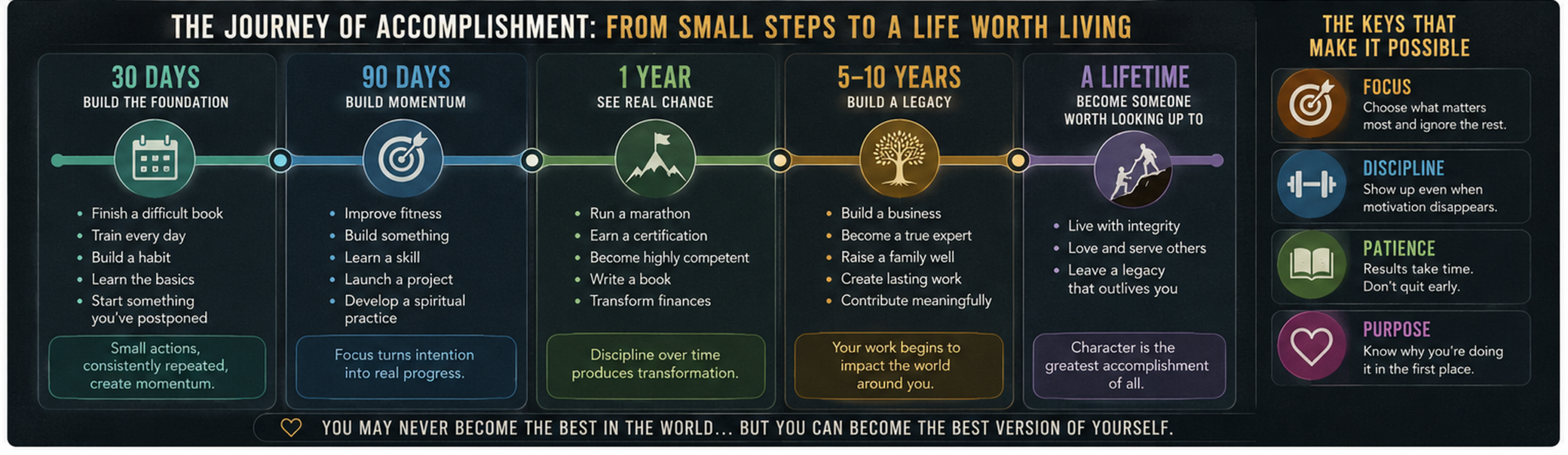
The details will be different for everyone, but looking at achievement across different timescales makes human potential much easier to grasp:
- In 30 days: finish a difficult book, complete 20 focused practice sessions, build a small project, begin volunteering, establish an exercise routine, start learning a skill, improve your finances, or finish something you have postponed for months.
- In 90 days: produce a beginner portfolio, write a substantial first draft, complete structured training, launch a small business experiment, improve your fitness, develop a spiritual practice, or accumulate dozens of hours of deliberate practice.
- In one year: earn a certification, create a meaningful body of work, become noticeably competent at an instrument or trade, substantially improve your health, complete a major physical challenge, improve your finances, serve regularly in your community, or take a project from vague idea to something real.
- In five to ten years: develop professional-level competence, build a sustainable business, become deeply skilled in a craft, mentor others, raise a family well, create lasting work, transform your financial life, or become someone your family and community genuinely rely upon.
- Over a lifetime: develop a reputation for courage, generosity, competence, honesty, service, discipline, love, wisdom, or faithfulness—the kinds of accomplishments that rarely go viral but can profoundly shape other people’s lives.
There is something important hiding inside that timeline. A decade sounds enormous when you look forward, but every decade is made of ordinary days. When you admire somebody’s ten-year accomplishment, you are often admiring thousands of fairly uneventful Tuesdays that eventually became remarkable when added together.
Dreaming Is Not the Same as Doing
The person who dreams about writing a book and the person who writes for thirty minutes every morning may look almost identical for the first week. After five years, they may live completely different lives. This is where inspiration has to become behavior, because wanting an outcome intensely does not automatically create the routine needed to produce it.
Psychologists use the term implementation intentions for specific “if-then” plans that connect a situation with an intended action. Instead of saying, “I should exercise more,” the plan becomes, “If it is Monday, Wednesday, or Friday at 6:00 p.m., I go to the gym.” A major review covering 94 independent tests found that implementation intentions had a meaningful positive effect on goal achievement.
The broader lesson is almost disappointingly simple: deciding exactly when and how you will act is often more useful than repeatedly thinking about what you want. “I want to write a book someday” is a dream; “At 7:00 tomorrow morning, I write for 30 minutes before checking my phone” is the beginning of a book. “I want to become generous” is an aspiration; giving some of your time or money to somebody who needs it this week is behavior.
Eventually, every dream has to survive contact with a calendar.
The Question Nobody Likes Asking: What Are You Willing to Give Up?
Nearly every exceptional accomplishment has a hidden cost: selection. Time spent becoming excellent at one thing cannot be spent becoming excellent at everything else, and the more serious the goal becomes, the more noticeable that trade-off tends to be. This does not mean achievement requires destroying your health, relationships, marriage, family, or sanity; in many cases, sacrificing those things would turn the accomplishment itself into a kind of failure.
It does mean that the statement “I could become incredible at anything” needs a small but important correction. Perhaps you could become extremely good at something. You probably cannot simultaneously become an elite athlete, concert pianist, world-class programmer, renowned novelist, surgeon, master carpenter, successful entrepreneur, competitive chess player, endlessly available parent, world traveler, and contemplative monk.
Modern life makes accepting this particularly difficult because our phones continually advertise alternate versions of ourselves. There is always another path, another business, another skill, another city, another career, another hobby, another place to travel, and another person you could theoretically become. Choosing therefore feels strangely like losing, because each commitment closes countless hypothetical doors.
But choosing is not failure. Choosing is how a life acquires shape.
Fame, Achievement and the Scoreboard Problem
There is another problem with wanting to become extraordinary: extraordinary according to whom? Fame, money, followers, job titles, awards, prestige, and recognition are all external scoreboards. They are not meaningless—money can create freedom, professional success can represent years of effort, and recognition can open valuable doors—but they are poor tools for answering whether someone became a good or admirable human being.
A person can become famous while destroying his family. Someone can become enormously wealthy while becoming miserable, or achieve tremendous professional success while treating everyone underneath them terribly. An athlete can reach the highest level of competition and still feel empty once competition ends, just as somebody with an enormous audience can feel desperately lonely.
The reverse is also true. Someone whose name will never appear in a history book can have a profound influence on children, friends, neighbors, coworkers, students, patients, customers, or strangers. An ordinary-looking life may contain decades of generosity, dependability, courage, sacrifice, craftsmanship, patience, and love that are invisible to nearly everyone except the people directly affected by them.
This is why the goal cannot simply be to “be somebody.” You already are somebody. The more interesting question is what kind of somebody you are constructing through repeated decisions.
Jesus and a Completely Different Definition of Greatness
For Christians, this is where Jesus becomes something fundamentally different from another inspirational figure in a collection of successful people. His example changes the scoreboard entirely. The Gospels repeatedly associate greatness with serving, loving, forgiving, sacrificing, speaking truth, caring for people who are ignored, showing mercy, resisting hypocrisy, remaining faithful under pressure, and refusing to measure human value by wealth or social rank.
That makes Jesus an unusual answer to the question, Who should I try to become like? Christianity makes unique claims about who Jesus is, so He does not fit neatly beside athletes, entrepreneurs, inventors, artists, or philosophers. Yet the qualities Christians are encouraged to imitate are remarkably practical and often play out in situations so ordinary that nobody else ever notices them.
You may never have millions of followers, but you can notice somebody everyone else ignores. You may never build a billion-dollar company, but you can be generous when keeping everything for yourself would be easier. You can forgive somebody, keep your word, raise children with love, defend someone vulnerable, tell the truth when lying would benefit you, perform excellent work when nobody is watching, remain humble when you succeed, and refuse to become cruel merely because life has sometimes been cruel to you.
Those actions do not resemble the childhood fantasy of “becoming somebody.” They may be much closer to actually becoming somebody worth looking up to.
Maybe the Real Dream Was Never Fame
Something interesting happens when people examine their biggest fantasies closely. The person dreaming about fame may really be craving recognition, while the person dreaming about billions may be longing for freedom. Someone obsessed with becoming the best in the world may not actually care about ranking first; they may want the satisfaction of knowing they did not waste whatever abilities they were given.
Likewise, a person who imagines being widely successful may simply want proof that their life mattered. Fame is one possible form of proof, but it is far from the only one. Once the need underneath the fantasy becomes clear, the number of ways to satisfy it grows dramatically.
You can be respected without being famous. You can become financially free without becoming a billionaire, become remarkably skilled without becoming number one in the world, and influence hundreds of people without millions knowing your name. You can build something valuable without appearing in a documentary about it, and you can live an extraordinary life that looks almost completely ordinary from the outside.
That may be one of adulthood’s most comforting realizations. The dream does not necessarily have to die; sometimes it simply has to mature.
What If You Really Did Give Something Everything You Had?
Suppose that old thought remains inside you: What if I actually went for it? The healthy response is neither to laugh at yourself nor to assume victory is guaranteed. A better approach is to treat the question as an experiment and gather evidence from your own life.
Choose something that genuinely matters to you and study the people who became excellent at it. Separate the parts of their success that came from reproducible behavior from the parts that depended on circumstance. Build your own practice around the behaviors that actually created competence, then give the experiment enough time to produce evidence before declaring yourself incapable.
Instead of endlessly asking whether you could someday become the greatest, ask yourself what quality you admire most in the people you look up to, what they repeatedly did that you are currently unwilling to do, and what the smallest real version of that behavior would look like this week. Ask what one year of repetition might produce, what five years could realistically produce, and what sacrifices serious pursuit would require. Then ask perhaps the most revealing question of all: If nobody ever applauded the result, would becoming this person still be worth it?
If an accomplishment matters only when strangers applaud, you may not really want the accomplishment. You may want the applause.
You Do Not Need to Become Obsessed to Become Excellent
There is another myth worth challenging: the idea that meaningful achievement requires absolute obsession. The modern success story often includes waking at 4:00 a.m., working eighteen hours, sacrificing everything, never resting, ignoring relationships, and somehow “wanting it more” than everybody else. There are certainly extraordinary people who have lived this way, but that does not make extreme obsession the only route to meaningful accomplishment.
A person who practices an instrument five hours a week for ten years accumulates roughly 2,600 hours of practice. Someone who writes 500 words five days a week produces around 130,000 words in a year, enough raw material for a substantial book. A person who steadily improves a small business for several focused hours each week can become almost unrecognizable from where they began after five years.
Consistency usually does not feel extraordinary while it is happening. Its results can be extraordinary.
This matters because the question What if I gave it everything? can easily become another form of perfectionism. Maybe you do not need to give one goal literally everything. Maybe you need to give it enough, consistently, for long enough.
That sounds less cinematic, but it is much more compatible with being a human being who has relationships, responsibilities, needs sleep, sometimes gets sick, and still wants to enjoy being alive.
The Internet Makes Everybody Else’s Life Look More Complete
Previous generations compared themselves mostly to relatives, neighbors, coworkers, celebrities, and the occasional extraordinary person featured in a newspaper or on television. We compare ourselves to nearly everybody. A few swipes can expose you to the best athlete, smartest investor, funniest comedian, wealthiest entrepreneur, strongest lifter, happiest-looking family, most talented craftsman, most disciplined monk, most adventurous traveler, and most beautiful home you have seen all day.
No individual human being can compete with a feed assembled from the highlights of thousands of other human beings. Yet psychologically, we sometimes try. That can create the bizarre impression that our ordinary life is evidence of failure.
You are washing dishes while someone else is summiting Everest. You are answering annoying emails while somebody else announces a million-dollar business. You are fixing something around the house while somebody else unveils a masterpiece, and for a moment your own life seems strangely unimpressive.
But the person summiting Everest also washes dishes. The millionaire answers irritating emails. The celebrated artist has boring days, arguments, headaches, paperwork, doubts, chores, and periods where very little seems to happen. Extraordinary lives contain enormous amounts of ordinary living; we simply do not usually see those parts.
Perhaps You Haven’t Missed Your Chance
Another reason big dreams become uncomfortable with age is that they begin to acquire a deadline. At 18, “someday” can mean almost anything. At 40, 50, or 60, someday becomes mathematically smaller, and certain possibilities genuinely do narrow.
That realization can hurt, but it can also create clarity. You probably cannot live every life you once imagined, and there are accomplishments whose biological or practical window may genuinely have closed. That does not mean the important part of your life is over.
People regularly begin businesses, creative careers, fitness transformations, education, volunteer work, spiritual practices, relationships, books, crafts, and entirely new chapters long after the age when popular culture suggests they should already have “made it.” History is filled with people whose important work began surprisingly late, and everyday life contains even more examples that never become famous enough to enter history.
You do not need infinite time. You need enough time to do something meaningful, and many people still have far more of that than fear tells them.
Final Verdict: You May Never Discover Your Absolute Limit—and That Is Okay
Giving something everything you have does not guarantee fame, wealth, mastery, greatness, or a place in history. Anyone promising otherwise is selling an attractive fiction. Human potential exists inside real bodies, unequal circumstances, limited time, competing responsibilities, chance events, genetic differences, and a world containing billions of other people with dreams of their own.
But the opposite conclusion—that therefore you should stop dreaming—is equally foolish. There may be abilities in you that have barely been tested because you have never given them sustained attention. There may be work you could create, people you could help, skills you could master, problems you could solve, places you could go, and qualities of character you could develop that would astonish the version of you who exists today.
And if you occasionally catch yourself thinking that perhaps you were meant to do something enormous, you are not ridiculous and you are certainly not alone. Human beings naturally imagine possible futures, including spectacular ones. Some of those dreams will prove unrealistic, some will disappear, some will evolve, and a few may contain useful clues about what deserves more of your life.
Perhaps the goal is not to extinguish the thought that you could still become someone remarkable. Perhaps the goal is to become much more careful about what remarkable actually means.
The purpose of a role model is not simply to remind you how extraordinary they are. At their best, role models show you a quality, habit, courage, skill, discipline, sacrifice, or way of living that might also be possible in you. Jesus presents an even deeper challenge, because perhaps the ultimate accomplishment is not merely doing something that causes other people to look up to you; perhaps it is becoming the kind of person whose life makes other people’s lives better.
So maybe the question is no longer, Could I become one of the best? Maybe the better question is: What would becoming my best actually look like—and am I willing to start behaving like that person now?
Further Reading
Hazel Markus and Paula Nurius’s foundational 1986 paper “Possible Selves” explores how imagined future versions of ourselves can shape motivation, hopes, fears, and behavior.
Read “Possible Selves” from Stanford
For a more skeptical look at the idea that practice alone produces greatness, Brooke Macnamara, David Hambrick, and Frederick Oswald’s meta-analysis “Deliberate Practice and Performance in Music, Games, Sports, Education, and Professions” examines how much practice actually explains differences in performance.
I never thought about it like that those people you read about in the obituaries might not mean much to you but there are people out there with tears in their eyes reading that same obituary reflecting on how important that particular person was in their life.