
AI Ranks Hidden Knowledge: What Percentage of These Mysteries Might Be Real?
Human beings have always suspected that reality is bigger than the version we are handed. Across cultures, people have searched for hidden knowledge in temples, scriptures, myths, dreams, stars, secret societies, government files, ancient ruins, and now the internet. Some of these ideas are clearly symbolic. Some are probably exaggerated. But some may contain a real mystery buried under layers of myth, psychology, and bad evidence.
That is what makes hidden knowledge so powerful. It sits in the strange territory between imagination and investigation. A person can laugh at conspiracy theories in the morning, then spend three hours at night reading about UFOs, ancient civilizations, simulation theory, or forgotten spiritual traditions. The pull is not always irrational. Sometimes curiosity is the mind’s way of saying, “Something about the official version feels incomplete.”
So what happens if we ask artificial intelligence to rank these mysteries by likelihood? Not to “prove” them, not to replace serious research, and not to pretend that a percentage score is scientific certainty. Instead, the goal is to look at each mystery through a balanced lens: available evidence, historical context, psychology, scientific plausibility, and the common ways humans misunderstand patterns.
Before we go deeper, here is the basic framework of the hidden-knowledge map: ancient mysteries, UFOs, consciousness, symbolism, lost civilizations, and fringe theories all orbit the same basic human question — “What are we not being told?”
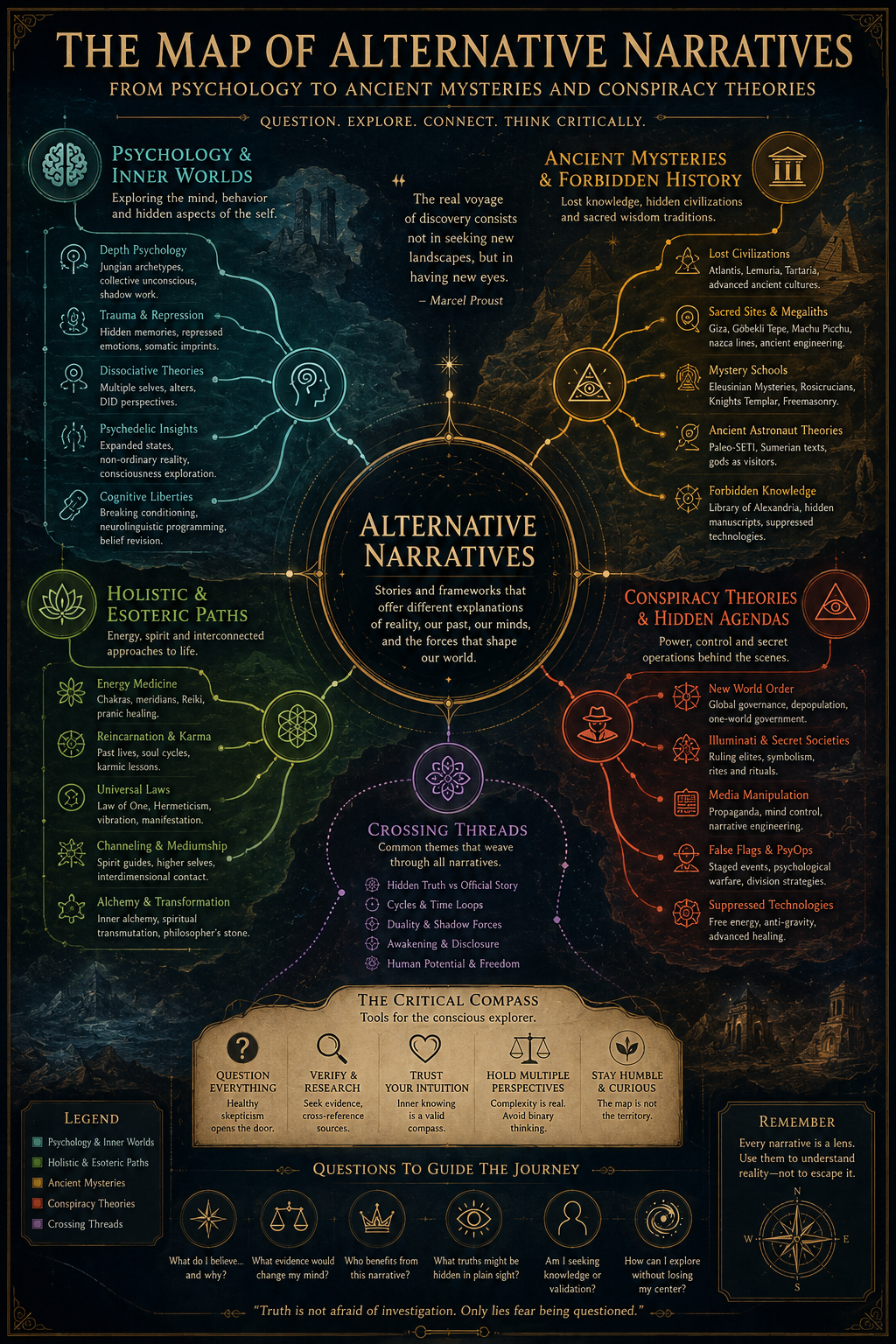
The Psychology Behind Hidden Knowledge
Before ranking the mysteries, we need to be honest about the mind doing the ranking. Humans are pattern-seeking creatures. That is not an insult; it is one of the reasons we survived. Our ancestors had to notice tracks in mud, movement in grass, changing weather, dangerous animals, hidden motives, and social threats. The same brain that finds real patterns can also find false ones.
Researchers have connected illusory pattern perception with belief in conspiracy theories and supernatural beliefs, meaning people can sometimes connect dots that are not truly connected. But that does not mean every alternative belief is foolish. It means the human mind is both powerful and vulnerable. It can detect real hidden structures, but it can also build imaginary ones when uncertainty becomes uncomfortable.
Hidden knowledge also gives people a psychological reward. It creates the feeling of seeing behind the curtain. When institutions fail, when governments lie, when media narratives shift, and when experts disagree, people naturally become more open to alternate explanations. That is not always paranoia. Sometimes skepticism is healthy. The danger begins when curiosity turns into certainty without evidence.
This is why the best approach is not blind belief or automatic dismissal. The better approach is ranked curiosity. Some mysteries deserve serious attention. Some deserve symbolic interpretation. Some deserve skepticism. And some deserve to be treated as modern mythology.
How the AI Ranking Works
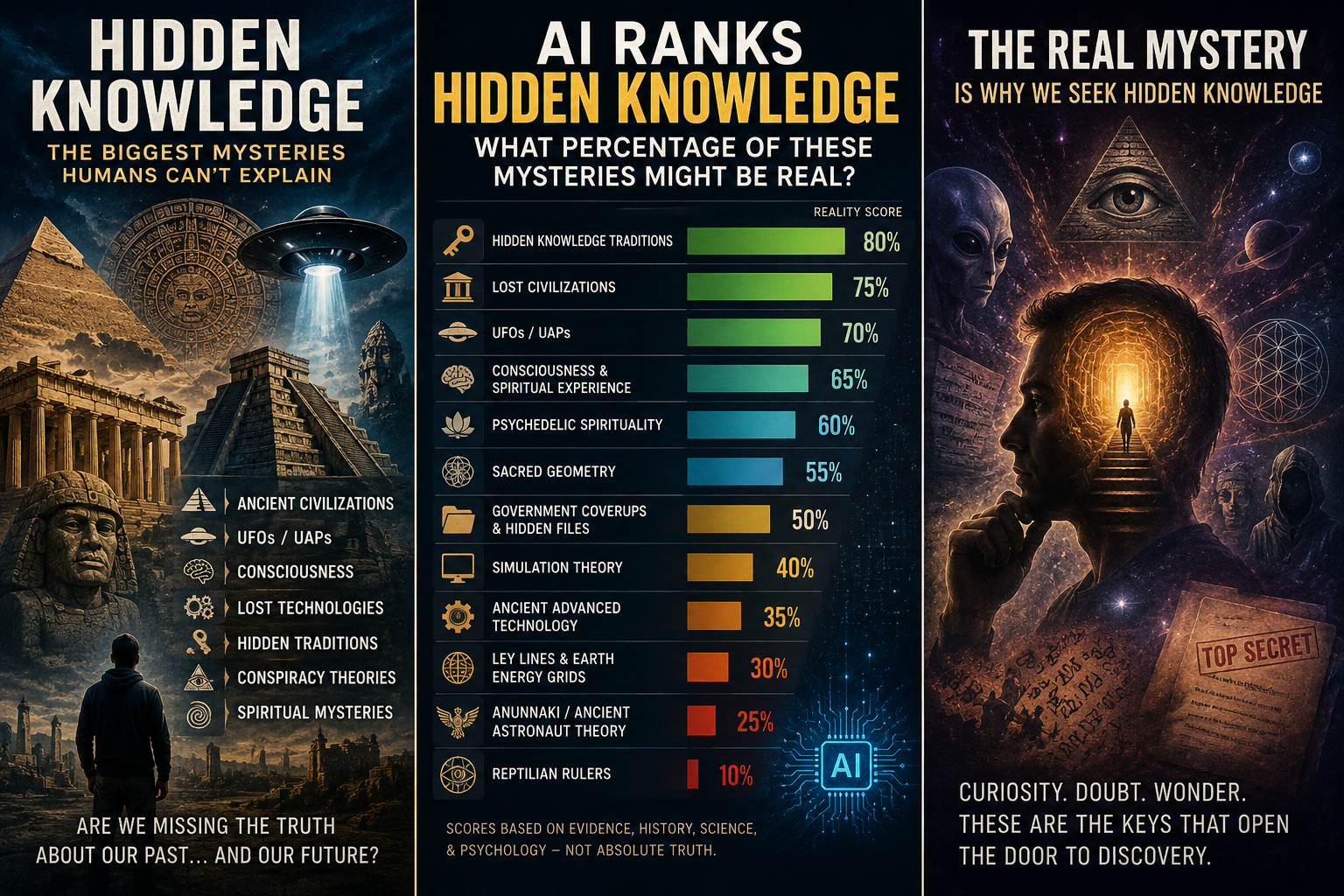
These percentages are not “proof scores.” They are probability-style estimates based on five factors: credible evidence, historical support, scientific plausibility, consistency of claims, and whether the mystery has a real-world core even if the popular version is exaggerated. A 70% score does not mean the claim is proven. It means there is likely something real underneath the story. A 10% score does not mean the idea is worthless. It means the literal claim has very weak evidence.
This matters because hidden knowledge topics are often bundled together unfairly. UFOs, lost civilizations, chakras, reptilians, simulation theory, and ancient aliens are not all equally plausible. Some are based on government reports or archaeology. Some are based on philosophy. Some are based on personal experience. Others mostly survive because they are emotionally powerful stories.
1. UFOs / UAPs — Reality Score: 70%
UFOs deserve one of the highest scores, but with a major clarification. The strongest claim is not “aliens are visiting Earth.” The stronger and more defensible claim is that people, pilots, sensors, and governments have reported unidentified aerial phenomena that are not always easily explained. That part is real enough to be studied seriously.
NASA’s UAP independent study argued that unidentified anomalous phenomena deserve a rigorous, evidence-based approach and better data collection methods. That alone moves UFOs out of pure fringe territory and into a legitimate mystery category. NASA did not conclude that UAPs are extraterrestrial, but it did acknowledge that the topic needs better scientific study.
The skeptical view is also strong. Recent Pentagon-related reporting has emphasized that many sightings turn out to be balloons, drones, birds, satellites, sensor errors, or ordinary phenomena, and no public evidence has proven extraterrestrial technology. That is why the score is not 95%. The mystery is real; the alien conclusion remains unproven.
Verdict: UFOs are very likely “real” as unexplained aerial events. The extraterrestrial interpretation remains possible but unproven.
2. Lost Civilizations — Reality Score: 75%
Lost civilizations rank even higher because archaeology repeatedly shows that human history is older, stranger, and more complex than earlier models assumed. This does not mean Atlantis is proven. It means the general idea that forgotten peoples, buried settlements, and underestimated ancient cultures existed is not fringe at all.
Göbekli Tepe is a perfect example. UNESCO describes it as a site in Upper Mesopotamia where hunter-gatherer groups built monumental structures in the Pre-Pottery Neolithic period, around the 10th to 9th millennia BC. That is astonishing because it challenges simplistic ideas about early humans being too primitive for large symbolic or ritual architecture.
Supporters of lost-civilization theories often go too far by jumping from “ancient people were more capable than we thought” to “there must have been a vanished global super-civilization.” That leap is not proven. But the basic idea that much of human history is still buried, misunderstood, or missing is extremely reasonable.
Verdict: Lost civilizations are highly plausible. The exaggerated versions need caution, but the core idea is strong.
3. Ancient Advanced Technology — Reality Score: 35%
This one is tricky. Ancient people absolutely had impressive engineering, astronomy, architecture, and symbolic systems. The problem is the word “advanced.” If advanced means “more intelligent and capable than modern people often assume,” then yes. If advanced means lasers, anti-gravity machines, electrical grids, or alien-powered construction, the evidence becomes much weaker.
Many ancient technology claims begin with a real feeling of awe. The pyramids, megalithic temples, precision stonework, and astronomical alignments are genuinely impressive. The mistake is assuming that “I do not know how they did this” means “they could not have done it without impossible technology.” Ancient people had time, skill, organization, observation, and social motivation.
The skeptical view is that modern people often underestimate ancient craftsmanship because we confuse technological simplicity with intellectual inferiority. That is a bad assumption. A society can lack modern machines and still produce extraordinary work through geometry, labor coordination, ritual importance, and generational skill.
Verdict: Ancient skill was real. Ancient sci-fi technology remains weakly supported.
4. Hidden Knowledge Traditions — Reality Score: 80%
This is one of the strongest categories because hidden knowledge traditions absolutely existed. Mystery schools, initiatory religions, esoteric interpretations, monastic traditions, oral teachings, secret societies, and restricted spiritual texts all appear across history. The real debate is not whether hidden teachings existed. The debate is what those teachings actually contained.
People are fascinated by hidden traditions because they suggest that religion and spirituality may have public teachings and deeper inner teachings. That idea is not absurd. Many traditions have had beginner teachings, symbolic teachings, priestly knowledge, initiations, and guarded interpretations. Knowledge has often been controlled because it carries power, status, and social influence.
Where things become questionable is when people claim every ancient symbol secretly points to one universal hidden doctrine. That can become too neat. Cultures are different. Symbols change over time. A serpent, a sun disk, or a pyramid does not always mean the same thing everywhere.
Verdict: Hidden traditions are very real historically. The “one secret master code behind everything” idea is much harder to prove.
5. Consciousness and Spiritual Experience — Reality Score: 65%
Spiritual experiences are real in the simplest sense: people genuinely have them. They report mystical unity, visions, near-death experiences, ego dissolution, intense intuition, deep meditation states, and encounters with what feels like a larger intelligence. The hard question is interpretation. Are these experiences contact with a spiritual reality, unusual brain states, symbolic visions, or some mixture of all three?
Consciousness remains one of the deepest questions in science and philosophy. We can study brain activity, perception, memory, and attention, but subjective experience itself is still mysterious. That does not prove every spiritual claim. But it does mean consciousness should not be dismissed as “just chemicals” in a shallow way.
The skeptical position is that powerful experiences can feel cosmic while still being generated internally. Dreams feel real while we are in them. Psychedelic experiences can feel more real than ordinary waking life. Meditation can radically alter perception. The feeling of truth is not always the same as proof.
Verdict: Spiritual experiences are real as human experiences. Their ultimate source remains open to interpretation.
6. Simulation Theory — Reality Score: 40%
Simulation theory is fascinating because it is not exactly a conspiracy theory. It is more like a philosophical possibility wrapped in modern technology. The basic idea is simple: if advanced civilizations can create highly realistic simulations, and if many simulated worlds could exist, then maybe our reality is one of them.
The reason this theory has staying power is that technology keeps making the idea feel less absurd. Video games, virtual reality, artificial intelligence, and digital worlds are improving quickly. People can imagine future beings creating simulated conscious worlds because we are already building crude versions of artificial environments.
The skeptical view is that simulation theory currently lacks direct evidence. It may be logically possible, but possibility is not probability. Also, even if reality has mathematical structure, that does not automatically mean it is computer code. The universe can be deeply ordered without being a video game.
Verdict: Simulation theory is philosophically serious but evidentially weak. It is possible, not proven.
7. Ley Lines and Earth Energy Grids — Reality Score: 30%
Ley lines are compelling because humans love maps, alignments, and sacred geography. The idea that ancient sites may sit on meaningful lines across the Earth is visually and spiritually powerful. It gives the planet itself a hidden structure, almost like a sacred nervous system.
The stronger version of this claim is cultural: humans often chose sacred places carefully. Temples, stone circles, burial sites, mountains, springs, and ceremonial centers were not random. They were connected to landscape, astronomy, travel routes, power, water, fertility, and ritual meaning. Sacred geography is real.
The weaker version is the claim that ley lines are measurable energy channels with consistent physical properties. That evidence is much thinner. Some alignments may be meaningful. Others may be coincidence, especially when people draw enough lines across enough locations.
Verdict: Sacred geography is real. Literal Earth energy grids remain unproven.
8. Sacred Geometry — Reality Score: 55%
Sacred geometry earns a middle score because part of it is clearly real and part of it becomes speculative. Geometry appears throughout nature, architecture, art, religious symbolism, and biological structure. Circles, spirals, triangles, symmetry, ratios, and repeating patterns do shape how humans perceive beauty and order.
The spiritual interpretation is where things become more debated. Many traditions saw geometry as a bridge between the physical and the divine. That does not mean every geometric symbol has supernatural power. But it does mean geometry has long been used as a language of meaning, harmony, and cosmic order.
The skeptical view is that humans may be projecting mystical meaning onto patterns because the brain enjoys symmetry and repetition. Still, the fact that geometry affects perception, design, and symbolism makes it more grounded than many fringe claims.
Verdict: Sacred geometry is real as symbolism, design, and natural pattern. Its supernatural claims are harder to prove.
9. Anunnaki / Ancient Astronaut Theory — Reality Score: 25%
The Anunnaki are a powerful topic because they combine ancient texts, sky-being mythology, lost-civilization curiosity, and modern alien theories. People are drawn to the idea because it offers a dramatic answer to human origins: maybe the gods were not gods, but advanced beings misunderstood by ancient people.
The stronger claim is that ancient Mesopotamian religion included complex divine beings, cosmic stories, kingship myths, and sky-associated symbolism. That is historically real. The weaker claim is that these beings were extraterrestrials who genetically engineered humans or ruled early civilization as literal alien overlords.
The skeptical problem is interpretation. Ancient texts are symbolic, religious, political, poetic, and culturally specific. Reading them as technical alien reports can flatten their original meaning. That does not make the topic worthless, but it means the popular ancient-astronaut version is much less secure than the historical Anunnaki tradition itself.
Verdict: The Anunnaki are real as ancient mythological beings. The alien-engineer interpretation is speculative.
10. Reptilian Rulers — Reality Score: 10%
Reptilian theory ranks very low as a literal claim. The idea that shapeshifting reptilian beings secretly rule the world has little credible evidence and relies heavily on anecdote, symbolic interpretation, and conspiracy layering. It is one of those topics where the psychological explanation is much stronger than the literal one.
That said, reptilian symbolism itself is ancient and interesting. Serpents, dragons, lizards, and underworld creatures appear in many cultures. They often represent wisdom, danger, renewal, hidden power, chaos, fertility, or the primal forces beneath civilization. In that symbolic sense, the “reptilian” image has deep roots.
The modern conspiracy version likely survives because it gives a monstrous face to real feelings of powerlessness. People know elites exist. They know institutions manipulate narratives. They know wealth and power concentrate. Turning that into “reptilian overlords” may be myth-making around real social anxiety.
Verdict: Reptilian symbolism is meaningful. Literal reptilian rulers are extremely unlikely.
11. Psychedelic Spirituality — Reality Score: 60%
Psychedelic spirituality is another category where the experience is real, but the interpretation is debated. Psychedelics can produce profound states of awe, unity, terror, healing, pattern recognition, symbolic visions, and encounters with seemingly intelligent presences. Many cultures have used altered states in ritual contexts for a very long time.
Supporters argue that these substances open doors to deeper layers of mind or reality. Skeptics argue that they chemically alter perception and generate powerful internal experiences. Both sides may be partly right. A brain-based event can still reveal meaningful truths about the self, trauma, fear, identity, and connection.
The danger is overclaiming. Not every vision is cosmic truth. Not every entity is external. Not every insight should be trusted the next morning. But dismissing all psychedelic spirituality as hallucination also misses how deeply these experiences can transform people.
Verdict: Psychedelic spiritual experience is real and powerful. Whether it reveals external realities remains uncertain.
12. Government Coverups and Hidden Files — Reality Score: 50%
This category needs careful handling. Governments absolutely keep secrets. Classified programs, surveillance operations, military experiments, intelligence failures, and public deception have happened many times. So the general idea that governments hide information is not fringe.
The problem is that real secrecy becomes fuel for unlimited speculation. Once people know some secrets exist, they may assume every rumor is true. That is how a reasonable suspicion can turn into an all-purpose conspiracy worldview. “Governments hide things” is true. “Therefore my favorite theory is true” does not follow.
UFO secrecy claims sit in this complicated space. Some information may be classified for military reasons, sensor capabilities, national security, or embarrassment. That does not automatically mean alien bodies or reverse-engineered craft. The hidden reason may be much more ordinary.
Verdict: Government secrecy is real. Specific extraordinary claims still need specific evidence.
Why These Mysteries Matter Today
Hidden knowledge matters because people are losing trust in simple narratives. The internet has exposed everyone to ancient texts, declassified files, alternative researchers, podcasts, leaked documents, spiritual teachers, skeptics, and wild speculation all at once. That creates a strange environment where curiosity expands faster than discernment.
This is why ranking mysteries is useful. It prevents two lazy extremes. One extreme says, “Everything alternative is nonsense.” The other says, “Everything hidden must be true.” Both are weak positions. A serious mind should be able to say: UFOs deserve study, reptilian rulers are probably mythology, lost civilizations are plausible, simulation theory is philosophical, and consciousness remains genuinely mysterious.
The future of hidden knowledge should not be blind belief. It should be disciplined curiosity. That means asking better questions, separating evidence from entertainment, and admitting when a mystery is interesting but not proven.
Final Ranking Summary
Here is the final AI-style ranking from most plausible to least plausible:
- Hidden Knowledge Traditions — 80%
- Lost Civilizations — 75%
- UFOs / UAPs — 70%
- Consciousness and Spiritual Experience — 65%
- Psychedelic Spirituality — 60%
- Sacred Geometry — 55%
- Government Coverups and Hidden Files — 50%
- Simulation Theory — 40%
- Ancient Advanced Technology — 35%
- Ley Lines and Earth Energy Grids — 30%
- Anunnaki / Ancient Astronaut Theory — 25%
- Reptilian Rulers — 10%
Final Verdict: The Truth Is Probably Uneven
The biggest mistake people make with hidden knowledge is treating it as one giant package. Either they accept all of it, or they reject all of it. But reality is probably uneven. Some mysteries likely contain real historical fragments. Some are symbolic. Some are psychological projections. Some are misunderstood science. Some are entertainment. And a few may point toward questions we still do not know how to ask properly.
The strongest hidden knowledge topics are not necessarily the loudest ones. Lost civilizations, hidden traditions, consciousness, and UAPs deserve serious attention because they have real evidence, real history, or real unanswered questions behind them. The weaker topics may still matter, but more as mythology, symbolism, or cultural psychology than literal fact.
So what percentage of these mysteries might be real? The answer depends on what we mean by “real.” Real as history? Real as psychology? Real as spiritual experience? Real as physical evidence? That distinction is everything.
The smarter path is not to believe everything. It is to stay curious without surrendering your judgment. That is where the real rabbit hole begins.
- NASA’s UAP research page for a grounded scientific look at unidentified anomalous phenomena.
- UNESCO’s Göbekli Tepe page for a credible ancient-civilization example that shows how surprising human history can be.
Reader note: This article explores unusual claims, theories, beliefs, and interpretations. It aims to separate documented history, symbolism, belief, interpretation, and speculation wherever possible. Extraordinary claims are not presented as established fact unless supported by credible evidence.
I do believe in the occult though. Scary stuff.