
Ancient Practices That Still Work in the Modern World
Modern humans have access to more technology, entertainment, and information than any civilization in history. We can communicate instantly across continents, ask artificial intelligence almost any question imaginable, and consume endless streams of content twenty-four hours a day. In many ways, life has become more advanced than ancient people could have ever imagined.
And yet, despite all of this progress, many people feel mentally exhausted, distracted, anxious, overstimulated, emotionally scattered, and disconnected from themselves. The modern world solved many physical problems, but it also created entirely new psychological ones. People today often struggle to sit quietly, focus deeply, sleep properly, think clearly, or simply feel at peace without constant stimulation in the background.
This is where ancient practices become fascinating. Ancient civilizations may not have had modern technology, but many of them understood something important about regulating the human mind and nervous system. Across cultures separated by oceans and thousands of years, humans repeatedly developed similar practices involving silence, fasting, walking, breath control, sunlight, ritual, and solitude. That pattern raises an interesting question: were ancient people accidentally discovering tools that modern society is now slowly rediscovering?
This article is not about claiming ancient humans had magical superpowers or hidden mystical technologies. Instead, it explores a simpler and perhaps more important idea. Many ancient practices survived for centuries because they consistently affected the human mind in meaningful ways. In a world dominated by notifications, algorithms, artificial light, and endless stimulation, some of these old habits may be more relevant than ever.
The Modern World Is Loud
One of the strangest things about modern life is how difficult silence has become. Many people wake up and immediately reach for a phone. They drive while listening to podcasts, work with music in the background, eat while watching videos, and fall asleep with television still playing. Entire days pass without a moment of true quiet.
For many people, silence almost feels uncomfortable at first. When external noise disappears, internal noise becomes easier to hear. Thoughts that were buried under entertainment and stimulation suddenly rise to the surface. Anxiety, uncertainty, loneliness, regret, confusion, or unresolved emotions become more noticeable. It is no surprise that so many people keep some kind of background noise running constantly.
At the same time, there is something strangely peaceful about finally turning everything off. Many people have experienced moments where they shut down the television, remove their headphones, dim the lights, and suddenly realize how overstimulated they had become. What initially felt uncomfortable slowly begins to feel calming. The nervous system finally has room to breathe.
Ancient humans experienced silence far more often than modern people do. They lived without endless digital stimulation, without social media feeds refreshing every few seconds, and without artificial noise following them everywhere. Many ancient spiritual traditions intentionally used silence as a tool for reflection, discipline, and mental clarity. Monks, hermits, mystics, and philosophers often sought isolation not because they hated people, but because silence helped them hear themselves think.
Ancient Practices vs Modern Overstimulation
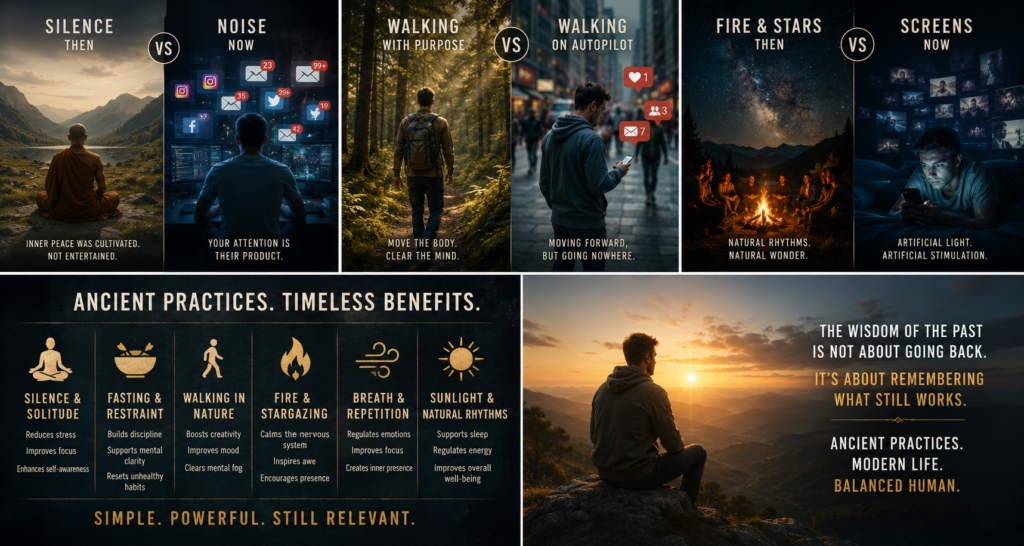
Silence and Solitude
Silence may be one of the most underrated ancient practices still available to modern people. Throughout history, silence has been used in monasteries, meditation retreats, religious traditions, vision quests, and philosophical schools. In many traditions, silence was not seen as emptiness. It was seen as a way of clearing mental clutter.
Modern people often underestimate how much stimulation they absorb every day. Even when relaxing, the brain is usually processing information: flashing images, conversations, advertisements, music, opinions, alerts, scrolling feeds, and emotional reactions. The nervous system rarely gets a break from input.
This may explain why many people suddenly feel mentally lighter after spending time in nature, sitting quietly, or disconnecting from screens for a few hours. The brain is no longer constantly switching tasks and reacting to stimulation. Silence allows mental momentum to slow down.
That does not mean everyone needs to live like a monk in the mountains. But intentionally creating small pockets of silence may help modern people regain a sense of internal stability. Even a quiet walk, sitting outside without headphones, or spending an evening without screens can feel surprisingly restorative.
Walking Long Distances
Walking may be one of humanity’s oldest forms of therapy. Ancient humans walked constantly. They traveled on foot, hunted on foot, migrated on foot, explored forests, mountains, deserts, and coastlines without engines carrying them everywhere. Walking was not a fitness trend. It was life itself.
Many people still notice that walking has a strange effect on the mind. Thoughts begin to organize themselves differently. Anxiety softens slightly. Ideas connect more naturally. Problems that felt overwhelming indoors suddenly become manageable while moving through nature.
There is also something psychologically powerful about walking without constant stimulation. Many people today walk while scrolling phones, listening to videos, or checking notifications every few minutes. Ancient walking practices were different. People walked with their surroundings. They listened to wind, birds, footsteps, rivers, trees, and silence.
Some people still instinctively use walking this way today. Long walks through forests, quiet roads, or parks often become moments of reflection. People sort out problems, think about who they want to become, clarify goals, or regain emotional balance. The body moves, but the mind settles.
Research continues to support the cognitive benefits of walking and nature exposure. Studies suggest time spent in natural environments may reduce stress and improve mood, focus, and mental restoration. (apa.org)
Fasting and Voluntary Restraint
Fasting appears in countless ancient traditions across the world. Christianity, Islam, Buddhism, Hinduism, Judaism, Greek philosophy, and many indigenous traditions all incorporated periods of voluntary abstinence from food. That pattern alone makes fasting historically fascinating.
Modern culture often encourages constant consumption. Eat immediately when hungry. Snack constantly. Order food instantly. Satisfy every craving quickly. Ancient cultures frequently approached appetite differently. Periodically saying “no” to desire was viewed as a form of discipline and self-control.
Many people who practice fasting today report increased mental clarity, sharper focus, or a stronger sense of discipline. Researchers are also exploring how fasting may influence metabolism, cellular repair processes, and overall health. (nih.gov)
At the same time, fasting should not be romanticized into a magical cure-all. Extreme fasting can become unhealthy, obsessive, or dangerous when taken too far. Ancient wisdom often emphasized moderation and intention, not self-destruction.
The deeper value of fasting may not even be physical. It may be psychological. Voluntarily resisting an urge reminds the mind that it does not need to obey every impulse immediately. In an age built around instant gratification, that lesson may matter more than ever.
Fire Watching and Stargazing
Ancient humans spent enormous amounts of time around fire. Before smartphones, televisions, electric lights, and streaming platforms, humans gathered around flames. They stared into fires, listened to stories, watched sparks rise into darkness, and looked at stars overhead.
Modern people still seem strangely drawn to fire. Campfires, candles, fireplaces, and lanterns create an atmosphere that many people instinctively find calming. Some researchers have even suggested that watching fire may reduce blood pressure and encourage relaxation and social bonding. (pubmed.ncbi.nlm.nih.gov)
This becomes especially interesting when compared to modern screens. Humans now spend massive amounts of time staring at artificial light sources designed to maximize engagement and stimulation. Social media feeds, video platforms, flashing advertisements, and algorithmic content are engineered to capture attention continuously.
Fire is different. Fire slows attention instead of fragmenting it. It does not rapidly bombard the nervous system with new information every few seconds. It simply exists, moving slowly and naturally. The same can be said for looking at stars, clouds, oceans, or forests. These environments often calm the mind instead of overstimulating it.
Breathwork and Repetition
Breath-focused practices appear throughout human history. Yogic traditions, martial arts, meditation systems, chanting rituals, and religious prayers all recognized the connection between breathing and mental state.
This makes sense physiologically. Breathing patterns directly affect the nervous system. Fast, shallow breathing is often associated with stress and anxiety. Slower, controlled breathing may encourage relaxation and emotional regulation.
Repetition also plays a fascinating role in ancient spiritual practices. Repeated prayers, chants, mantras, and rhythmic phrases appear across cultures worldwide. Whether someone interprets these practices spiritually or psychologically, repetition clearly affects attention and mental focus.
The Hare Krishna mantra is one example of rhythmic repetition used to focus the mind and create a meditative state. Similar practices exist in many religions and traditions. Humans seem naturally drawn toward rhythm, repetition, and focused mental loops.
Modern people often repeat things too, but usually unconsciously: doom-scrolling, refreshing feeds, checking notifications, replaying worries, or consuming endless short-form content. Ancient repetition was often intentional. Modern repetition is frequently algorithmic.
Sunlight and Natural Rhythms
Ancient humans lived far closer to natural light cycles than modern people do. They woke with sunlight, spent much of the day outdoors, and experienced darkness naturally at night. Modern humans often experience the exact opposite.
Many people wake indoors, commute indoors, work indoors, relax indoors, and spend evenings surrounded by artificial light and screens. Entire weeks can pass with surprisingly little direct sunlight exposure.
This matters because sunlight strongly influences circadian rhythms, sleep cycles, mood, and energy regulation. Researchers continue studying links between sunlight exposure, sleep quality, mental health, and overall well-being. (sleepfoundation.org)
Modern life often disconnects humans from natural rhythms. Artificial lighting allows people to stay awake deep into the night. Phones and screens stimulate the brain before sleep. Blue light exposure may interfere with melatonin production and sleep timing.
Ancient humans did not have perfect lives, but many of their daily rhythms were more synchronized with nature than modern schedules often are. Reconnecting with sunlight, outdoor time, and natural cycles may help restore balance many people do not realize they have lost.
The Skeptical View
Of course, not every ancient practice deserves blind admiration. Ancient humans also believed many things that were incorrect, superstitious, or harmful. Just because something is old does not automatically make it wise.
This is important because modern wellness culture sometimes romanticizes the past unrealistically. Ancient humans faced disease, hardship, violence, poor sanitation, and extremely difficult living conditions. Modern medicine, science, and technology have dramatically improved many aspects of life.
The goal is not to reject modernity and pretend civilization was better thousands of years ago. The goal is balance. Ancient practices become interesting when modern science, psychology, or lived experience suggest they genuinely affect human well-being in positive ways.
A thoughtful approach combines modern knowledge with useful ancient insights rather than blindly worshipping either one.
Why Ancient Practices Matter Today
These practices matter because modern humans increasingly live in environments their nervous systems may not be fully adapted for. Constant stimulation, endless scrolling, artificial light, nonstop advertising, fractured attention, and digital overload create psychological conditions unlike anything humans experienced for most of history.
Ancient practices often worked by slowing the mind down rather than accelerating it further. Silence reduced noise. Walking reduced stagnation. Fasting reduced constant consumption. Fire watching reduced stimulation. Sunlight restored natural rhythms. Breathwork stabilized attention.
Many modern people are beginning to rediscover these habits not because they are trendy, but because they genuinely feel restorative in an overstimulated world.
There is also something psychologically grounding about realizing that humans across thousands of years struggled with many of the same internal problems modern people still face: fear, distraction, temptation, uncertainty, loneliness, anxiety, identity, purpose, and self-control. Technology changed dramatically, but human nature did not change nearly as much.
Final Verdict
Ancient humans may not have had smartphones, artificial intelligence, streaming platforms, or modern medicine, but they understood something important about regulating the human mind and nervous system. Across civilizations, humans repeatedly developed practices involving silence, fasting, walking, breathwork, ritual, sunlight, and stillness because these habits consistently affected how people felt, thought, and lived.
Modern society often pushes people toward constant stimulation, consumption, distraction, and mental fragmentation. Ancient practices frequently moved in the opposite direction. They slowed people down. They created focus. They reduced noise. They encouraged reflection.
That does not mean modern people need to abandon technology and live in caves. But it may mean there is wisdom in intentionally reintroducing some of these older habits into daily life.
In a world that constantly pulls attention outward, ancient practices may help people reconnect inward.