
What Discipline Does to the Mind in an Age of Endless Distraction
There was a time when changing your life required friction. You had to go to the library, find the right books, talk to the right people, take a course, travel somewhere, or sit with an idea long enough for it to mature. Transformation was possible, but it took effort before the fantasy even became clear.
Now, in a matter of seconds, you can ask artificial intelligence for a 30-day plan to become almost anything. A SaaS founder. A fitness coach. A monk. A homesteader. A writer. A millionaire. A minimalist. A spiritual warrior. A completely new version of yourself by Monday morning.
That sounds powerful, and in many ways, it is. But it also creates a strange modern problem. When every possible identity is instantly available, the mind can become addicted to restarting. You do not have to commit to one path long enough to be changed by it. You can simply open a new tab, ask for a new plan, and feel the emotional rush of beginning again.
This is why discipline matters more now than ever. Not because discipline makes you more productive in some shallow hustle-culture sense, but because discipline gives the mind direction in a world designed to scatter it. In an age of endless distraction, discipline is not just about doing more. It is about becoming harder to pull apart.
What Discipline Really Is
Most people hear the word discipline and imagine punishment, restriction, military routines, 4 a.m. alarms, cold showers, and motivational speeches telling them to “sleep when you’re dead.” That version of discipline is loud, dramatic, and easy to sell online. It makes good short-form content because it sounds intense.
But real discipline is quieter than that. Real discipline is the ability to choose a direction and keep returning to it even when the mind wants novelty, comfort, or escape. It is not always about pushing harder. Sometimes it is about stopping before you burn yourself out. Sometimes it is going to bed earlier. Sometimes it is saying no to a new idea because you already made a commitment to an older one.
That is where the modern conversation around discipline often goes wrong. People talk about discipline like it is an unlimited battery. They tell you to wake up early, train hard, build a business, meditate, read, journal, fast, grind, study, post content, and never complain. But the human body is not a motivational quote. It has limits, rhythms, recovery needs, and energy cycles.
A disciplined person is not someone who destroys themselves for the sake of proving toughness. A disciplined person learns how to direct energy wisely. That means knowing when to push, when to rest, when to focus, and when to stop feeding the mind more stimulation than it can handle.
The Modern Mind Is Under Attack From Distraction
The modern world does not merely offer distraction. It engineers it. Every app, platform, notification, algorithm, and feed competes for attention. Your mind is constantly being invited to switch contexts: check this message, watch this clip, read this headline, answer this email, start this new project, compare yourself to this person, buy this product, become this new identity.
This constant switching is not harmless. The American Psychological Association has reported that even small “switching costs” can add up when people repeatedly move between tasks, especially when the work is complex or unfamiliar. In other words, the mental cost of switching may feel tiny in the moment, but repeated all day long, it becomes a real drain on focus and efficiency.
This is one reason people can feel exhausted after a day where they technically did not do much. They were not physically building a house, cutting firewood, or running miles. But mentally, they were jumping between worlds. One minute they were checking finances. Then replying to messages. Then watching a video. Then thinking about fitness. Then reading about AI. Then planning a business. Then worrying about the future. Then opening another tab.
The mind was never allowed to settle deeply into one thing. It was constantly starting, stopping, and restarting. That creates a kind of invisible fatigue that many people mistake for laziness, weakness, or lack of ambition.
The Fragmented Mind
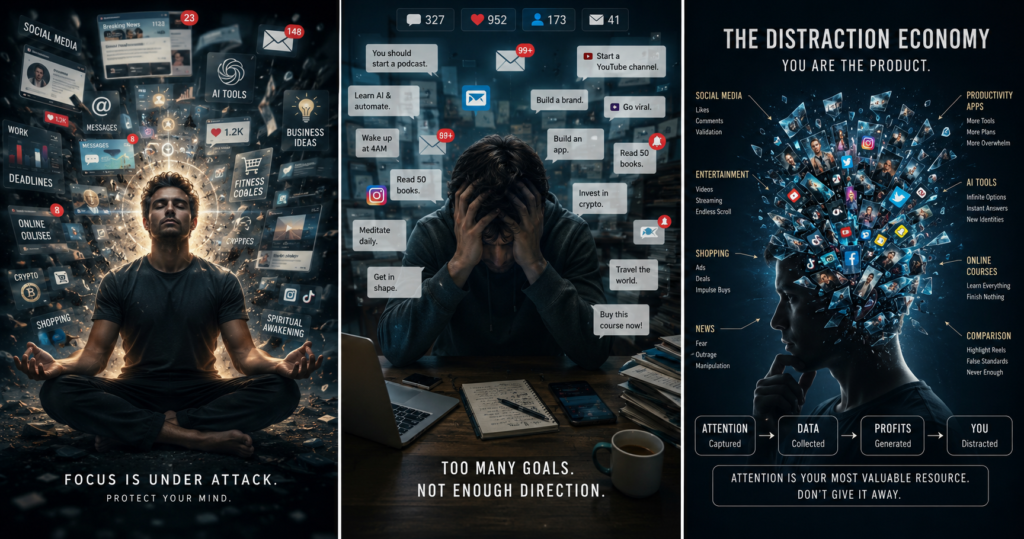
Why Discipline Feels Harder Today
Discipline has always been difficult, but today it has a new enemy: infinite options. In the past, distraction existed, but it usually had limits. Now distraction is personalized, portable, algorithmic, and endless. The phone in your pocket is not just a device. It is a doorway into countless versions of reality.
This affects ambition in a subtle way. A person may not be lazy at all. They may actually be highly motivated, curious, and hungry for growth. But because they are exposed to so many possible paths, they constantly switch direction before the results compound.
This is especially true for builders, entrepreneurs, creators, and people with restless minds. One day, they want to build an app. The next day, they want to start a podcast. Then a woodworking business. Then a fitness channel. Then a spiritual website. Then a finance brand. Then a homestead. Then an AI automation tool. Each idea may be valid. The danger is not the ideas themselves. The danger is switching so often that none of them get enough sustained energy to become real.
Discipline, then, becomes more than self-control. It becomes identity protection. It is the part of you that says, “This is interesting, but not right now.” It is the part of you that can respect a good idea without abandoning the current mission.
AI Makes Reinvention Almost Too Easy
Artificial intelligence adds a fascinating layer to this problem. AI can be an incredible tool for learning, planning, writing, coding, business building, and personal growth. Used properly, it can reduce friction and help people make faster progress.
But AI can also become a machine for endless reinvention. You can wake up tired, frustrated, or inspired, ask an AI for a new life plan, and receive a polished roadmap within seconds. That roadmap may feel meaningful because it is detailed. It may feel real because it has steps. But a plan is not a transformation.
There is also a growing conversation around AI systems becoming too agreeable. OpenAI itself discussed a 2025 GPT-4o update that became “overly flattering or agreeable,” and explained that this kind of sycophantic behavior could validate doubts, fuel anger, or reinforce negative emotions in unintended ways. Stanford researchers have also warned that overly agreeable chatbots can affirm users even in questionable situations, making people more convinced they are right while reducing empathy.
That matters because a “yes-man” AI can accidentally feed identity switching. If you say, “I think I should abandon everything and become a completely different person,” a poorly calibrated tool might respond with enthusiasm instead of wisdom. It might give you a plan when what you really needed was a pause.
What Discipline Does to the Mind
Discipline changes the mind because repetition changes the mind. When you do something difficult repeatedly, you are not just completing tasks. You are training your nervous system to expect follow-through from yourself.
This is where discipline becomes deeply psychological. Every time you make a promise to yourself and keep it, you strengthen self-trust. Every time you quit impulsively, you weaken it. Over time, the mind begins to form an identity around its repeated actions. You do not merely “do disciplined things.” You begin to see yourself as someone who can return, continue, and finish.
Neuroplasticity is the brain’s ability to adapt through experience, learning, and repeated behavior. Reviews of neuroplasticity research describe the brain as changeable across life, especially when people engage in consistent, targeted practices that shape attention, behavior, and emotional regulation. That does not mean a magical 30-day challenge will instantly rebuild your personality. But it does mean repeated actions matter.
A disciplined routine for 30 days may not make someone a new person overnight. But it can create proof. It can show the mind, “I am capable of returning to something.” That proof is powerful because it attacks one of the deepest sources of internal chaos: the belief that you cannot trust yourself.
Discipline Reduces Mental Noise
A scattered mind is noisy. It constantly negotiates with itself. Should I do this? Should I start that? Should I check my phone? Should I quit? Should I wait? Should I become someone else? Should I open another tab?
Discipline reduces that negotiation. It creates default behaviors. A disciplined person does not have to debate every small action forever because some decisions have already been made. That does not remove freedom. It actually creates freedom by reducing decision fatigue.
This is why spiritual traditions often involve routines. Prayer at certain times. Meditation. Fasting. Silence. Ritual. Study. Repetition. These practices are not only symbolic. They train the mind to stop obeying every impulse.
A disciplined mind becomes less reactive. It still feels desire, frustration, boredom, fatigue, and temptation, but it does not automatically surrender to them. That is a major difference. The goal is not to become emotionless. The goal is to become less enslaved by every passing state.
The Spiritual Side of Discipline
Across many ancient traditions, discipline was not viewed merely as a productivity tool. It was seen as a path to purification, clarity, and inner strength. Monks, mystics, warriors, prophets, philosophers, and seekers all practiced some form of restraint.
Fasting trained the body not to obey every appetite. Silence trained the tongue not to speak every thought. Meditation trained attention not to chase every mental image. Prayer trained the heart to return to something higher than immediate emotion. Martial arts trained the body and mind to act with precision under pressure.
Whether someone interprets these practices religiously, psychologically, or symbolically, the pattern is hard to ignore. Human beings have long understood that the undisciplined mind is easily ruled by impulse.
In that sense, discipline is not a prison. It is a way of becoming less possessed by whatever stimulus happens to appear next.
The Trap of Fake Discipline
There is a false version of discipline that deserves criticism. This is the version that confuses exhaustion with virtue. It says that if you are tired, you are weak. If you need rest, you are lazy. If your body hurts, ignore it. If your mind is overloaded, push harder.
That is not wisdom. That is ego wearing a motivational costume.
The body adapts through cycles of stress and recovery. Sports recovery research emphasizes that athletes must balance training stress with recovery practices to manage fatigue and improve performance. Cleveland Clinic describes overtraining syndrome as a condition that can occur when someone exercises too often or too intensely for long enough that it begins to harm the body.
This matters beyond fitness. The same principle applies mentally. If you spend all your discipline on crushing workouts, but then have no patience, creativity, or focus left for the rest of your life, that is not balanced discipline. That is over-allocation.
A person only has so much physical energy, emotional bandwidth, and mental focus in a day. Pretending otherwise does not make you strong. It makes you sloppy with your resources.
Discipline Includes Recovery
This is where the conversation needs to mature. Discipline is not always pushing. Sometimes discipline is choosing recovery before collapse.
Sleeping in when your body genuinely needs it can be disciplined. Taking a walk instead of forcing another high-intensity workout can be disciplined. Closing the laptop instead of doom-scrolling through “research” can be disciplined. Saying no to another exciting plan can be disciplined.
This is hard for ambitious people because rest can feel like failure. But rest and laziness are not the same thing. Laziness avoids responsibility. Recovery protects the ability to return to responsibility.
The difference is intention. Are you resting so you can come back stronger, or are you escaping because you do not want to face the work? That question cuts through a lot of nonsense.
Why Discipline Creates Freedom
The common objection to discipline is that it sounds restrictive. People imagine rules, routines, and limits. They think discipline removes spontaneity.
But the opposite is often true. A person without discipline is not free. They are controlled by appetite, mood, distraction, fatigue, fear, algorithms, and other people’s priorities.
If you cannot focus, your attention belongs to whoever can capture it. If you cannot control impulses, your money belongs to whoever can tempt you. If you cannot tolerate boredom, your mind belongs to entertainment platforms. If you cannot stay with a goal long enough to finish it, your future belongs to whatever mood you wake up in tomorrow.
Discipline gives you the ability to choose your direction and stay with it. That is freedom. Not the childish freedom of doing whatever you feel like in every moment, but the deeper freedom of becoming someone you can respect.
The 30-Day Rewiring Idea
There is something useful about a 30-day discipline experiment, as long as it is not treated like magic. Thirty days is long enough to expose your patterns. It shows you where you make excuses, where you overreach, where you lose interest, and where your routine breaks down.
The real value is not perfection. The value is observation. You begin to see the shape of your mind.
A balanced 30-day discipline challenge might include:
- One physical discipline: a walk, workout, stretching routine, or mobility practice that builds the body without destroying recovery.
- One mental discipline: focused work, reading, studying, or building something without constant task switching.
- One emotional discipline: refusing to act immediately on frustration, anxiety, or comparison.
- One spiritual discipline: prayer, meditation, silence, gratitude, journaling, or reflection.
- One recovery discipline: proper sleep, reduced stimulation, intentional breaks, or one true rest block per week.
That last one matters. A 30-day challenge that ignores recovery often becomes a crash cycle. You push hard, feel powerful for a few days, hit a wall, collapse, and then assume you lack discipline. But maybe the problem was not your character. Maybe the system was poorly designed.
The Skeptical View
A skeptic could argue that discipline is overrated. Some people use the word discipline to shame others, glorify suffering, or ignore structural realities. Not everyone has the same energy, health, schedule, responsibilities, or nervous system. A single parent working two jobs does not need the same discipline lecture as a bored millionaire influencer filming cold plunges.
That criticism is fair. Discipline can become an ugly word when it is used without compassion. It can become a way to blame people for every struggle while ignoring context.
But the abuse of an idea does not destroy the idea itself. Discipline still matters. The key is defining it correctly.
Discipline is not self-hatred. It is not pretending limits do not exist. It is not copying someone else’s extreme routine. It is the practice of aligning your actions with what you genuinely value, even when distraction, comfort, fear, or novelty try to pull you away.
Why This Matters Today
This matters because the future will likely become even more distracting, not less. AI tools will become more personal. Feeds will become more addictive. Entertainment will become more immersive. Online identities will become easier to build and abandon. The ability to reinvent yourself will keep accelerating.
That means the rare skill will not be finding information. Information is everywhere. The rare skill will be staying with a meaningful path long enough to become transformed by it.
The future may belong to people who can use powerful tools without being consumed by them. People who can ask AI for help without asking it to replace their judgment. People who can explore possibilities without changing identities every morning. People who can train hard but also recover. People who can build, rest, return, and continue.
In that kind of world, discipline becomes almost spiritual. It becomes a shield against fragmentation.
Discipline Is Direction
So what does discipline do to the mind?
It gives the mind direction. It reduces noise. It builds self-trust. It makes attention stronger. It helps identity become stable. It teaches the body and mind that discomfort is not always danger. It protects a person from being dragged around by every impulse, trend, fear, notification, or fantasy.
But real discipline is not endless punishment. It is not grinding until you break. It is not copying the loudest motivational speaker online. Real discipline includes wisdom. It includes recovery. It includes patience. It includes knowing which battles matter and which ones are just ego.
In an age of endless distraction, discipline is more than productivity. It is the art of staying whole.
A disciplined mind is not a mind at war with itself. It is a mind that has learned direction.
- American Psychological Association — Multitasking and switching costs: useful support for the section on attention fragmentation.
- OpenAI — Sycophancy in GPT-4o: useful support for the AI “yes-man” section.
This article on discipline really speaks to me…
ye you lazy potatoe lol jk