
Human Consciousness Explained: Why Science Still Cannot Fully Explain Awareness
Human beings have mapped the human genome, split the atom, built artificial intelligence systems capable of writing essays and generating images, and sent machines into deep space. Yet one of the most important questions imaginable still remains unresolved: why are we conscious at all? Not just intelligent. Not just reactive. Conscious. Aware. Experiencing reality from the inside.
Science can explain many processes happening inside the brain. Researchers can track electrical activity, identify regions associated with memory and emotion, and even predict certain decisions before people consciously realize they are making them. But none of that fully explains the deepest mystery at the center of human existence — why there is a subjective experience happening in the first place. Why does the universe feel like something from our perspective rather than nothing at all?
That question has haunted philosophers, scientists, monks, theologians, futurists, and ordinary people for thousands of years. Some believe consciousness is simply an emergent property of the brain, no different than heat emerging from fire. Others suspect consciousness may be more fundamental than matter itself. And increasingly, modern technology is forcing humanity to confront an uncomfortable possibility: if we someday create artificial intelligence more intelligent than ourselves, could it become conscious too?
Before we dive into spirituality, AI, souls, and digital immortality, it helps to visualize the major ideas surrounding the mystery of consciousness and why this subject sits at the center of science, philosophy, and human identity.
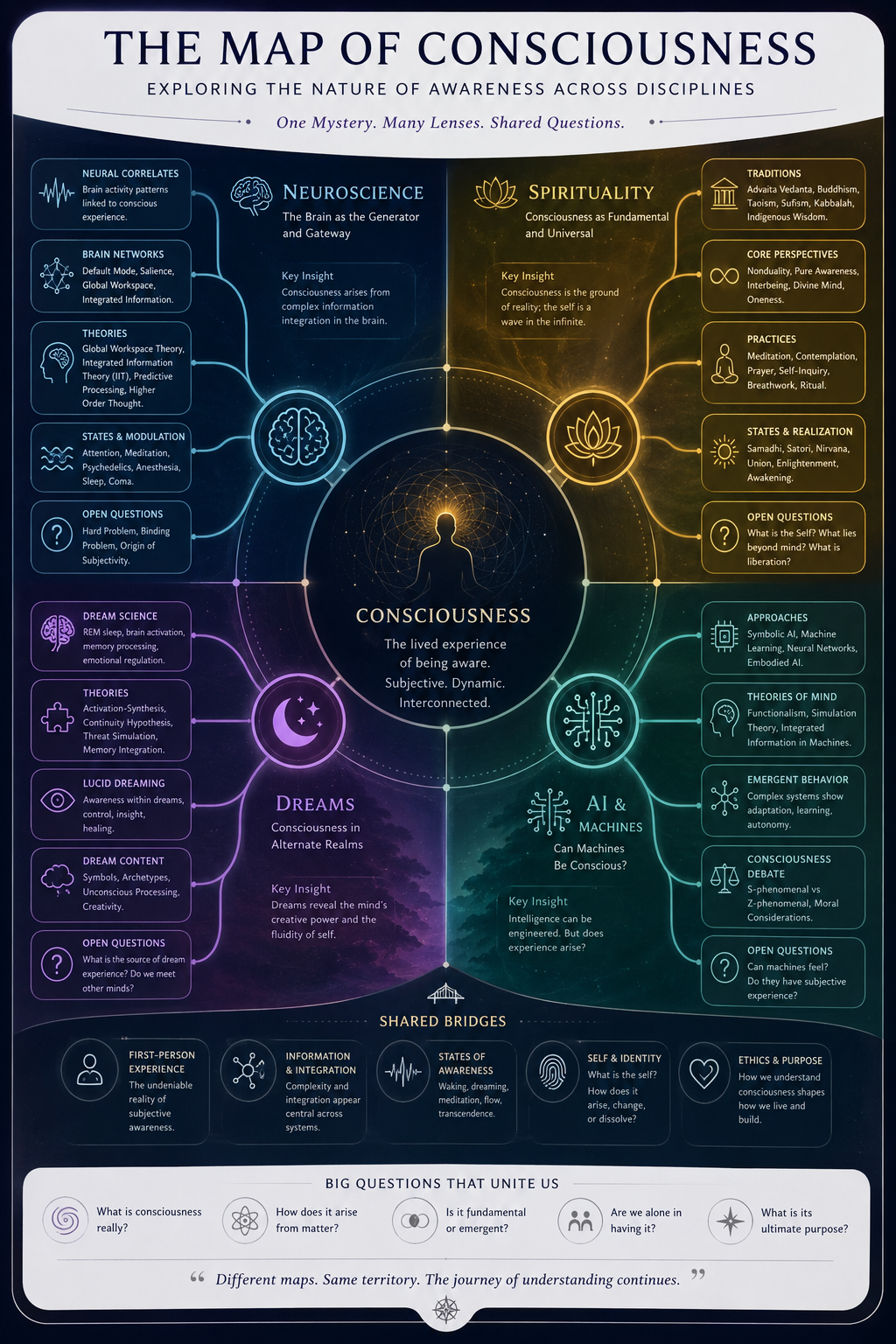
What Is Consciousness, Really?
At the simplest level, consciousness refers to subjective awareness. It is your experience of being you. The redness of a sunset, the feeling of fear, the taste of coffee, the memory of childhood, the inner voice reading these words right now — all of these belong to conscious experience. A computer may process information, but does it experience information? That distinction is everything.
The strange part is that consciousness seems impossible to fully measure from the outside. Scientists can observe brain activity, but they cannot directly observe the actual feeling of awareness itself. This is why consciousness is often called “the hard problem,” a phrase popularized by philosopher David Chalmers. Explaining behavior is difficult but manageable. Explaining why awareness exists at all is something else entirely.
This is where the mystery begins splitting into two major camps. One side argues consciousness is generated entirely by physical processes in the brain. The other believes consciousness may be something deeper — perhaps filtered through the brain rather than created by it. That difference completely changes how a person views life, death, spirituality, and even reality itself.
The Terrifying Possibility: Consciousness Ends at Death
One reason consciousness fascinates people so deeply is because it is inseparable from mortality. If consciousness is nothing more than brain activity, then when the brain shuts down permanently, awareness may simply end forever. No afterlife. No continuation. No soul. Just silence.
Many scientists lean toward this explanation because there is strong evidence connecting mental states to physical brain states. Damage certain parts of the brain and personality changes. Alter brain chemistry and perception changes. Interrupt neural activity and consciousness fades. To many researchers, this strongly suggests consciousness emerges from biological processes.
But emotionally, many humans resist this conclusion. Not simply because of fear, but because consciousness feels strangely profound. People intuitively sense that subjective awareness is more mysterious than a machine-like process. The experience of being alive feels too deep, too personal, too strange to reduce entirely to electrical signals and chemical reactions.
This tension has existed for centuries. Materialism offers a clean scientific framework, but it leaves many people unsatisfied existentially. Spiritual interpretations offer meaning and continuity, but often lack measurable proof. Consciousness exists exactly at that uncomfortable border.
The “21 Grams” Soul Experiment
One of the most famous attempts to scientifically investigate the soul came from early 20th-century physician Duncan MacDougall. He attempted to weigh dying patients before and after death, claiming there appeared to be a tiny loss in mass — roughly 21 grams. Popular culture later turned this into the famous idea that “the soul weighs 21 grams.”
Scientifically, the experiment is considered deeply flawed. The sample size was tiny, the measurements were inconsistent, and many natural explanations exist for small weight changes during death. Modern researchers generally do not consider the experiment reliable evidence of a soul leaving the body.
Yet the story survives because it captures something emotionally powerful. Humans desperately want to know whether consciousness continues after death. The experiment became symbolic rather than scientific — a cultural reflection of humanity’s hope that awareness is more than temporary biology.
That is an important theme throughout consciousness research: many ideas survive not because they are proven, but because they speak to deep human fears and desires.
Why Consciousness Is Still a Scientific Mystery
Despite enormous advances in neuroscience, no theory fully explains why consciousness exists at all. Scientists can describe mechanisms associated with awareness, but explaining subjective experience itself remains elusive. This is why consciousness is still one of the most debated topics in philosophy and cognitive science.
Some theories suggest consciousness emerges from highly complex information processing. Others argue consciousness may arise when systems integrate information in specific ways. More radical thinkers propose that consciousness could be a fundamental property of reality itself, somewhat like space or time.
There is also growing interest in panpsychism, the philosophical idea that consciousness may exist in some extremely primitive form throughout nature. That does not mean rocks are “thinking” like humans. Instead, it suggests subjective experience may exist on a spectrum rather than appearing suddenly only in human brains.
This idea sounds strange at first, but it partially explains why people begin asking unusual questions:
- Are dogs conscious?
- Are octopuses conscious?
- Are plants aware in some limited way?
- Could mycelium networks process information intelligently?
- Could advanced AI someday experience awareness?
The deeper scientists explore intelligence and perception, the blurrier the boundaries become.


- Octopuses have distributed nervous systems, meaning parts of their arms can process information semi-independently.
- Some neuroscientists estimate the human brain contains roughly 86 billion neurons.
- Trees may exchange nutrients and warning signals through underground fungal networks.
- Certain AI researchers openly debate whether future sufficiently advanced AI systems could require moral consideration.
- Near-death experience reports across cultures often contain recurring themes: tunnels, light, detachment from the body, and altered perception of time.
- Philosophers still cannot fully explain why physical matter produces subjective experience at all — the “hard problem of consciousness.”
Are Animals, Plants, and Mycelium Conscious?
Animal consciousness is now taken much more seriously than it once was. Many animals clearly experience pain, emotion, memory, social attachment, and problem-solving abilities. Some species recognize themselves in mirrors. Others mourn their dead. Octopuses can solve puzzles. Dolphins communicate socially. Dogs display emotional bonding behaviors remarkably similar to humans.
Plants are far more controversial. There is evidence that plants communicate chemically, respond dynamically to threats, and exchange resources through underground fungal networks. Some researchers describe forests as interconnected systems where information moves through mycorrhizal fungal pathways — sometimes nicknamed the “wood wide web.”
However, most scientists stop short of calling plants consciously aware in the human sense. Reactivity and communication are not automatically the same thing as subjective experience. Still, the fact that plants and fungi behave in unexpectedly complex ways has forced people to rethink simplistic assumptions about life and intelligence.
This matters philosophically because consciousness may not be binary. It may exist across layers and gradients rather than appearing suddenly like an on-off switch.
Artificial Intelligence and the Fear of Synthetic Consciousness
Artificial intelligence has revived consciousness debates in a dramatic way. Modern AI systems can already generate language, create art, mimic emotional conversation, solve problems, and simulate reasoning surprisingly well. This raises an uncomfortable question: if AI keeps improving exponentially, could consciousness eventually emerge inside a machine?
Right now, there is no strong evidence that current AI systems are conscious. They process information statistically and generate outputs based on patterns rather than inner subjective experience. But many experts disagree about whether consciousness is fundamentally impossible for machines or simply not achieved yet.
This is where science fiction suddenly feels less fictional. Futurists have imagined uploaded minds, digital immortality, robotic consciousness, and preserved personalities for decades. Shows like Futurama jokingly depicted heads preserved in jars, but beneath the humor lies a serious philosophical question: if your memories and personality were copied perfectly into a machine, would that still be you?
That question has no easy answer. A copy may behave like you, remember your life, and speak in your voice. But would your personal awareness continue inside it? Or would it merely be a convincing imitation while your original consciousness still ends?
This is one reason consciousness may become the defining philosophical issue of the AI age.
Cryonics and the Dream of Escaping Death
Cryonics is another fascinating intersection between science, fear, and consciousness. Some people choose to have their bodies or brains preserved at extremely low temperatures after death, hoping future technology may someday revive them. Organizations already exist that offer these preservation services, often at enormous cost.
Critics argue there is currently no proven method for reviving a cryonically frozen human brain while preserving identity and memory intact. Supporters respond that future technologies may solve problems that currently seem impossible. After all, many technologies once appeared absurd before becoming reality.
At its core, cryonics is not really about freezing bodies. It is about preserving consciousness. The people paying for cryonics are betting that identity can survive interruption if enough information remains intact. Whether that hope is visionary or desperate depends largely on how one defines consciousness itself.
Dreams, Meditation, and Altered States
Consciousness becomes even stranger when we examine altered states. Dreams can feel vividly real despite occurring entirely inside the mind. Meditation can radically alter perception of self and time. Psychedelics can produce experiences people describe as more real than ordinary waking life.
This is partly why spiritual traditions became so deeply tied to consciousness exploration. Long before modern neuroscience existed, humans experimented with fasting, chanting, isolation, breathwork, meditation, and ritual in attempts to understand awareness itself. Many traditions concluded that ordinary waking consciousness is only one layer of reality.
Skeptics argue these experiences are brain-generated illusions. Spiritual practitioners argue the brain may function more like a receiver or filter than a creator of consciousness. Neither side has fully resolved the issue.
What is undeniable is that altered states consistently convince many people that consciousness is larger and stranger than everyday perception suggests.
Why This Mystery Matters More Than Ever
Consciousness is no longer just a philosophical curiosity. Advances in neuroscience, AI, virtual reality, biotechnology, and machine learning are forcing humanity to confront questions that once belonged only to religion and science fiction.
If consciousness can emerge from complexity, advanced AI may someday become morally significant. If consciousness is fundamental, reality itself may be profoundly different than materialism assumes. If consciousness can be copied digitally, concepts like identity and mortality could change forever.
At the same time, consciousness research affects ordinary human life right now. It shapes how we think about death, mental health, spirituality, ethics, animals, technology, and what it means to be alive. Even our political and economic systems increasingly revolve around capturing human attention — essentially competing for slices of consciousness itself.
This is why the topic resonates so deeply. Consciousness is not just another scientific mystery. It is the mystery through which every other mystery is experienced.
The Skeptical View
A balanced article must acknowledge the skeptical perspective clearly. Skeptics argue that humans often romanticize consciousness because subjective experience feels emotionally important. Just because something feels mysterious does not mean supernatural explanations are correct.
From a skeptical scientific perspective:
- consciousness strongly correlates with brain activity
- spiritual experiences may result from altered neurochemistry
- near-death experiences can occur under measurable physiological conditions
- AI language ability does not imply subjective awareness
- pattern recognition often creates false meaning
These are important cautions. Humans are capable of convincing themselves of extraordinary things, especially when fear, mortality, and identity are involved.
But skeptics also admit something important: consciousness itself remains unresolved. Explaining neural mechanisms is not necessarily the same as explaining awareness itself.
Final Verdict: The Mystery May Be the Point
Perhaps the strangest thing about consciousness is that every attempt to fully explain it eventually runs into a wall. Materialism explains mechanisms but struggles with subjective experience. Spirituality explains meaning but struggles with measurable proof. AI mimics intelligence but leaves open the question of inner awareness.
Maybe consciousness is not a puzzle humans are fully equipped to solve yet. Or maybe consciousness is so fundamental that trying to reduce it completely misses the point.
The terrifying possibility is that consciousness ends permanently at death. The equally terrifying possibility is that consciousness continues in ways far stranger than we can currently imagine. Between those extremes sits the uncomfortable truth: humanity still does not know.
And perhaps that uncertainty explains why consciousness fascinates us more than almost any other subject. Every human being experiences awareness directly, yet nobody can fully explain what awareness actually is. We are mysteries attempting to study mystery itself.