
Spirituality: Finding Meaning, Calm, and Inner Security in an Uncertain World
There comes a point in life when practical success is not enough. You can have goals, responsibilities, bills paid, projects moving, and people around you, yet still feel an ache underneath everything. It is not always depression, and it is not always crisis. Sometimes it is the deeper human question rising to the surface: what is all this actually for?
That question is where spirituality begins. Not necessarily religion, although religion can be part of it. Not necessarily crystals, rituals, incense, or mystical language, although some people find meaning there too. At its core, spirituality is the search for meaning, steadiness, and connection in a world that often feels unstable, noisy, and hard to understand.
The modern world gives people more information than ever, but not always more peace. We can scroll endlessly, compare constantly, work relentlessly, and still feel internally homeless. Spirituality matters because it asks us to stop living only on the surface of life. It asks us to build an inner center strong enough to withstand uncertainty.
What Spirituality Actually Means
Spirituality is often misunderstood because people either inflate it into something vague and magical or dismiss it as unrealistic. For some, the word brings up organized religion, prayer, God, and tradition. For others, it suggests meditation, energy, consciousness, nature, or personal awakening. For skeptics, it can sound like a comforting story people tell themselves when life becomes too difficult.
But spirituality does not have to be blind belief. It can be understood as the practice of orienting your life around meaning instead of mere reaction. It is the discipline of asking deeper questions before life hardens you into routine. It is the attempt to live with purpose, gratitude, humility, and courage even when circumstances do not give you certainty.
In that sense, spirituality is not about escaping reality. It is about facing reality with more depth. Life includes loss, fear, aging, disappointment, responsibility, love, beauty, and mystery. A spiritual person does not avoid these things. They try to relate to them wisely.
Here is a useful visual group for this article. These images should help readers understand spirituality as a practical inner framework rather than something vague or detached from real life.
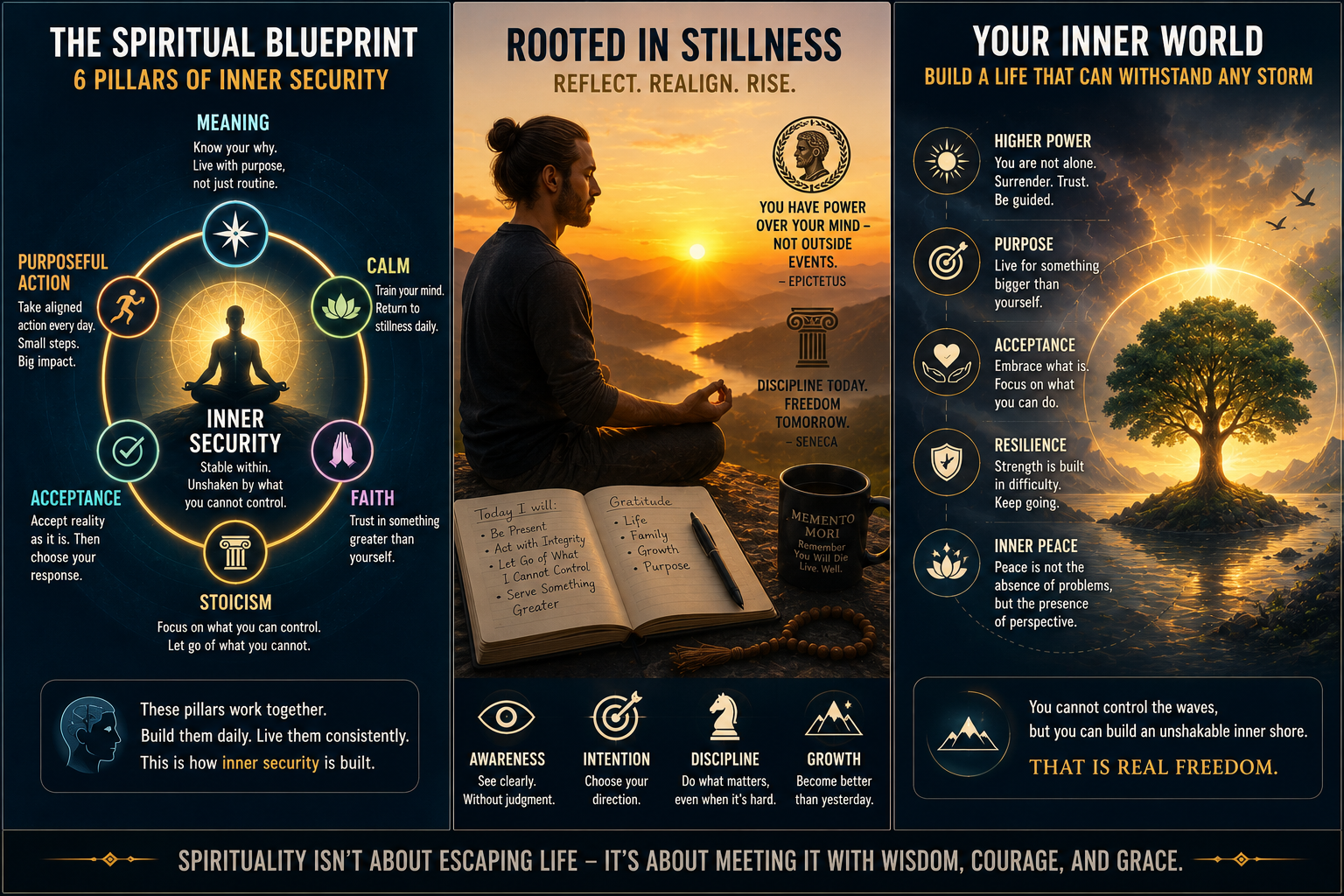
Why People Search for Meaning
People usually do not search for meaning when life feels easy. They search when the old answers stop working. A job loss, breakup, death, illness, failure, burnout, or even a quiet season of dissatisfaction can force someone to ask questions they were too busy to face before. Why am I here? What kind of person am I becoming? What matters when everything temporary falls away?
These questions are uncomfortable, but they are not signs of weakness. They are signs that the human being is more than a machine built to work, consume, sleep, and repeat. We need meaning because we are aware of time. We know life is temporary. We know our choices matter, but we do not always know how.
Spirituality gives people a way to interpret suffering without being destroyed by it. That does not mean every bad event is good or that pain should be romanticized. Some suffering is simply painful, unfair, and brutal. But the search for meaning asks whether even difficult experiences can deepen wisdom, compassion, courage, or clarity.
The Need for Inner Security
Most people try to build security outside themselves first. They look for stable income, stable relationships, stable routines, stable health, and stable plans. There is nothing wrong with that. External stability matters, and pretending it does not is naive.
But external security is always partly fragile. Jobs change. People leave. Bodies age. Plans fail. The economy shifts. The future refuses to guarantee itself. If your entire sense of safety depends on everything going according to plan, then life will constantly feel threatening.
Inner security is different. It does not mean you never feel fear. It means you develop a stable relationship with yourself, your values, and your response to life. You may not control what happens next, but you begin to trust that you can meet it with presence, honesty, and deliberate action. That kind of security is not granted in one dramatic moment. It is built slowly through practice.
Stoicism: Ancient Calm for Modern Chaos
Stoicism fits naturally into any serious discussion of spirituality because it deals with one of life’s hardest truths: much of what happens is not under your control. The Stoics understood that people suffer not only from events themselves, but from their judgments, expectations, resistance, and attachment to outcomes. They taught that peace begins by separating what is yours to govern from what is not.
This is not passive thinking. Stoicism does not tell you to give up. It tells you to stop wasting your strength on what you cannot command, so you can use that strength where it actually matters. You cannot fully control other people, the past, the weather, the economy, aging, or every outcome of your efforts. But you can work on your character, choices, discipline, attention, honesty, courage, and response.
That is deeply spiritual, even if it is not always framed as religion. It teaches humility because you admit the limits of your control. It teaches responsibility because you stop blaming everything outside yourself. It teaches calm because you no longer treat every inconvenience as an attack from the universe.
Acceptance Is Not Weakness
Acceptance is one of the most misunderstood spiritual principles. Many people hear the word and think it means surrendering, becoming passive, or allowing life to crush you. But real acceptance is not weakness. It is the refusal to waste energy arguing with reality after reality has already arrived.
If something has happened, your first task is to see it clearly. Denial delays wisdom. Resistance burns energy. Bitterness traps you in the emotional loop of wishing the past were different. Acceptance does not mean approving of what happened. It means admitting that it is now part of the landscape you must navigate.
This is where the old serenity-style wisdom becomes powerful: accept what you cannot change, change what you can, and learn the difference. That sentence is popular because it is practical. It prevents two opposite errors: helpless passivity and exhausting control. Spiritual maturity lives between those extremes.
Believing in a Higher Power
For many people, belief in a higher power is one of the strongest sources of calm. That higher power may be understood as God, divine intelligence, universal consciousness, providence, or something beyond human language. The exact framework differs, but the psychological and spiritual effect can be similar: the person no longer feels completely alone inside existence.
Belief in a higher power can soften the terror of uncertainty. It can help people endure grief, failure, and confusion because they trust that life is not merely random noise. Prayer, surrender, gratitude, and worship can give structure to pain. They allow a person to place their burdens somewhere beyond their own nervous system.
The skeptical view matters too. Belief can become unhealthy when it is used to avoid responsibility, deny reality, or excuse harmful behavior. But at its best, faith does not make people weaker. It makes them steadier. It gives them the courage to act while accepting that not everything is theirs to control.
Spirituality Without Dogma
Some people are drawn to spirituality but suspicious of rigid belief systems. They may not know exactly what they believe about God, the soul, the afterlife, or destiny. They may respect religion but struggle with institutions. They may feel something sacred in nature, music, silence, service, or moments of deep connection.
That kind of spirituality still counts. The search for meaning does not always arrive fully labeled. Sometimes it begins as a quiet refusal to live cynically. Sometimes it is the sense that beauty matters. Sometimes it is the feeling that conscience is real, love is not merely chemical, and life contains layers we do not fully understand.
A grounded spiritual life does not require pretending to know everything. In fact, humility may be one of its clearest signs. The person who admits mystery often sees more clearly than the person who claims certainty too quickly. Spirituality should deepen honesty, not replace one kind of confusion with another.
Calm Is a Practice, Not a Mood
Many people chase calm as if it is a mood they can capture permanently. They imagine that one day they will become peaceful enough that stress, anger, fear, and sadness stop visiting. But that is not how human life works. Calm is not the absence of all disturbance. It is the ability to return to center after disturbance arrives.
This is where spiritual practices become useful. Meditation, prayer, journaling, breathwork, walking in nature, reading wisdom literature, attending worship, practicing gratitude, or reflecting quietly at the end of the day all train the mind to return. They are not magic. They are repetitions. Each practice teaches the nervous system and the soul the same message: come back.
The mistake is expecting one practice session to transform everything. Inner calm is more like physical fitness than a one-time insight. You build it through repetition. Five minutes of sincere stillness every day will usually do more than one dramatic spiritual weekend followed by months of neglect.
The Journey Is the Destination
One of the most repeated spiritual ideas is that the journey matters as much as the destination. That can sound cliché until life proves it true. Many people spend years postponing peace until a future condition is met. They tell themselves they will relax after the promotion, after the move, after the relationship improves, after the debt is gone, after they finally become the person they think they should be.
But the finish line keeps moving. There is always another goal, another problem, another uncertainty, another reason to delay presence. If you cannot find some meaning in the process, success will never fully satisfy you. You will reach one milestone and immediately hand your peace to the next one.
Spirituality challenges that pattern. It does not tell you to stop striving. It tells you to stop abandoning the present while you strive. Build, work, improve, and pursue your goals, but do not treat today as worthless just because tomorrow is unfinished.
Competing Only With Yourself
Comparison is one of the fastest ways to lose spiritual balance. The moment your attention becomes obsessed with someone else’s path, your own path starts to blur. You begin measuring your life against people with different histories, advantages, wounds, responsibilities, and destinies. That comparison rarely creates wisdom. It usually creates anxiety or pride.
A more grounded approach is to compete with your former self. Are you more honest than you were last year? More disciplined? More patient? More courageous? More aligned with what you claim to value? These questions bring your power back because they return attention to your own choices.
This does not mean ignoring inspiration from others. It means refusing to let someone else’s timeline become the judge of your worth. Your spiritual task is not to become a copy of another person. It is to become responsible for your own life.
Positivity Without Denial
There is a shallow version of positivity that tells people to ignore pain, force a smile, and pretend everything is fine. That kind of positivity can be harmful because it teaches people to distrust their own experience. If life hurts, admitting that it hurts is not negativity. It is honesty.
Grounded positivity is different. It acknowledges difficulty while refusing to let difficulty become the entire story. It says, “This is hard, but I am still capable of responding.” It says, “I do not see the path yet, but that does not mean no path exists.” It says, “I can grieve and still remain open to meaning.”
This is one of the quiet powers of spirituality. It does not have to deny darkness in order to believe in light. It can hold both. That is what makes it mature.
Why Spirituality Matters Today
Spirituality matters today because modern life is filled with noise but often starved of depth. People are surrounded by opinions, algorithms, advertising, outrage, entertainment, and pressure to constantly perform. It is easy to stay distracted for years and still never sit quietly with the basic question: am I living in a way that actually means something to me?
Without spirituality, or at least some deeper philosophy of life, people often become reactive. They chase approval, fear discomfort, numb themselves with distraction, and measure their worth by external markers. They may appear functional on the outside while feeling internally scattered.
A spiritual orientation gives life a center. It reminds you that your character matters. Your attention matters. Your response to suffering matters. Your ability to love, forgive, build, serve, and keep going matters. Meaning is not always something you discover like buried treasure. Sometimes it is something you create through how you live.
Final Verdict: Spirituality Is How You Stand Inside Uncertainty
Spirituality does not remove uncertainty from life. It teaches you how to stand inside it. It does not guarantee comfort, success, or perfect clarity. It gives you practices, perspectives, and principles that help you remain grounded when life refuses to be predictable.
For some people, that grounding comes through God. For others, it comes through Stoicism, meditation, nature, service, family, conscience, or the quiet belief that life has meaning even when it is difficult. The form matters less than the result. Does it make you more honest? More courageous? More compassionate? More stable? More awake to the life in front of you?
The deeper lesson is simple but demanding: you cannot wait for life to become certain before you begin living with meaning. You must build meaning while things are still unresolved. You must practice calm while the world is still noisy. You must choose faith, discipline, acceptance, and presence before you have perfect proof that everything will work out.
That is not weakness. That is strength. Spirituality, at its best, is the art of becoming anchored in a world that keeps moving.