
Nag Hammadi Library: The 1945 Discovery Explained
In late 1945, somewhere in the rugged landscape of Upper Egypt, a buried cache of ancient books re-entered the world. The discovery would eventually become known as the Nag Hammadi Library, a collection of Coptic manuscripts containing teachings, myths, prayers, dialogues, philosophical reflections, and alternative Christian writings that had been nearly invisible for more than a millennium.
For many readers, the discovery begins and ends with the Gospel of Thomas. That text alone is compelling: a collection of sayings attributed to Jesus, without the familiar narrative of Bethlehem, miracles, crucifixion, and resurrection found in the New Testament Gospels. But Thomas was only one work in a much stranger and more diverse collection. The Nag Hammadi codices also preserved texts about Sophia, angelic rulers called archons, the creation of the world, mystical ascent, resurrection, secret revelations, divine wisdom, and the conflict between ignorance and spiritual awakening.
The Nag Hammadi Library did not reveal a single hidden “real Bible,” and it did not prove that every non-canonical Christian text had been systematically suppressed. What it did reveal was more interesting: early Christianity was never as intellectually uniform as later popular retellings often make it sound. These books preserve evidence of ancient communities wrestling with the same massive questions people still ask now: Who is God? Why is the world broken? What is the soul? What did Jesus teach? And what does salvation actually mean?
Nag Hammadi at a Glance
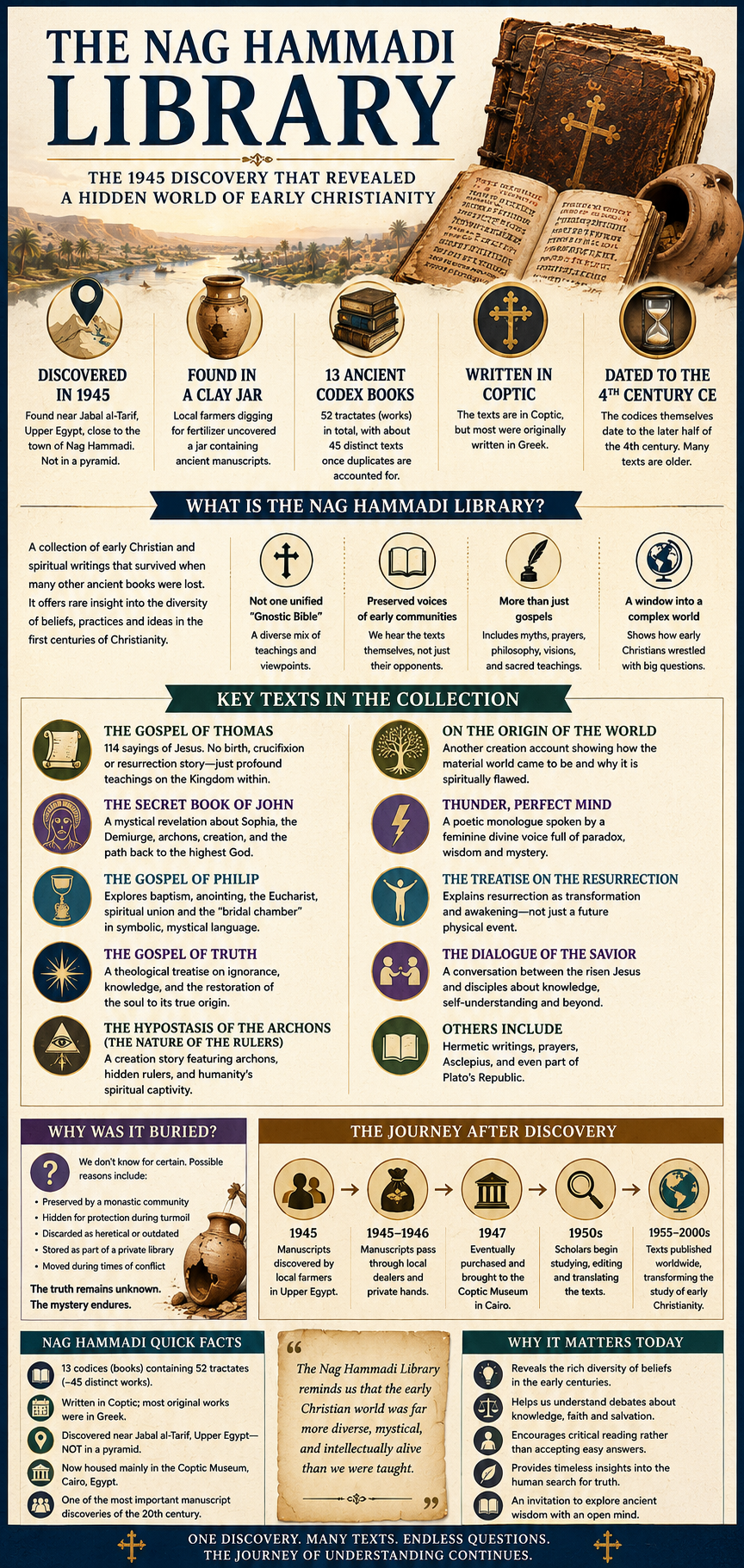
- The manuscripts were discovered in Upper Egypt in 1945, near the cliffs of Jabal al-Tarif, not inside a pyramid.
- The find is traditionally described as 13 leather-bound papyrus codices containing 52 tractates, with repeated works reducing the number of distinct texts.
- The books were written in Coptic, the language of Egyptian Christianity, and most appear to be translations or adaptations of older Greek works.
- The surviving physical codices are generally dated to the second half of the fourth century CE.
- The writings inside are older than the books themselves, with individual works coming from different communities and periods of early Christianity.
- The collection includes the Gospel of Thomas, Gospel of Philip, Gospel of Truth, Secret Book of John, Thunder, Perfect Mind, Hermetic texts, and even a section of Plato’s Republic.
Was the Nag Hammadi Library Found in a Pyramid?
No. The Nag Hammadi Library was not found in a pyramid, a tomb chamber, or a lost temple. The manuscripts were reportedly discovered near Jabal al-Tarif, a cliff formation on the east bank of the Nile in Upper Egypt, roughly 11 kilometres northeast of the modern town of Nag Hammadi.
The most repeated version of the story says that local farmers were digging for sebakh or sabakh—fertilizer-rich soil gathered from ancient deposits—when they uncovered a large earthenware jar. The jar allegedly contained the manuscripts, wrapped or stored as a group. One man commonly associated with the discovery is Muhammad Ali al-Samman, although the exact details of who found the manuscripts, who was present, and what happened immediately afterward are not fully settled.
That uncertainty is worth taking seriously. The story became famous because it has everything: a hidden jar, ancient books, rural Egypt, family conflict, black-market antiquities, and a trail that eventually led to Cairo and international scholarship. But historians have identified conflicting versions of the discovery account, including disagreements over the number of people present and even who first uncovered the jar.
The solid fact is simpler and more important: a collection of ancient Coptic codices surfaced in Upper Egypt in 1945. The manuscripts eventually reached scholars and institutions, and their publication transformed the study of Gnosticism, Coptic Christianity, and the variety of religious thought circulating during late antiquity.
What Exactly Was Found?
The Nag Hammadi Library is often described as 13 ancient books, but the technical picture is a little messier. The collection consists of leather-bound papyrus codices—books with pages rather than scrolls—and includes 52 tractates or individual works. Because several texts appear more than once, scholars commonly speak of roughly 45 distinct works within the collection.
This was not a random pile of scraps. These were substantial manuscript books, copied with care and bound in leather. The codices are among the oldest well-preserved examples of book-form manuscripts to survive from the ancient world, which makes the discovery important not only for theology but also for the history of writing, reading, libraries, and book production.
The manuscripts are written in Coptic, but most of the underlying works were probably first composed in Greek. That distinction matters. The surviving books may date to fourth-century Egypt, while the ideas and writings inside them often come from earlier Greek-speaking Christian and philosophical environments.
One clue comes from the recycled documentary papers used in some of the book covers. A dated text incorporated into the cover of Codex VII indicates that it was made after 348 CE, and scholars generally place the production of the codices in the latter half of the fourth century. That dates the physical books—not necessarily the original composition of every text inside them.
A Library, But Not One Unified “Gnostic Bible”
The phrase “Nag Hammadi Library” is useful, but it can also mislead people. It sounds as though the manuscripts were collected by one person, one church, or one secret society that agreed on everything. The evidence does not support that neat picture.
Many of the writings are associated with traditions modern scholars call Gnostic, a broad label for movements that often emphasized spiritual knowledge, the soul’s alienation from the material world, and salvation through awakening or revelation. But the collection does not represent one simple Gnostic denomination. Its texts differ sharply in style, theology, genre, and purpose.
Some are revelation dialogues in which a risen Jesus teaches a disciple privately. Some are creation myths. Some are prayers. Some are philosophical treatises. Some are mystical poems. Some reinterpret Genesis in startling ways, while others focus on ethical transformation, asceticism, the soul, baptism, or sacred knowledge.
The collection also contains works outside what most readers would casually call Gnostic. It includes Hermetic material connected to Greco-Egyptian philosophical spirituality, as well as a reworked Coptic translation of part of Plato’s Republic. The Nag Hammadi Library was therefore not simply “lost Christian scripture.” It was a surviving cross-section of a much wider intellectual and spiritual world.
The Gospel of Thomas: The Text Most People Come Looking For
The Gospel of Thomas is probably the best-known work in the Nag Hammadi Library. Unlike Matthew, Mark, Luke, or John, it is not a narrative biography of Jesus. It does not tell the story of his birth, public ministry, crucifixion, or resurrection. Instead, it presents a collection of 114 sayings attributed to Jesus.
Some sayings feel familiar because they resemble material found in the New Testament Gospels. Others are stranger, more paradoxical, or more inward-looking. Readers encounter sayings about seeking, finding, becoming “one,” recognizing what is hidden, and discovering the kingdom in ways that can sound mystical or cryptic.
The Gospel of Thomas is important because it shows that early Christians preserved Jesus traditions in more than one literary form. Not every ancient “gospel” was trying to function as a biography. Some were sayings collections, some were revelation dialogues, and some were theological meditations written in the voice of an apostle or disciple.
Its date remains debated. The fourth-century Coptic copy found at Nag Hammadi is not the same thing as the date of the original composition. Scholars continue to debate how early Thomas is, how it relates to the canonical Gospels, and whether certain sayings preserve independent traditions or later reinterpretations. The responsible approach is to treat Thomas as historically important without casually declaring it either “the oldest gospel” or “a fake written centuries later.”
The Secret Book of John: Sophia, Creation, and the Archons
The Secret Book of John, also called the Apocryphon of John, is one of the most important texts in the entire collection. It appears in three Nag Hammadi codices, an unusual level of repetition that suggests it held special importance for the communities that copied these books.
The text is framed as a secret revelation from the risen Jesus to John, the son of Zebedee. Its subject is enormous: the origin of the divine realm, the creation of the material world, the making of humanity, the cause of spiritual ignorance, and the path back to the highest God.
This is where readers encounter ideas such as Sophia, divine Wisdom; the Demiurge, an inferior creator figure; and the archons, lower cosmic rulers who help maintain ignorance and spiritual captivity. These terms are often thrown around casually in alternative-spirituality content online, but the original texts are much more complicated than a simple “good God versus evil creator” cartoon.
The Secret Book of John is an ideal future article because it opens up several major themes at once: Sophia, the Garden of Eden, the serpent, the creation of Adam, the rulers of the material cosmos, and the idea that knowledge can be liberating rather than merely forbidden. It also gives readers a useful entry point into why Gnostic creation stories could sound radically different from Genesis while still clearly interacting with biblical language.
The Gospel of Philip: Mysticism, Sacraments, and Misused Claims
The Gospel of Philip is another text that has attracted more attention than most of the Nag Hammadi collection. It is often dragged into sensational claims about Jesus and Mary Magdalene, but that is not the best way to read it. The text is not a conventional biography, and it does not provide a straightforward historical account of Jesus’ private life.
Instead, the Gospel of Philip is a dense collection of reflections on sacraments, spiritual rebirth, baptism, anointing, Eucharistic imagery, resurrection, and a mysterious concept called the bridal chamber. Its language is symbolic, layered, and often difficult to interpret.
The “bridal chamber” is not simply a claim about ordinary marriage. In the text’s wider symbolic world, it points toward spiritual reunion, restoration, and the overcoming of division. That does not stop people from using isolated lines to support dramatic theories, but a careful reading requires more restraint.
This is exactly why the Gospel of Philip would make an excellent follow-up article. It allows for a strong myth-versus-text format: what the manuscript actually says, what later readers claim it says, and why those are often not the same thing.
Other Major Works Recovered at Nag Hammadi
The Nag Hammadi Library is full of texts that deserve their own articles. A few stand out immediately:
- The Gospel of Truth — not a biography of Jesus, but a theological meditation on ignorance, revelation, divine knowledge, and restoration.
- The Hypostasis of the Archons — often translated as The Nature of the Rulers; a reinterpretation of Genesis involving cosmic rulers, Eden, Adam, Eve, and spiritual deception.
- On the Origin of the World — another large creation narrative that explores how the visible world came to exist and why it is spiritually flawed.
- Thunder, Perfect Mind — a remarkable poetic monologue spoken by a feminine divine voice full of paradoxes: exalted and despised, wise and foolish, strong and weak.
- The Treatise on the Resurrection — a letter-like work that treats resurrection as more than a future event, emphasizing transformation and spiritual understanding.
- The Dialogue of the Savior — a revelation dialogue between Jesus and disciples, focused on knowledge, self-understanding, and the path beyond death.
- Discourse on the Eighth and Ninth — a Hermetic text about spiritual ascent through higher realms of reality.
- The Prayer of Thanksgiving and Asclepius 21–29 — works connected to Hermetic religious philosophy rather than a simple Christian-Gnostic category.
Together, these works show why the Nag Hammadi Library is better understood as a world of texts than as a single book. It contains competing answers to the same ancient questions: What is the soul? Why does suffering exist? Is the world good, fallen, or imprisoned? What does resurrection mean? And how does a person move from ignorance toward truth?
Why Were the Codices Buried?
This is one of the most tempting mysteries surrounding Nag Hammadi, and it is also one of the easiest places to overstate the evidence. Scholars do not know with certainty who buried the codices, when they were buried, or why.
One long-standing theory connects the books to nearby Pachomian monasteries. Some scholars have argued that monks may have owned, copied, studied, or preserved the manuscripts. Others suggest they may have been collected as texts to refute, or that they represented a more diverse reading culture within Egyptian monastic communities than older assumptions allowed.
Another popular theory links the burial to Athanasius of Alexandria’s 367 CE festal letter, which listed books he considered canonical and warned against certain other writings. The timing is interesting, but it remains a theory, not a solved case. There is no surviving note saying, “These books were buried because of Athanasius.”
That uncertainty should make the discovery more interesting, not less. The manuscripts may have been hidden for protection, discarded as outdated, stored as grave goods, preserved by readers who valued them, or moved during a period of conflict. The honest answer is that the library still keeps part of its origin story hidden.
What the Nag Hammadi Discovery Changed
Before 1945, scholars knew about many Gnostic and non-canonical Christian teachings mainly through critics such as Irenaeus, Hippolytus, and other church writers who argued against them. The Nag Hammadi codices provided direct access to the voices of the texts themselves.
That does not mean every criticism made by early church writers was false, nor does it mean the codices suddenly disproved the New Testament. It means historians could finally compare polemical descriptions with surviving primary texts. That is a major shift in any field: moving from hearing only what opponents said about a group to reading some of that group’s own literature.
The find also complicated the overly simple idea that early Christianity was one unified movement that later fragmented. The manuscripts reveal diversity much earlier: competing interpretations of Jesus, salvation, creation, authority, scripture, ritual, spiritual knowledge, and the material world.
For readers today, the Nag Hammadi Library is valuable because it offers a warning against easy answers. It does not prove every alternative claim made online, but it does prove that the ancient religious world was far more varied, experimental, mystical, and intellectually alive than many people were taught.
Final Thoughts
The Nag Hammadi Library was not discovered in a pyramid, and it is not a secret vault containing one simple replacement for the Bible. It is more valuable than that. It is a surviving library from a turbulent world where Christians, philosophers, mystics, monks, and religious seekers were trying to understand the nature of God, the origin of evil, the destiny of the soul, and the meaning of Jesus.
The Gospel of Thomas may be the doorway, but it is not the whole building. Beyond it are creation myths, secret dialogues, mystical poetry, sacramental reflections, resurrection teachings, and a stunning variety of ancient spiritual thought. That makes Nag Hammadi a perfect starting point for a larger series: one discovery, many texts, and enough unanswered questions to keep readers exploring for a long time.
- Nag Hammadi Archive — Claremont Colleges Digital Library — Explore digitized Nag Hammadi manuscripts and scholarly collection material.
- The Nag Hammadi Codices and Their Ancient Readers — Cambridge University Press — A scholarly study of the codices, their material form, possible origins, and ancient reading practices.
I personally believe the library of Nag Hammadi was buried to keep others from discovering the truth. A lot of the texts seem to take apart the churches’ narrative and replace it with one that gives power to the self and not the church. Almost like the hiding of the texts was an attempt to keep humanity fragmented.