
Are We Living Inside a Designed Reality?
What if the world around you is not quite what it appears to be? Not fake in the shallow sense, not meaningless, and not some cartoonish illusion where nothing matters, but something stranger: a deeply convincing reality generated by a higher system. Every tree, memory, atom, argument, sunset, dream, and coincidence could still feel real from the inside, while being part of something larger than we currently understand.
That is the unsettling pull of Simulation Theory. It does not simply ask whether life is “like a video game.” That version is too cheap. The deeper question is whether reality itself could be informational, generated, computed, or designed in a way that our minds experience as physical existence. If a future civilization could create conscious beings inside a simulated universe, and if such simulations could vastly outnumber base realities, then how confident should we be that we are living in the original layer?
The idea sounds like science fiction, and in many ways it is. It lives in the same mental neighborhood as The Matrix, virtual reality, artificial intelligence, ancient spiritual ideas about illusion, and modern debates about consciousness. But it also touches serious philosophy, physics, and technology. That combination is exactly why it refuses to disappear.
What Is Simulation Theory?
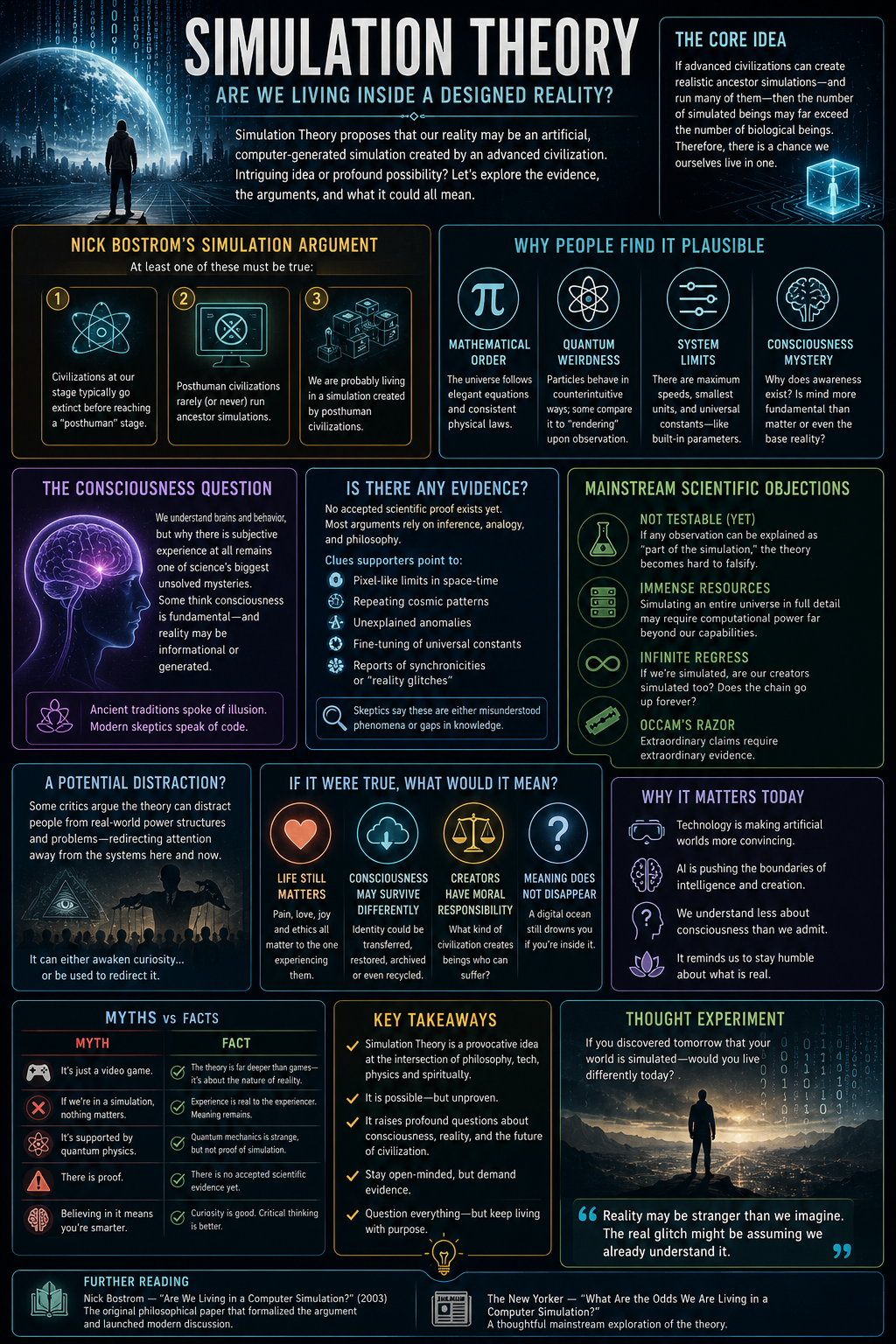
Simulation Theory is the idea that our experienced reality may be an artificial or generated environment rather than the deepest layer of existence. In its modern form, the theory is often linked to philosopher Nick Bostrom, who argued that at least one of three broad possibilities may be true: civilizations like ours never reach a stage where they can create ancestor simulations, advanced civilizations choose not to run such simulations, or we are probably already living in one.
That argument does not prove we are simulated. It is more like a philosophical trapdoor. If technology keeps advancing, if conscious minds can eventually be simulated, and if advanced civilizations run many simulated worlds, then simulated observers could eventually outnumber biological observers in base reality. Under that scenario, it becomes harder to casually assume we are definitely in the original world.
The key word is “if.” Simulation Theory depends on major assumptions. We do not currently know whether consciousness can be simulated. We do not know whether future civilizations would have enough computing power. We do not know whether they would want to run realistic historical worlds full of suffering, confusion, joy, discovery, and moral consequence. The theory is fascinating because it is possible enough to provoke thought, but unproven enough to demand caution.
Why Simulation Theory Fascinates People
Simulation Theory fascinates people because it connects old human questions with new technological imagination. Long before computers existed, people wondered whether the visible world was the full truth. Ancient philosophers questioned appearances. Mystics described the material world as illusion, veil, dream, or shadow. Religions often suggested that ordinary life is only one layer of a deeper reality.
Modern technology gives that ancient suspicion a new costume. Instead of a dream, we imagine code. Instead of a veil, we imagine rendering. Instead of spiritual realms, we imagine nested simulations. The vocabulary has changed, but the human unease is familiar: what if the world we experience is not the foundation, but the surface?
There is also the video game analogy. A person living in the early 1980s saw crude digital blocks. A person today can wear a headset and enter increasingly realistic virtual environments. Artificial intelligence can generate images, voices, videos, conversations, and entire synthetic scenes. If this is what early-stage technology can do, people naturally wonder what a civilization thousands or millions of years more advanced could create.
That does not mean the universe is a simulation. But it explains why the idea feels newly plausible. We are the first generations to watch artificial worlds become convincing in real time. Once humans start building miniature realities, it becomes harder not to ask whether we are also inside one.
The Strange Features of Reality Supporters Point To
Supporters of Simulation Theory often point to the unusual structure of reality itself. The universe is not random chaos. It follows mathematical laws with astonishing precision. Gravity, electromagnetism, quantum mechanics, relativity, chemistry, and planetary motion can be described through equations. To some people, that mathematical elegance feels less like accident and more like architecture.
Mathematics is one of the strongest emotional arguments for believers, even if it is not proof. Nature behaves as though it is readable. The same universe that produces storms, stars, cells, and brains also obeys deep numerical patterns. Supporters ask a provocative question: why should reality be so mathematically structured in the first place?
Skeptics respond that this may be backwards. Maybe mathematics describes reality because humans invented or discovered mathematical systems that fit patterns. A map matching a landscape does not prove the landscape was created by the map. Mathematics may be our best language for describing nature, not evidence that nature is software.
Still, the strangeness remains. Whether mathematics is discovered, invented, or somehow built into reality, the universe is astonishingly orderly. Simulation Theory thrives in that gap between explanation and wonder.
Quantum Mechanics and the “Rendering” Analogy
Quantum mechanics is another reason Simulation Theory gets attention. At small scales, particles behave in ways that challenge everyday intuition. They can exist in probabilistic states, become entangled, and appear affected by measurement in ways that are difficult to visualize using ordinary common sense. This has led some people to compare quantum behavior to a video game rendering only what the player observes.
The analogy is seductive. In a video game, the entire world does not need to be fully rendered at all times. The system prioritizes what the player sees or interacts with. Supporters speculate that perhaps physical reality works in a similar way, with measurement acting like a request for definite information. In this view, the universe may be less like solid machinery and more like an information system responding to interaction.
But this is where careful thinking matters. Quantum mechanics is real science. The simulation interpretation is speculation layered on top of real science. Strange quantum behavior does not automatically mean there is a cosmic computer. It may simply mean reality operates according to principles our everyday brains did not evolve to understand intuitively.
The best way to handle this section is neither blind belief nor lazy dismissal. Quantum physics shows that reality is stranger than common sense. It does not prove Simulation Theory, but it does weaken the overconfident assumption that the world is simple, obvious, and fully understood.
Consciousness: The Hardest Problem in the Room
The most haunting part of Simulation Theory is not physics. It is consciousness. Why is there subjective experience at all? Why does the brain produce the feeling of being someone? Why is there an inner world of pain, memory, color, love, fear, imagination, and self-awareness instead of only blind physical processes?
This is often called the hard problem of consciousness. We can study neurons, electrical signals, brain regions, and behavior, but that still does not fully explain why experience exists from the inside. A machine could process information without feeling anything, at least as far as we know. A brain processes information and somehow produces the lived sense of being.
Simulation Theory becomes interesting here because it suggests consciousness may not be what we assume. If reality is informational, then consciousness might be part of the system at a deeper level. Perhaps awareness is not merely a byproduct of matter, but something more fundamental, more portable, or more difficult to reduce.
That is a big leap. We should not pretend it is proven. But the mystery of consciousness keeps the door cracked open. Until we understand why experience exists, we should be humble about what reality is and what minds are.
Is There Any Real Evidence?
This is where many articles on Simulation Theory become careless. There is currently no accepted scientific proof that we live in a simulation. No public experiment has revealed hidden code behind the universe. No confirmed “glitch” has exposed the machinery of reality. No creator, operator, or external civilization has been detected.
Most of the theory relies on philosophy, probability, analogy, and speculation. The argument is not “we found the code.” The argument is closer to this: if advanced simulations become possible, and if many are created, then simulated worlds may greatly outnumber original worlds. Therefore, perhaps we are more likely to be inside one of the simulations than in base reality.
That is interesting, but it is not the same as evidence. It depends on assumptions stacked on assumptions. Maybe advanced civilizations destroy themselves before reaching that stage. Maybe they reach it but refuse to create conscious simulations for ethical reasons. Maybe consciousness cannot be simulated at all. Maybe universe-scale simulations are impossible because of physical limits we do not yet understand.
Supporters still look for clues. They point to pixel-like limits, cosmic patterns, fine-tuned constants, synchronicities, déjà vu, strange coincidences, and reports of reality glitches. These stories are compelling, but most can also be explained through psychology, probability, incomplete science, or selective attention. Strange does not automatically mean artificial.
The Fine-Tuning Question
One of the strongest philosophical arguments connected to Simulation Theory is fine-tuning. The universe appears to have physical constants that allow stars, chemistry, planets, and life to exist. If certain values were slightly different, life as we know it might not be possible. Supporters argue that this resembles careful calibration.
The fine-tuning argument is not exclusive to Simulation Theory. Religious thinkers may see it as evidence of God. Multiverse supporters may argue that many universes exist, and we naturally find ourselves in one compatible with observers. Simulation supporters may argue that constants look like adjustable parameters in a designed system.
The honest answer is that fine-tuning remains deeply debated. It is a real philosophical and scientific puzzle, but different people interpret it differently. It may suggest design. It may suggest a multiverse. It may reflect unknown physical necessity. Or it may be a question we are not yet equipped to answer.
This is why Simulation Theory works best as a thought experiment rather than a doctrine. It invites us to ask why reality has the properties it has, but it should not rush to declare victory before the evidence arrives.
The Mainstream Scientific Objections
The biggest scientific objection to Simulation Theory is testability. For an idea to become strong science, it needs to make predictions that can be tested. If every possible observation can be explained as “part of the simulation,” then the theory becomes difficult to falsify. A theory that explains everything can sometimes explain nothing.
There is also the resource problem. Simulating an entire universe in full detail seems almost unimaginably difficult. Every galaxy, particle, interaction, biological system, thought, and historical moment would require staggering computation if simulated at full resolution. Supporters respond that the simulation may not need to render everything fully all the time, but that is another assumption.
Then there is the infinite regress problem. If our universe is simulated by a higher civilization, who created theirs? Are they also simulated? Does the chain go upward forever? At some point, the theory either requires a base reality or a structure far stranger than the one it tries to explain.
These objections do not destroy Simulation Theory, but they stop it from being treated as established fact. The idea is intellectually serious enough to discuss, but not strong enough to believe blindly.
Could Simulation Theory Become a Distraction?
There is another criticism that is less scientific and more cultural. Some people argue that Simulation Theory can become a distraction from real-world power. Instead of asking who controls media, money, surveillance, technology, governments, and institutions, people drift into abstract debates about cosmic programmers.
That is a fair warning. A powerful idea can awaken curiosity, but it can also redirect attention. If someone uses Simulation Theory as an excuse to ignore responsibility, avoid action, or treat life like a meaningless game, then the theory becomes harmful. Reality still has consequences, whether it is simulated or not.
On the other hand, the theory can also produce humility. It can remind people not to be arrogant about what they think they know. It can encourage deeper questions about consciousness, ethics, technology, and the future of artificial intelligence. The danger is not the question itself. The danger is turning the question into escapism.
A balanced mind can explore the idea without becoming trapped by it.
If Reality Were Simulated, Would Life Still Matter?
One of the strangest assumptions people make is that simulated reality would automatically be meaningless. That does not follow. If you suffer, the suffering matters to you. If you love someone, that love matters to the one experiencing it. If a child laughs, a person grieves, or someone sacrifices for another, the meaning does not vanish simply because the substrate is different.
A digital ocean still drowns you if you are inside it. A simulated heart can still break if consciousness is genuinely present. The moral weight of experience depends on the reality of the experience, not necessarily the material underneath it.
In fact, if Simulation Theory were true, ethics might become even more important. It would raise disturbing questions about the responsibility of creators. What kind of civilization would create conscious beings capable of suffering? Would simulated beings have rights? Could creators be judged for the worlds they design?
These questions are no longer purely fictional. As artificial intelligence advances, humanity may eventually face weaker versions of them. If we create increasingly complex artificial minds, we may become the “higher layer” we once imagined.
The AI Connection
Artificial intelligence gives Simulation Theory new urgency because it makes the creation of artificial minds feel less impossible. Today’s AI systems are not conscious in any proven sense, but they are already capable of generating language, images, code, voices, videos, and synthetic environments. They can imitate conversation, create fictional worlds, and respond in ways that feel increasingly lifelike.
This does not mean AI proves simulated reality. But it changes the emotional landscape. The more humans build systems that imitate intelligence, the easier it becomes to imagine intelligence itself emerging in artificial environments. The more we build virtual worlds, the easier it becomes to imagine future worlds that are vastly more convincing than ours.
The most practical takeaway is not “we are definitely simulated.” It is that the boundary between natural and artificial experience may become one of the defining questions of the future. Simulation Theory is not just about where we came from. It may also be about what we are becoming.
If future humans build conscious simulations, we may have to answer the very questions we are now asking about ourselves.
Ancient Illusion, Modern Code
Part of the appeal of Simulation Theory is that it feels both futuristic and ancient. Plato’s cave imagined people mistaking shadows for reality. Eastern spiritual traditions often describe ordinary perception as incomplete or illusory. Mystics across cultures have suggested that the visible world is not the final layer.
Modern Simulation Theory replaces shadows with pixels and illusion with computation. The ancient seeker asked, “What lies beyond the veil?” The modern technologist asks, “What lies beyond the interface?” The emotional question is almost the same.
Of course, similarity does not equal proof. Ancient teachings do not prove we live in a computer simulation. But they do show that humans have always suspected reality contains hidden depth. The computer age simply gives that suspicion a new metaphor.
Maybe that is the deeper reason the theory spreads. It speaks to an old human intuition using the language of modern technology.
The Best Argument Against Believing Too Quickly
The strongest argument against believing Simulation Theory too quickly is simple: humans are pattern-seeking creatures. We are very good at finding meaning, even where none exists. We see faces in clouds, messages in coincidences, and design in randomness. That ability helps us survive, but it can also mislead us.
A person who wants reality to be mysterious will find mystery everywhere. A person who wants evidence of glitches will notice every coincidence. A person who feels trapped by life may find comfort in imagining the world as a game or test. Psychology can make speculative ideas feel more certain than they are.
That does not mean the theory is false. It means personal fascination should not be confused with proof. The honest position is to stay curious without surrendering judgment. Wonder is valuable, but standards matter.
The universe may be strange. Our interpretation of it may be stranger.
Why Simulation Theory Matters Today
Simulation Theory matters today because it forces us to confront uncertainty. We live in a time when technology is making artificial reality more convincing, artificial intelligence more powerful, and digital life more immersive. The line between real and generated is already blurring in media, relationships, work, entertainment, and identity.
Even if we are not living in a simulation, we are building simulated layers around ourselves. Social media is a filtered reality. Algorithms shape what people see. AI can fabricate images and voices. Virtual worlds are becoming more believable. In a practical sense, the simulation question is no longer only cosmic. It is social, technological, and psychological.
The theory also matters because it humbles scientific arrogance and spiritual arrogance at the same time. Science has learned a staggering amount, but it has not solved consciousness, origin, purpose, or the deepest nature of reality. Spiritual traditions may contain powerful insights, but they can also overstate certainty. Simulation Theory sits between these worlds and asks both sides to admit how much remains unknown.
That humility is useful. A person who knows they do not fully understand reality may become more careful, more curious, and less easily manipulated.
Should You Believe Simulation Theory?
Simulation Theory is one of the most fascinating ideas of the modern age, but it remains unproven. It combines philosophy, probability, artificial intelligence, physics, consciousness, ancient metaphysics, and science fiction into one enormous question: what if reality is not the base layer?
Believing it as fact would be premature. There is no accepted scientific proof that we live inside a simulation, and many arguments depend on assumptions we cannot currently verify. The theory has serious problems, including testability, computing limits, infinite regress, and the unresolved mystery of consciousness.
But dismissing it without thought is also lazy. Reality has already turned out to be stranger than common sense. Quantum mechanics, relativity, consciousness, and the mathematical structure of nature all suggest that the universe is not as obvious as it appears. Simulation Theory may not be true, but it points toward questions worth asking.
The smartest position is probably not belief or disbelief. It is disciplined curiosity. Stay open. Stay skeptical. Do not mistake speculation for evidence, but do not mistake today’s limits for tomorrow’s impossibilities.
If reality is a system, then questioning it may be part of waking up. And if it is not, the act of questioning still makes you more awake than most.
Nick Bostrom’s Original Simulation Argument
This is the paper that made the theory famous and brought it into mainstream philosophy.
Nick Bostrom: Are You Living in a Computer Simulation?
The New Yorker – What Are the Odds We Are Living in a Computer Simulation?
Readable, mainstream publication discussing the theory in a thoughtful way.
The New Yorker: What Are the Odds We Are Living in a Computer Simulation?
Reader note: This article explores unusual claims, theories, beliefs, and interpretations. It aims to separate documented history, symbolism, belief, interpretation, and speculation wherever possible. Extraordinary claims are not presented as established fact unless supported by credible evidence.