
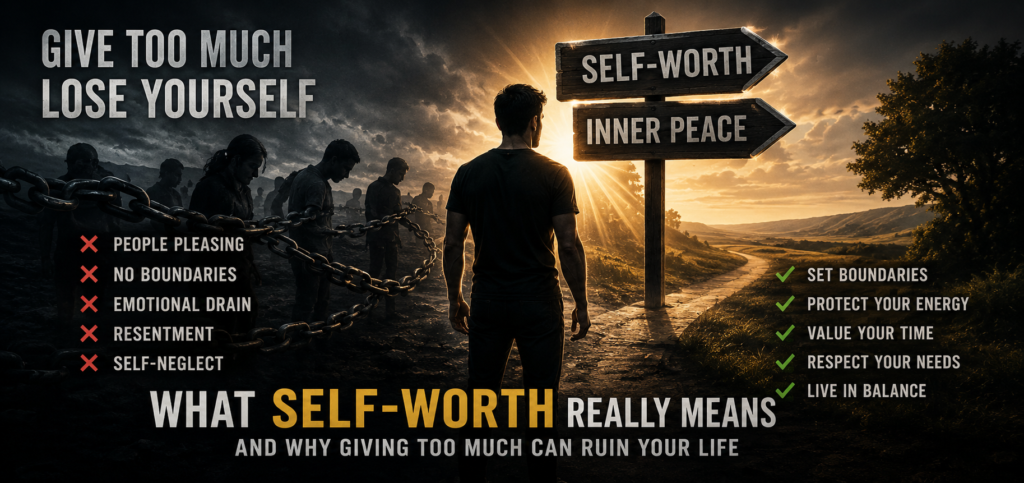
What Self-Worth Really Means — And Why Giving Too Much of Yourself Can Quietly Ruin Your Life
There is a quiet mistake many good people make, and it rarely looks like a mistake at first. They give more than they have. They listen when they are exhausted. They compromise before anyone even asks them to. They put themselves last so often that eventually they forget they were ever allowed to have a place in line.
At first, this can feel noble. It can feel loving, mature, spiritual, generous, or emotionally intelligent. You become the person who understands, the person who helps, the person who stays calm, the person who makes life easier for everyone else. People may even praise you for it, which makes the pattern harder to notice.
But over time, something changes. The giving starts to feel less like love and more like obligation. The patience turns into irritation. The kindness becomes resentment wearing a smile. Eventually, you realize you have been investing your energy into everyone else’s stability while quietly abandoning your own.
What Self-Worth Really Means
Self-worth is one of those phrases people use casually without really stopping to define it. Some people hear it and think of confidence, ego, self-esteem, or motivational quotes on social media. Others hear it and immediately feel uncomfortable, as if valuing yourself too much might make you selfish, arrogant, or detached from others.
But real self-worth is not arrogance. It is not walking into a room believing you are better than everyone else. It is not dominating conversations, refusing feedback, or demanding special treatment. That is not self-worth. That is insecurity wearing armor.
Real self-worth is quieter than that. It is the inner belief that your time matters, your energy matters, your emotions matter, and your life is not less important than everyone else’s. It is the ability to care about others without disappearing into their needs. It is the ability to give from a full place instead of trying to earn your right to exist through usefulness.
Self-Worth Is Not Selfishness
One of the biggest traps around self-worth is the belief that valuing yourself means caring less about other people. This belief keeps many decent people stuck in unhealthy patterns for years. They say yes when they mean no, stay silent when they are hurt, and stretch themselves beyond reason because they are terrified of becoming “selfish.”
But selfishness and self-worth are not the same thing. Selfishness says, “Only I matter.” Low self-worth says, “Everyone else matters more than me.” Healthy self-worth says, “I matter too.” That small difference changes everything.
A person with self-worth does not stop loving others. They simply stop using self-abandonment as proof of love. They still help, listen, support, and show up, but they do it with awareness. Their kindness has a center. Their generosity has a boundary. Their compassion includes themselves.
Why Over-Giving Feels Good at First
Over-giving often starts with good intentions. Many people who give too much are not weak or foolish. They are usually observant, empathetic, and sensitive to emotional changes around them. They notice when someone is upset. They sense tension before anyone says it out loud. They step in quickly because they do not want others to suffer.
At first, this can feel powerful. You feel needed. You feel useful. You feel like the one who keeps everything together. If you have spent much of your life feeling unseen, being needed can become intoxicating because it feels like proof that you matter.
But that is where the hidden trade begins. Instead of resting in your own worth, you start borrowing worth from other people’s dependence on you. Their relief becomes your validation. Their approval becomes your emotional paycheck. Their need becomes the thing that convinces you that you have value.
The Hidden Cost of Being Too Available
Being available is not automatically a problem. Healthy relationships require generosity, flexibility, and support. The problem begins when you become so available that people no longer have to consider what it costs you. Your energy becomes a public resource. Your time becomes flexible by default. Your boundaries become negotiable.
When this happens, you quietly train others to expect unlimited access to you. They may not even be bad people. They may simply adapt to what you repeatedly allow. If you always answer, always adjust, always rescue, and always absorb the inconvenience, people learn that your needs are optional.
That is when resentment begins to grow. Not always loudly. Sometimes it shows up as fatigue, irritation, emotional numbness, or a strange heaviness you cannot explain. You may start avoiding messages, dreading requests, or feeling angry at people who have technically done nothing wrong except accept the role you trained them to expect.
The Spiritual Trap of Self-Erasure
Many people confuse self-worth with ego because spiritual and motivational spaces often praise selflessness. We are told to be humble, serve others, forgive quickly, let go of ego, and lead with love. Those ideas can be beautiful when they are balanced. But when they are distorted, they become a recipe for self-erasure.
True humility does not mean pretending your needs do not exist. Real compassion does not require you to become emotionally bankrupt. Genuine spirituality should make you more whole, not easier to drain. A person with no boundaries is not automatically enlightened; sometimes they are simply unprotected.
This is the part people do not like to hear: if your peace depends on everyone else being happy with you, you are not centered. You are externally anchored. Your emotional state is being controlled by approval, conflict avoidance, and other people’s reactions. That is not spiritual freedom. That is dependency dressed in soft language.
The Difference Between Kindness and People-Pleasing
Kindness is honest. People-pleasing is strategic. Kindness gives because it chooses to. People-pleasing gives because it is afraid not to. From the outside, they may look similar, but internally they are completely different experiences.
When you are kind, you can help someone and still remain connected to yourself. You can say yes without resentment and no without collapse. You are not trying to control how people see you. You are simply acting from your values.
When you are people-pleasing, your nervous system is managing a threat. You are trying to avoid disappointment, conflict, rejection, criticism, or abandonment. You may smile, agree, and cooperate, but underneath it all you are negotiating for safety. That is why people-pleasing becomes exhausting. It is not generosity; it is emotional survival.
Self-Worth Shows Up in Your Ability to Say No
One of the clearest signs of healthy self-worth is the ability to say no without turning it into a courtroom defense. Low self-worth over-explains. It apologizes for having limits. It tries to soften the no so much that the other person can barely hear it. It leaves the door open even when the answer should be closed.
Healthy self-worth sounds much simpler. “That does not work for me.” “I am not available for that.” “I cannot take that on right now.” “I am choosing something else.” These statements are not rude. They are clear.
The challenge is that clarity can feel cruel when you are used to abandoning yourself. If you have spent years treating other people’s comfort as your responsibility, even a basic boundary can feel like aggression. But discomfort does not mean you are doing something wrong. Sometimes discomfort is simply the feeling of a new identity forming.
Why Boundaries Improve Relationships
Many people fear that if they build self-worth, they will lose people. Sometimes they are right, but not in the way they think. Healthy boundaries may cause certain relationships to weaken or end, especially if those relationships depended on your silence, availability, or guilt. That can hurt, but it is not always a loss.
Good relationships usually improve when boundaries become clearer. Your yes becomes more honest. Your presence becomes more intentional. Your help becomes cleaner because it is no longer mixed with resentment. People know where they stand with you, and you know where you stand with yourself.
Unhealthy relationships often react differently. Some people may accuse you of changing, becoming cold, or thinking you are better than them. But often what they really mean is that you are no longer as easy to access, pressure, or drain. Their reaction gives you information. It shows you whether they valued you as a whole person or mainly valued the version of you that had no limits.
Time Is Not Just Time
Time is not just a resource. It is your life broken into pieces. Every hour you give away unnecessarily is an hour you cannot use to build your future, restore your body, develop your gifts, enjoy your family, deepen your faith, create something meaningful, or simply breathe.
Most people understand this intellectually, but they do not live as if it is true. They give their time to conversations that go nowhere, obligations they secretly resent, distractions disguised as responsibilities, and emotional labor they were never actually asked to perform. Then they wonder why their own goals never move forward.
Protecting your time is not selfish. It is self-respect in practical form. If you do not consciously decide where your time goes, someone else will. And in many cases, they will spend it on their priorities, not yours.
The Quiet Resentment of Self-Betrayal
Resentment is often blamed on other people, but sometimes resentment is the emotional bill for self-betrayal. Every time you say yes while your body says no, something inside you notices. Every time you silence yourself to keep the peace, something inside you records the cost. Every time you abandon your own needs to maintain someone else’s comfort, you teach yourself that your inner world is not worth defending.
Eventually, the resentment leaks out. It may come out as sarcasm, withdrawal, impatience, emotional shutdown, or sudden anger over something small. The issue is rarely just the small thing that triggered the reaction. The real issue is the long pattern underneath it.
This is why self-worth is not just a confidence topic. It is an emotional stability topic. A person who constantly betrays themselves cannot stay peaceful for long. Peace requires alignment between what you feel, what you value, and how you actually live.
Being “Nice” Is Not the Same as Being Grounded
Niceness is often overrated because it can be used to hide fear. Many people are not nice because they are deeply loving. They are nice because they are afraid of being disliked, misunderstood, judged, or rejected. Their niceness is not fake exactly, but it is not fully free either.
A grounded person is not always nice in the surface-level sense. They may disappoint people. They may say difficult things. They may refuse requests. They may walk away from conversations that go in circles. But they are usually more trustworthy because they are honest.
This is an important distinction. Niceness tries to preserve comfort. Groundedness tries to preserve truth. A mature person can be kind without being false, compassionate without being spineless, and loving without becoming available for every emotional demand placed on them.
How to Re-Center Yourself Without Becoming Cold
Some people swing too far in the other direction once they realize they have been over-giving. They go from having no boundaries to building walls. They become suspicious, detached, and hard. That is understandable, especially after years of feeling used, but it is not the goal.
The goal is not to become cold. The goal is to become centered. A centered person still loves, but they do not lose themselves in love. They still give, but they do not give from guilt. They still listen, but they do not become a dumping ground. They still care, but they do not take ownership of every feeling in the room.
Re-centering starts with a pause. Before saying yes, ask yourself whether you actually have the capacity. Before fixing someone’s problem, ask whether it is truly yours to fix. Before explaining yourself, ask whether the explanation is necessary or whether you are trying to manage someone’s reaction.
Practical Signs Your Self-Worth Is Improving
Self-worth does not usually arrive in one dramatic breakthrough. It is built through repeated choices that slowly change how you relate to yourself. At first, those choices may feel awkward. Over time, they become your new normal.
Signs of improving self-worth include:
- You pause before automatically saying yes.
- You notice resentment earlier instead of ignoring it.
- You stop explaining every decision in excessive detail.
- You allow people to be disappointed without rushing to fix it.
- You choose rest without treating it like a moral failure.
- You spend more time on your own goals without constant guilt.
- You give from choice, not from fear.
These signs may look small from the outside, but internally they are major. Each one reinforces the same message: I am not an afterthought in my own life.
The Skeptical View: Can Self-Worth Become Self-Obsession?
There is a fair criticism worth taking seriously. Some self-worth content can become self-centered, shallow, or overly individualistic. It can encourage people to label every inconvenience as toxicity, every disagreement as disrespect, and every sacrifice as oppression. That is not maturity. That is ego using therapy language.
Real self-worth does not mean you never sacrifice. It does not mean your comfort always comes first. It does not mean every relationship must revolve around your preferences. Life requires compromise, service, patience, and responsibility.
The difference is whether the sacrifice is conscious and balanced or compulsive and self-erasing. Choosing to help someone you love during a hard season can be beautiful. Constantly abandoning your own life because you fear disapproval is something else entirely. Self-worth is not about refusing responsibility. It is about refusing to disappear.
Why This Matters Today
Self-worth matters more than ever because modern life constantly pulls people away from themselves. Phones demand attention. Work demands flexibility. Family systems demand roles. Social media demands comparison. Culture often praises productivity, availability, and performance while quietly punishing people who need rest, space, or time to rebuild.
In that environment, the person with weak self-worth gets consumed. They become available to every notification, every emotional demand, every guilt trip, every trend, and every crisis. They live reactively, always responding to what others need instead of choosing what their own life requires.
Self-worth gives you an inner filter. It helps you decide what deserves your attention, what drains your energy, what aligns with your values, and what needs to be released. Without that filter, life becomes a long series of other people’s priorities.
Final Verdict: Balance Is the Goal
Self-worth is not about becoming selfish, cold, arrogant, or unavailable. It is about becoming balanced. It is the quiet understanding that your life is also your responsibility, and that abandoning yourself does not make you more loving. It only makes you easier to drain.
The goal is not to stop giving. The goal is to give cleanly. Give when it is real. Help when you can. Love deeply. Be generous. But do not confuse love with self-erasure, and do not confuse guilt with goodness.
When you value yourself properly, your kindness becomes stronger because it is no longer infected with resentment. Your relationships become cleaner because your yes and no both mean something. Your peace becomes steadier because it is no longer controlled entirely by other people’s reactions.
You were not meant to disappear in service of everyone else. You were meant to participate in life fully, with presence, boundaries, and intention. Self-worth is not the act of placing yourself above others. It is the decision to finally stop placing yourself beneath them.
Wow I needed to hear this, great article!