
Book of Enoch Explained: Watchers, Giants & Judgment
The Book of Enoch is one of those ancient texts that seems to sit just outside the familiar biblical world, yet keeps pulling people back toward it. Readers hear about fallen angels, giants, the Nephilim, forbidden knowledge, strange heavenly visions, and a coming judgment—and naturally want to know whether this is a lost chapter of biblical history, spiritual symbolism, or something else entirely. The honest answer is that it is a little more complicated than the dramatic online summaries make it sound.
Usually, when people say “the Book of Enoch,” they mean 1 Enoch, an ancient Jewish apocalyptic collection attributed to Enoch, the patriarch in Genesis who “walked with God.” It expands the brief and mysterious material around Genesis 5 and Genesis 6 into a much larger story about angelic rebellion, human violence, cosmic order, divine justice, and the eventual restoration of creation. Scholars generally treat it as a composite work assembled over time rather than a single document personally written by the historical Enoch.
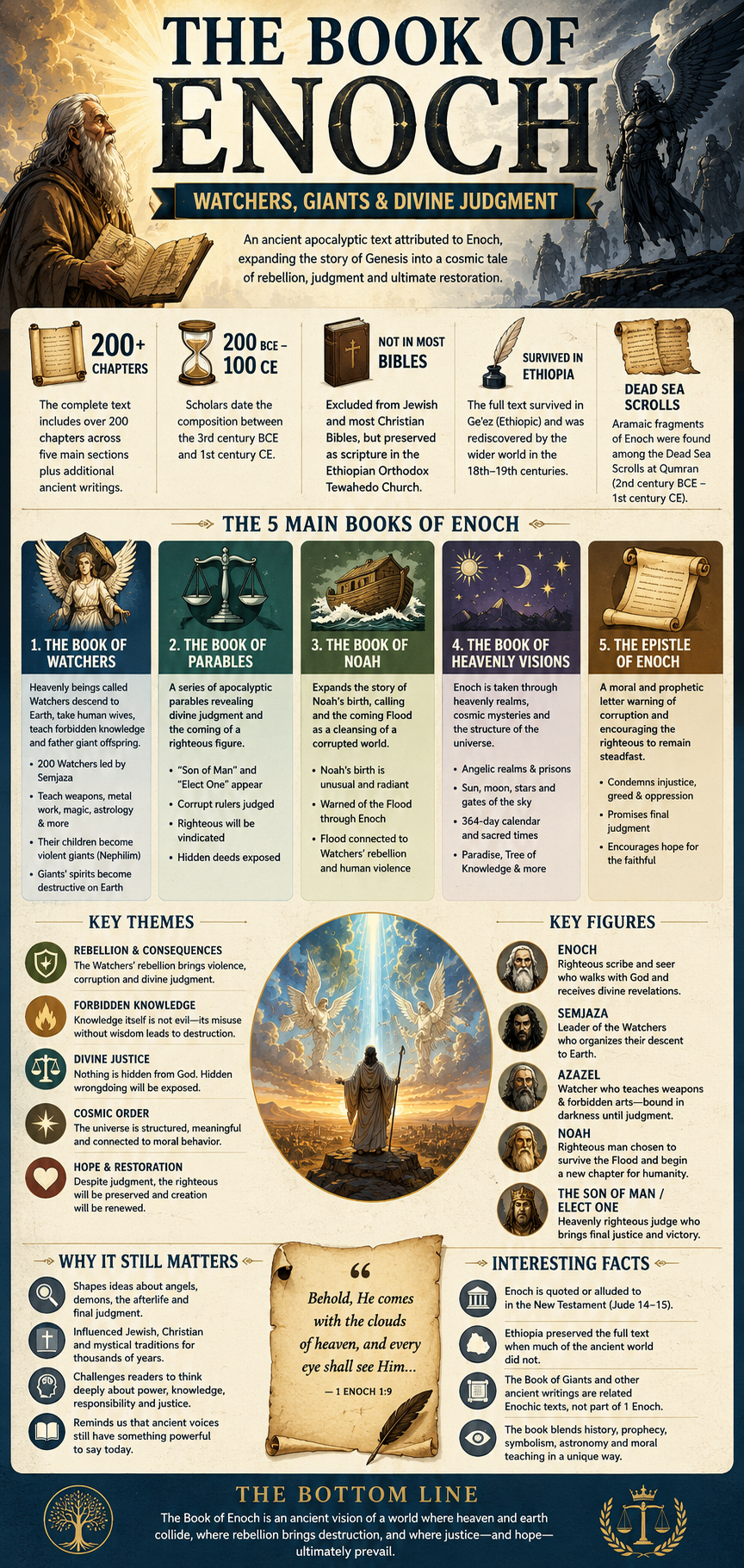
Book of Enoch at a Glance
- The Watchers are heavenly beings who descend to Earth, take human wives, and reveal dangerous knowledge.
- Their giant offspring help spread violence and corruption across the world.
- Enoch becomes a heavenly messenger who delivers judgment to the rebellious angels.
- Noah and the Flood appear as part of a larger cleansing of a world corrupted by both humans and supernatural beings.
- The book includes visions of heaven, angels, the dead, cosmic order, final judgment, and a mysterious righteous figure called the “Son of Man” or “Elect One.”
- Its core message is not simply about secrets or giants. It is about the belief that violence, injustice, oppression, and hidden wrongdoing will eventually be exposed.
A Note on the Edition Linked With This Article
The Standard English Version linked with this article arranges the material into five labeled sections: Watchers, Parables, Book of Noah, Kingdom of Heaven, and the Epistle of Enoch. It also includes extras such as the Book of Giants, “Evidence of Giants,” the Testament of Solomon, and references to Enoch in other writings. Those extras may be interesting, but they are not simply additional chapters of 1 Enoch itself.
Scholars usually describe 1 Enoch in a somewhat different structure: the Book of Watchers; the Book of Parables; the Astronomical Book or Book of Heavenly Luminaries; the Dream Visions, including the “Animal Apocalypse”; and the Epistle of Enoch. Material about Noah is generally treated as an appendix or related tradition rather than one of the main five divisions. That does not make the linked edition wrong—it simply means readers should not be confused when a scholarly article uses different section names or chapter ranges.
What the Book of Enoch Actually Is
The Book of Enoch is ancient Jewish apocalyptic literature. In this context, “apocalyptic” does not just mean catastrophe or the end of the world. It refers to writings built around revelations: visions of heaven, angelic guides, hidden realities, symbolic history, divine judgment, and the ultimate defeat of evil.
That genre matters because Enoch should not be approached like a modern history textbook, a scientific explanation of the universe, or a secret code that automatically unlocks every biblical mystery. Its writers use visions, cosmic imagery, angels, symbols, and moral warnings to wrestle with a hard question: why is there so much violence and injustice in the world, and what will God do about it? That question is still recognizable today, even if the book’s ancient imagery can feel strange.
The full form of 1 Enoch survived in the Ethiopic or Ge’ez tradition, which is why it is often called “Ethiopian Enoch.” Aramaic fragments of Enochic material were also found among the Dead Sea Scrolls at Qumran, confirming that major parts of the tradition circulated in Jewish communities long before the medieval period.
The book is not included in the Jewish Bible, the Roman Catholic Bible, or most Protestant Bibles. However, the Ethiopian Orthodox Tewahedo Church preserves Enoch as part of its scriptural tradition, and its survival in Ethiopia is one major reason modern readers can access the work in full.
The Watchers: Angels Who Crossed a Boundary
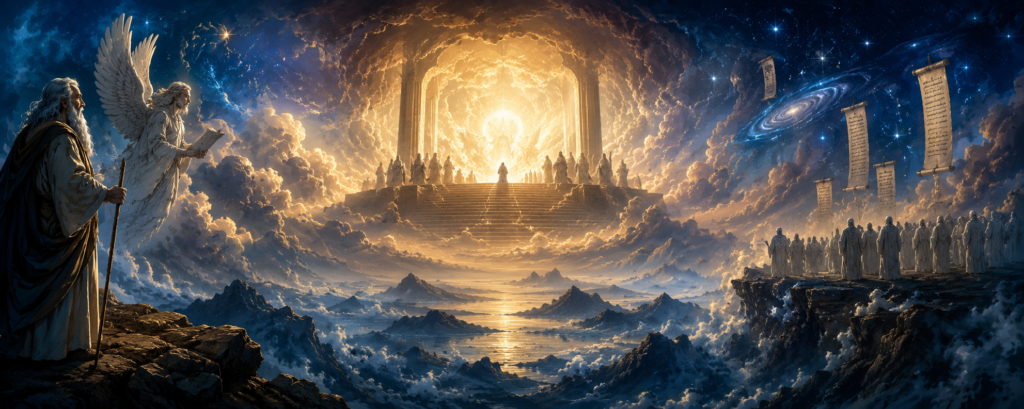
The best-known part of the Book of Enoch is the story of the Watchers. The text portrays them as heavenly beings who were supposed to remain in their proper spiritual realm. Instead, they look upon human women, desire them, descend to Earth, take wives, and father children with them.
In the edition linked here, two hundred Watchers descend on Mount Hermon under the leadership of Semjaza. They bind themselves together by oath so that no individual Watcher will bear the guilt alone. This detail matters because the rebellion is not accidental or impulsive; it is portrayed as organized, deliberate, and collective.
The Watchers do more than take human wives. They reveal knowledge that the text presents as spiritually dangerous when placed in corrupt hands. Azazel teaches weapon-making, metalworking, armor, ornamentation, and cosmetics, while other Watchers reveal enchantments, astrology, the courses of heavenly bodies, plant knowledge, and other mysteries.
It would be too simple to say the Book of Enoch believes all knowledge is evil. The book itself contains elaborate discussions of heavenly order, calendars, stars, wisdom, and cosmic patterns. Its deeper concern is about knowledge detached from wisdom, humility, and moral responsibility. In Enoch’s world, knowledge can become dangerous when it feeds violence, domination, vanity, exploitation, and pride.
Giants, Nephilim, and the Corruption of Earth
The offspring of the Watchers and human women are described as giants. Readers often connect them with the Nephilim mentioned briefly in Genesis 6, although the Book of Enoch expands that short biblical passage into a much larger supernatural narrative. In Enoch’s version, the giants grow violent, consume human resources, attack people, and help fill the world with bloodshed.
This is one reason the book has become so popular in alternative-history circles. It offers a dramatic explanation for why the world before Noah’s Flood had become so corrupt: humanity was not only sinful in the ordinary sense, but the boundaries between heaven and Earth had been violated. The Flood becomes a response to a world that has become spiritually and physically disordered.
The Book of Enoch goes even further by describing what happens after the giants die. Their bodies perish, but their spirits remain on Earth as destructive spirits that afflict, oppress, and mislead humanity. This idea became deeply influential in later Jewish and Christian discussions about demons and the origins of evil spirits.
That does not mean readers must accept the account as literal history in order to understand its power. The Watchers story can also be read as a warning about corruption flowing downward from powerful beings to ordinary people. Leaders, rulers, teachers, and spiritual authorities can cause enormous damage when they abuse their position, normalize violence, or hand destructive tools to people who are not prepared to use them wisely.
Enoch the Scribe and the Judgment of the Angels
Enoch is not presented as a passive observer. He becomes a heavenly scribe, messenger, and witness. The Watchers ask him to bring a petition before God because they fear the consequences of what they have done, but Enoch receives a severe answer: their plea will not be accepted.
The text assigns specific roles to major angels. Uriel warns Noah about the coming flood. Raphael binds Azazel in darkness. Gabriel is sent against the giants. Michael is told to bind Semjaza and the other rebellious Watchers until the day of final judgment.
That structure gives the story a courtroom atmosphere. Heaven is not shown as chaotic or helpless; it is portrayed as a place of order, accountability, records, messengers, punishments, and decisions. Earth may look out of control, but Enoch insists that injustice has not gone unnoticed.
The Flood story fits this larger pattern. In Genesis, the Flood is tied to human wickedness. In 1 Enoch, it is also tied to the destructive consequences of the Watchers’ rebellion and the violence unleashed through their giant offspring. Noah is preserved because he represents continuity, survival, and the possibility of a restored human future.
Heaven, Cosmic Order, and the Ancient Universe
One of the surprises awaiting first-time readers is how much of the Book of Enoch is not about giants at all. Enoch travels through visions of fiery prisons, angelic realms, mountains, rivers of fire, chambers of wind, resting places for the dead, Paradise, and sacred trees. He is shown a universe filled with structure, boundaries, appointed seasons, and spiritual meaning.
The book’s cosmology is ancient, not modern. It describes gates or portals through which the sun, moon, winds, and stars travel, and it lays out a calendar based on a 364-day year. Readers should not treat these sections as hidden astronomy that overturns modern science. They are better understood as an ancient religious attempt to describe a perfectly ordered creation.
That cosmic order is central to the book’s moral argument. The sun follows its course. The stars remain in their appointed places. Seasons arrive in their proper time. The problem, according to Enoch, is that human beings and rebellious angels refuse to remain within the limits placed upon them.
This is why the book constantly connects cosmic disorder with moral disorder. When humans become violent, dishonest, arrogant, or oppressive, the world itself is described as groaning under the weight of corruption. The universe is not morally neutral in Enoch. Creation is presented as a witness against those who abuse it.
The Elect One, the Son of Man, and Final Judgment
The Parables section introduces some of the book’s most important and debated language. Enoch sees the “Head of Days,” a majestic divine figure, alongside a righteous heavenly figure called the Elect One, the Righteous One, and the Son of Man. This figure judges kings, exposes hidden wrongdoing, protects the righteous, and overturns corrupt worldly power.
For Christian readers, these passages naturally sound familiar. The titles “Son of Man,” “Elect One,” heavenly judgment, and the defeat of arrogant rulers all resonate with New Testament language about Jesus. Some Christians see 1 Enoch as an important background text that helps explain how certain Jewish ideas about judgment and a heavenly deliverer were already circulating before and around the early Christian era.
Still, it is worth being disciplined. The Book of Enoch does not simply function as a secret Christian Gospel written before Christianity. Jewish, Christian, academic, and alternative readers interpret the “Son of Man” material differently. The responsible approach is to recognize the strong parallels without pretending that every reader, tradition, or scholar agrees on exactly how the figure should be identified.
One clear connection is the Epistle of Jude, which quotes or closely echoes 1 Enoch 1:9 in Jude 14–15. That demonstrates that Enochic language and ideas were known to at least some early Christian writers. It does not settle the question of biblical canon, but it does show that 1 Enoch belonged to the wider religious conversation of the ancient Jewish and Christian world.
Noah, Dream Visions, and Symbolic History
The linked edition includes a short “Book of Noah” section in which Noah’s birth is described as unusual and radiant. Lamech fears that Noah may be connected to the angels because of the child’s striking appearance, but Enoch reassures the family that Noah is truly Lamech’s son and will survive the coming destruction.
Elsewhere, Enoch receives an enormous symbolic vision often called the Animal Apocalypse. In this vision, people and nations appear as bulls, sheep, wild animals, birds, and stars. The imagery retells sacred history through symbols rather than ordinary narrative, turning Israel’s story, suffering, exile, leadership failures, and hoped-for restoration into a strange but memorable cosmic drama.
This is a useful reminder that not every scene in Enoch is meant to be read the same way. Some passages are visionary, some are symbolic, some are moral instruction, and some are cosmic speculation. Treating the entire book as a literal documentary account misses the genre and flattens what makes it interesting.
The Moral Message Many Readers Miss
The internet tends to focus on Watchers, giants, demons, and fallen angels because those are the most dramatic parts. But the Epistle of Enoch spends a great deal of time on something more recognizable: injustice. It condemns those who gain wealth through oppression, lie in court, exploit workers, celebrate violence, worship wealth, persecute the righteous, and assume their power will protect them from consequences.
That is the central challenge of the book. Enoch is not telling readers to become obsessed with secret knowledge. In fact, it repeatedly warns that hidden knowledge without righteousness can become destructive. Its strongest message is that people should walk honestly, reject violence, avoid corruption, and refuse to envy those who prosper through wrongdoing.
The book’s worldview is severe, but it is not hopeless. It repeatedly promises that injustice is temporary, that the righteous are not forgotten, and that creation will ultimately be cleansed and restored. Whether someone reads that literally, spiritually, or symbolically, the message is clear: apparent success is not the same as moral victory.
Why Was the Book of Enoch Left Out of Most Bibles?
The idea that the Book of Enoch was removed because it “revealed too much” is popular online, but that explanation is too neat. The development of Jewish and Christian biblical canons was complicated, gradual, and different across communities. A text could be widely read, influential, and respected without becoming part of every community’s official collection of Scripture.
The Dead Sea Scrolls show that Enochic writings circulated in ancient Jewish settings, but circulation alone did not automatically make a work canonical. The Israel Antiquities Authority catalogues Qumran Enoch manuscripts as non-biblical or parabiblical compositions, which is a useful reminder that ancient religious literature existed on a spectrum of authority and use.
The Ethiopian Orthodox Tewahedo tradition preserved 1 Enoch in its scriptural heritage, while Jewish and most Christian communities did not include it in their standard biblical canons. That difference is not proof of a conspiracy, nor does it make the book meaningless. It shows that ancient religious communities made different decisions about which writings would be read publicly as Scripture and which would remain influential outside the canon.
How to Read the Book of Enoch Wisely
- Read it as ancient religious literature, not as a modern science book or a secret intelligence report from the ancient world.
- Separate what the text actually says from later claims about aliens, hidden civilizations, giant skeletons, or suppressed history.
- Notice when the book is being symbolic, visionary, moral, or cosmic rather than assuming every passage works the same way.
- Keep Genesis 5–6, Daniel, Jude, and Revelation in mind as related biblical contexts.
- Treat the Book of Giants and other extras in the linked PDF as related Enochic material, not automatically as part of 1 Enoch itself.
Final Thoughts
The Book of Enoch is fascinating because it refuses to give a small answer to the problem of evil. It imagines a universe where heavenly rebellion, human violence, corrupt knowledge, oppressive power, and cosmic disorder are all connected. At the same time, it insists that none of those forces gets the final word.
You do not have to accept every vision literally to get something valuable from the book. Read it as a window into ancient Jewish imagination, spiritual warning, apocalyptic hope, and the questions that shaped later religious thought. The Watchers and giants may get people through the door, but the deeper message is about accountability, justice, humility, and the belief that hidden corruption will not remain hidden forever.
- Taking 1 Enoch Seriously — A scholarly overview of 1 Enoch’s structure, history, transmission, and influence.
- 4Q Enoch — Leon Levy Dead Sea Scrolls Digital Library — Explore official catalog information for an Aramaic Enoch manuscript from Qumran.
The idea that “hidden corruption will not remain forever” gives me comfort. I think automatically think of corrupt politicians getting rich performing sketchy insider trading.