
CIA Gateway Process Explained: What the Report Really Says
A declassified government document appears online. It contains language about consciousness, altered states, energy patterns, time-space, out-of-body experiences, and the possible ability to access information beyond normal perception. It carries official-looking stamps, military language, and a connection to the CIA’s online reading room.
Of course people are going to lose their minds over it.
The document is known as Analysis and Assessment of Gateway Process, and it has become one of the internet’s favourite pieces of “hidden knowledge.” Videos and social-media posts often present it as proof that the CIA discovered the secret of astral projection, manifestation, remote viewing, or escaping the limits of physical reality. Some versions go even further and claim the U.S. government confirmed that consciousness survives death, that the universe is a simulation, or that humans can bend reality with focused thought.
The truth is less simple—but honestly, more interesting. The Gateway report is real. It was written in 1983 for a U.S. Army operational group and later released through the CIA’s reading room. It discusses the Monroe Institute’s Gateway Experience and attempts to explain, in highly speculative language, how altered states of consciousness might work.
It is not a controlled scientific study proving that people can leave their bodies, see distant locations, or access supernatural knowledge. But it is a fascinating historical document because it reveals something important: during the Cold War, intelligence agencies were willing to investigate unusual claims when they believed even a small possibility of strategic advantage existed.
Quick Answer: What Is the CIA Gateway Process?
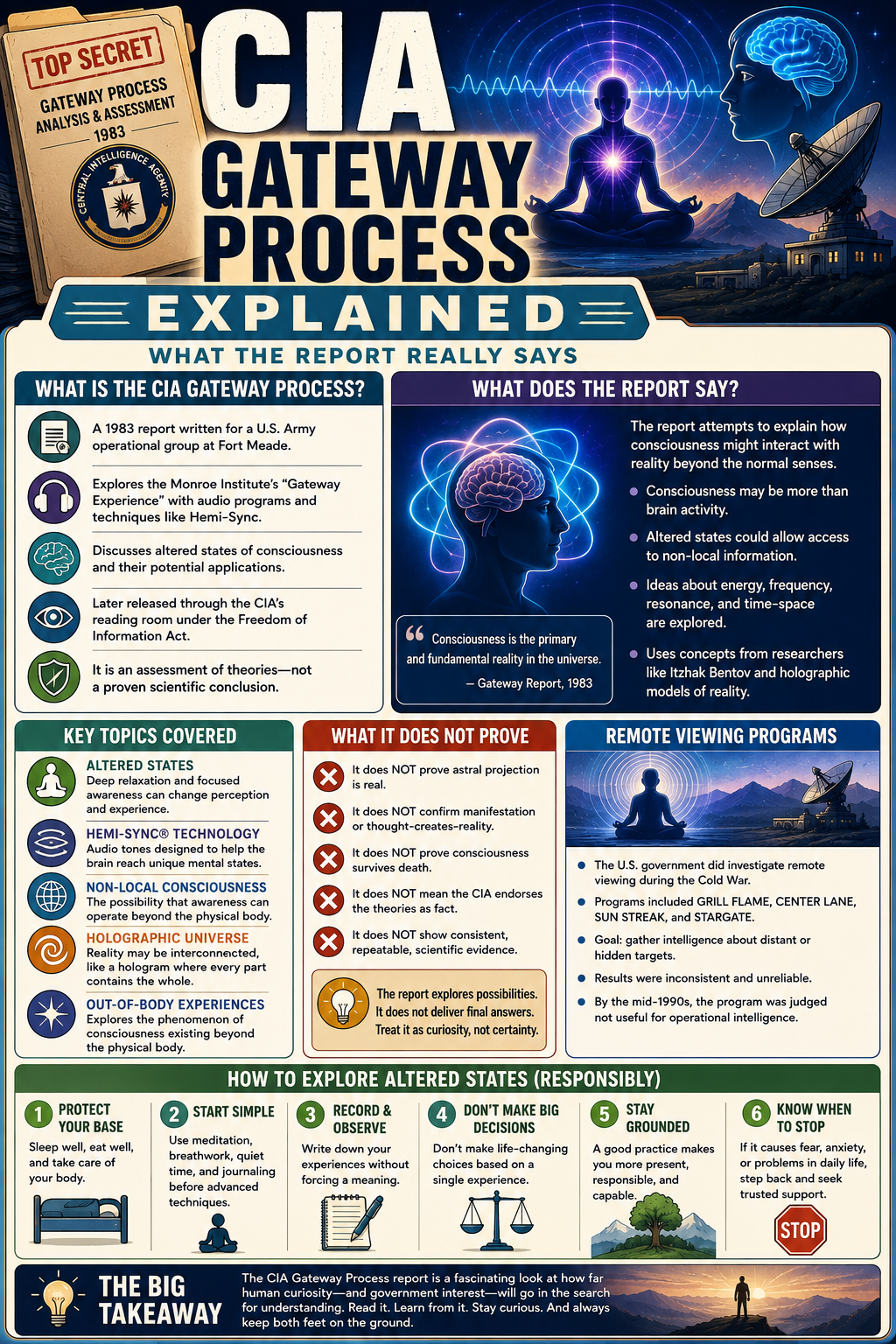
The CIA Gateway Process is the popular name for a 1983 military assessment titled Analysis and Assessment of Gateway Process. The report examined a consciousness-training program associated with the Monroe Institute, which used relaxation techniques and audio exercises intended to help participants enter unusual mental states.
At a glance:
- The famous report was written for a U.S. Army operational group, not as a public CIA scientific announcement.
- It discussed the Monroe Institute’s Gateway Experience and Hemi-Sync audio techniques.
- The report explored theories about consciousness, energy, altered states, remote viewing, and out-of-body experiences.
- The document contains speculation and theoretical models, not a clean laboratory proof of paranormal abilities.
- “Declassified” means the document was released to the public. It does not mean every claim inside it was verified or endorsed as fact.
- Remote-viewing programs did exist within parts of the U.S. intelligence community, but they were ultimately judged too unreliable for dependable intelligence work.
That distinction is the entire key to understanding the Gateway Process. A government agency investigating a strange possibility is not the same thing as a government agency proving that possibility is true.
Why the Gateway Report Became So Famous
The report is built for the modern internet. It has every ingredient needed to go viral: a classified-looking cover page, military terminology, consciousness theories, references to remote viewing, unusual physics language, and a suggestion that human awareness may not be as limited as people assume.
It also lands at the exact intersection of several powerful modern fascinations. People are hungry to know whether the mind is more than brain activity, whether death is the end, whether consciousness can reach beyond the body, and whether institutions know more than they tell the public. The Gateway report feels like a clue from behind a locked door.
But the document becomes much more dramatic when pieces are pulled out of context. A phrase about “time-space dimensions” turns into “the military proved humans can travel across time.” A mention of altered states turns into “the CIA developed a manifestation manual.” A theoretical discussion of energy becomes “science confirmed that thought creates reality.”
That is how internet mythology grows. A real document gets mixed with a real human desire for meaning, then the gaps are filled with certainty.
The better question is not, “Does this document prove every extraordinary claim?” It does not. The better question is, “Why did serious institutions spend time exploring ideas this strange, and what can we responsibly learn from the document today?”
First Correction: It Was Not a CIA Proof Document
The phrase “CIA Gateway Process” is convenient, but it can also be misleading. The famous report was dated June 9, 1983, addressed to the commander of a U.S. Army operational group at Fort Meade, and written by Wayne M. McDonnell. It later became widely accessible through the CIA’s Freedom of Information Act reading room, which is why people associate it so strongly with the CIA.
That matters because readers should understand what they are looking at. It is not a public statement saying, “The CIA has confirmed astral projection is real.” It is an internal assessment trying to make sense of a consciousness-training method and its possible implications.
Military and intelligence organizations have always looked into strange possibilities when national-security pressure was high enough. During the Cold War, U.S. agencies worried that rival powers might be developing unusual psychological, biological, technological, or paranormal capabilities. Even a low-probability idea could attract attention if officials believed the consequences of ignoring it might be serious.
That mindset explains why remote viewing, ESP, mind-influencing techniques, and altered states were investigated. It does not prove those methods worked as advertised. It proves that governments do not like leaving unknown possibilities completely unexplored.
What Was the Gateway Experience?
The Gateway Experience was developed around the work of Robert Monroe and the Monroe Institute. Monroe became known for his interest in altered states, out-of-body experiences, and the possibility that consciousness could operate differently when the body was deeply relaxed.
The training involved guided exercises, focused attention, relaxation, visualization, and audio technology often associated with the name Hemi-Sync. In simple terms, Hemi-Sync used slightly different tones delivered to each ear through headphones. The brain may perceive the difference between those tones as a rhythmic pulse, often called a binaural beat.
The intended goal was not just ordinary relaxation. The Gateway method aimed to help people reach what its creators described as unusual levels of awareness—states in which the body was deeply relaxed while the mind remained alert and focused.
This is where the document becomes interesting. Deep relaxation, meditation, breathwork, visualization, lucid dreaming, and sensory-reduction practices can absolutely change how a person experiences their thoughts, body, attention, emotions, and sense of time. Many people have powerful experiences in those states.
The leap occurs when subjective experience becomes a claim about external reality. Feeling detached from your body is real as an experience. That does not automatically prove your consciousness literally travelled outside your body and gathered accurate information from a distant location.
Those are two very different claims.
What the Report Actually Tries to Explain
The Gateway report reads like an attempt to build a bridge between spiritual experience, neuroscience, physics, and military interest. It discusses the possibility that human consciousness may interact with reality in ways ordinary waking awareness does not recognize.
The report describes altered states using ideas about frequencies, energy patterns, brain hemispheres, resonance, vibration, and holographic models of reality. It draws on theories that were intriguing to some thinkers at the time, including ideas associated with engineer and consciousness researcher Itzhak Bentov.
The basic concept is that the brain may be more than a passive receiver of outside information. The report considers whether focused mental states could help consciousness become more coherent, more stable, or more capable of perceiving information beyond the usual senses.
That is a huge idea. It is also an idea that needs evidence stronger than an interesting theoretical memo.
The report does not present a large, modern-style clinical trial with clear controls, statistical analysis, independent replication, and a final scientific conclusion. It is better understood as an internal exploration of a theory: a document asking, “Could something like this be possible, and should it be taken seriously enough to investigate?”
That is not nothing. But it is not proof.
The Holographic Universe Idea
One of the reasons the Gateway report feels so mind-bending is its use of “holographic” language. The document explores the thought that reality may function in a way somewhat similar to a hologram, where information is distributed across a whole pattern rather than stored in one obvious location.
This does not mean the report proved we live in a literal computer simulation. It does not mean every thought sends a signal into a universal cosmic database. It means the author was trying to use a conceptual model to explain how consciousness and reality might be connected in a deeper way.
This kind of thinking has a powerful emotional pull because it suggests that separation may be less absolute than it feels. Perhaps the self is not as isolated as it seems. Perhaps the observer and the observed are connected in ways ordinary life does not reveal.
That can be a useful philosophical idea. It can encourage humility, awareness, compassion, and curiosity. But it can also become a trap when people use it to avoid responsibility.
“The universe is responding to my vibration” sounds comforting until it becomes an excuse not to make the phone call, apply for the job, repair the relationship, learn the skill, or face a real problem. A spiritual idea that makes a person less grounded is not wisdom. It is avoidance wearing mystical clothing.
Gateway Process vs. Remote Viewing: They Are Related, but Not the Same
The Gateway report is often blended together with remote viewing, but they are not identical. Gateway was a training system aimed at altered states, focused awareness, and personal exploration. Remote viewing was the claimed ability to describe a distant or hidden target without using normal sensory access.
The U.S. intelligence community did spend years investigating remote-viewing claims. These programs went through several names, including GRILL FLAME, CENTER LANE, SUN STREAK, and STARGATE. Their purpose was practical: officials wanted to know whether a person could obtain useful intelligence about foreign locations, military facilities, hostages, equipment, or events without physically being there.
That is an extraordinary claim, so the evidence needed to support it should also be extraordinary. The intelligence interest alone cannot settle the question. Governments investigate possibilities because the cost of being wrong can be high, not because every possibility is likely to be true.
By the mid-1990s, an independent evaluation was conducted after the program returned to CIA oversight. The official conclusion was not that remote viewing had become a dependable intelligence tool. The program was judged too inconsistent and unreliable for routine operational use.
That matters because it clears away one of the biggest exaggerations online. The U.S. government did not quietly keep a perfect psychic-intelligence tool hidden from the public. If it had produced consistently reliable results, it would have been far more difficult to abandon.
What “Declassified” Really Means
The word “declassified” has become almost magical online. People hear it and assume the information must be true because it came from inside the government. But government documents can contain theories, guesses, conflicting opinions, early assessments, bad assumptions, incomplete intelligence, and ideas that were later rejected.
A declassified document tells you something important: someone in government wrote it, received it, used it, or stored it. That is historically valuable. It does not automatically tell you that every claim inside it survived serious testing.
Think of it like finding an old engineering notebook from a major company. The notebook may contain brilliant ideas, flawed ideas, rough calculations, abandoned prototypes, and questions nobody ever solved. The notebook proves that people were exploring those ideas. It does not prove every page became a working machine.
The Gateway report should be read the same way. It is evidence of institutional curiosity. It is evidence that altered consciousness was considered worth examining. It is not a final answer to the nature of reality.
What Science Can and Cannot Say
It would be dishonest to say that all altered-state experiences are meaningless. Meditation, breathwork, sleep deprivation, lucid dreaming, hypnosis, stress, grief, isolation, trauma, music, and focused attention can all profoundly affect perception. People can experience vivid imagery, time distortion, detachment from the body, emotional release, and intense feelings of connection.
Those experiences are real to the person having them. They may even lead to useful changes in their life. Someone may become calmer, less fearful, more reflective, more grateful, or more disciplined after a powerful inner experience.
But subjective intensity is not the same thing as objective verification. A dream can feel completely real while you are inside it. A coincidence can feel like destiny. A meditation insight can feel like a message from beyond the universe. Sometimes it may be deeply meaningful on a personal level without being literal evidence of an external supernatural event.
That is why the best approach is both open and disciplined. You do not need to mock every unusual experience. You also do not need to turn every unusual experience into a cosmic fact.
The Most Useful Lesson From Gateway
The Gateway Process becomes valuable when it pulls you back toward attention rather than fantasy.
Modern life trains people to live scattered. Notifications compete for attention. Stress narrows focus. Endless content creates the illusion of learning without the discomfort of actual reflection. Many people spend years reacting to life rather than consciously living it.
The Gateway material, at its most practical, asks a useful question: what might happen if you learned to direct your attention instead of surrendering it all day?
That does not require belief in remote viewing. It does not require buying expensive tapes, chanting frequencies, or telling yourself the universe is secretly arranging everything in your favour. It requires something more difficult and more useful: stillness, observation, honesty, and practice.
You may discover that your mind is louder than you realized. You may notice how much fear drives your decisions. You may uncover old resentment, unfinished goals, self-deception, or desires you have been avoiding.
That is already a major discovery.
How to Explore Altered States Without Losing Your Grounding
You do not need to join a secret program or accept every paranormal claim to explore consciousness carefully. Start with practices that improve attention and self-awareness without encouraging delusion or escapism.
A grounded approach might look like this:
- Protect sleep first. Do not chase mystical states by wrecking your sleep schedule. Exhaustion can create strange experiences, but it also damages judgment.
- Use simple practices before exotic ones. Try quiet sitting, breath awareness, journaling, prayer, walking without your phone, or a guided meditation before you go hunting for “higher dimensions.”
- Write down experiences without immediately interpreting them. Record what happened, how you felt, what you noticed, and what changed afterward. Let the meaning develop slowly.
- Do not make major decisions based on a single experience. Do not gamble money, end a relationship, stop medical care, or follow a stranger’s advice because you felt you received a message.
- Stay connected to ordinary life. A useful spiritual practice should make you more present, responsible, and capable—not more detached from work, family, health, and reality.
- Know when to stop. If a practice leaves you anxious, panicked, detached, unable to sleep, or unable to function normally, step back and seek qualified support.
The strongest spiritual explorers are not the people who believe every strange idea. They are the people who can face strange ideas without handing over their judgment.
Why the Gateway Process Still Matters
The CIA Gateway Process report matters because it sits at a strange crossroads. It is part Cold War history, part consciousness experiment, part spiritual speculation, and part warning about how easily official-looking documents can be misunderstood.
It shows that the human mind remains one of the least understood parts of existence. We know a great deal about the brain, but we still struggle with hard questions about consciousness, perception, dreams, identity, intuition, and what it means to be aware at all.
The document does not solve those mysteries. It does something more modest: it shows that people inside powerful institutions were willing to admit the mysteries existed.
That is worth noticing. But the right response is not blind belief. It is intelligent curiosity.
Curiosity Without Surrendering Your Judgment
The Gateway report is not proof that the CIA discovered a shortcut to astral projection. It is not a government-approved manifestation guide. It is not evidence that every spiritual claim on the internet is secretly true.
It is a real historical document about a real attempt to understand unusual states of consciousness. It contains bold ideas, speculative models, and questions that still bother people today. What is consciousness? Can attention change experience more deeply than we realize? Are there limits to human perception that we have not fully understood?
Those are good questions. They deserve serious thought.
Just do not confuse a question with an answer. Read the report. Let it stretch your imagination. Let it make you curious. Then keep both feet on the ground and build a life that works in the real world.
- CIA Reading Room: Analysis and Assessment of Gateway Process — Read the original 1983 Gateway Process assessment released through the CIA’s public reading room.
- CIA History: Did the CIA Really Study Psychic Powers? — See the CIA’s own historical overview of remote-viewing research and why the program was not restored.
Reader note: This article explores unusual claims, theories, beliefs, and interpretations. It aims to separate documented history, symbolism, belief, interpretation, and speculation wherever possible. Extraordinary claims are not presented as established fact unless supported by credible evidence.