
Gospel of Thomas Explained: The Kingdom Within and the Lost Sayings of Jesus
There are ancient texts that feel safely distant, like objects behind glass in a museum. Then there are texts like the Gospel of Thomas, which can feel uncomfortably close. It does not begin with a manger, a miracle, a crucifixion, or an empty tomb. Instead, it opens with a strange promise: hidden sayings of Jesus that must be interpreted, not merely read.
That is why the Gospel of Thomas has fascinated seekers, Christians, skeptics, scholars, mystics, and conspiracy-minded internet rabbit-hole explorers for decades. Some people see it as evidence that the real teachings of Jesus were buried. Others see it as a later spiritual text that borrowed familiar sayings and pushed them in a more mystical direction. The truth is more interesting than either extreme.
The Gospel of Thomas is not a secret decoder ring that suddenly overturns everything people know about Christianity. But it is also not a worthless curiosity. It is a challenging early Christian text that forces readers to confront a powerful question: what happens when faith is treated less as agreement with a story and more as a transformation in the way a person sees reality?
Quick Answer: What Is the Gospel of Thomas?
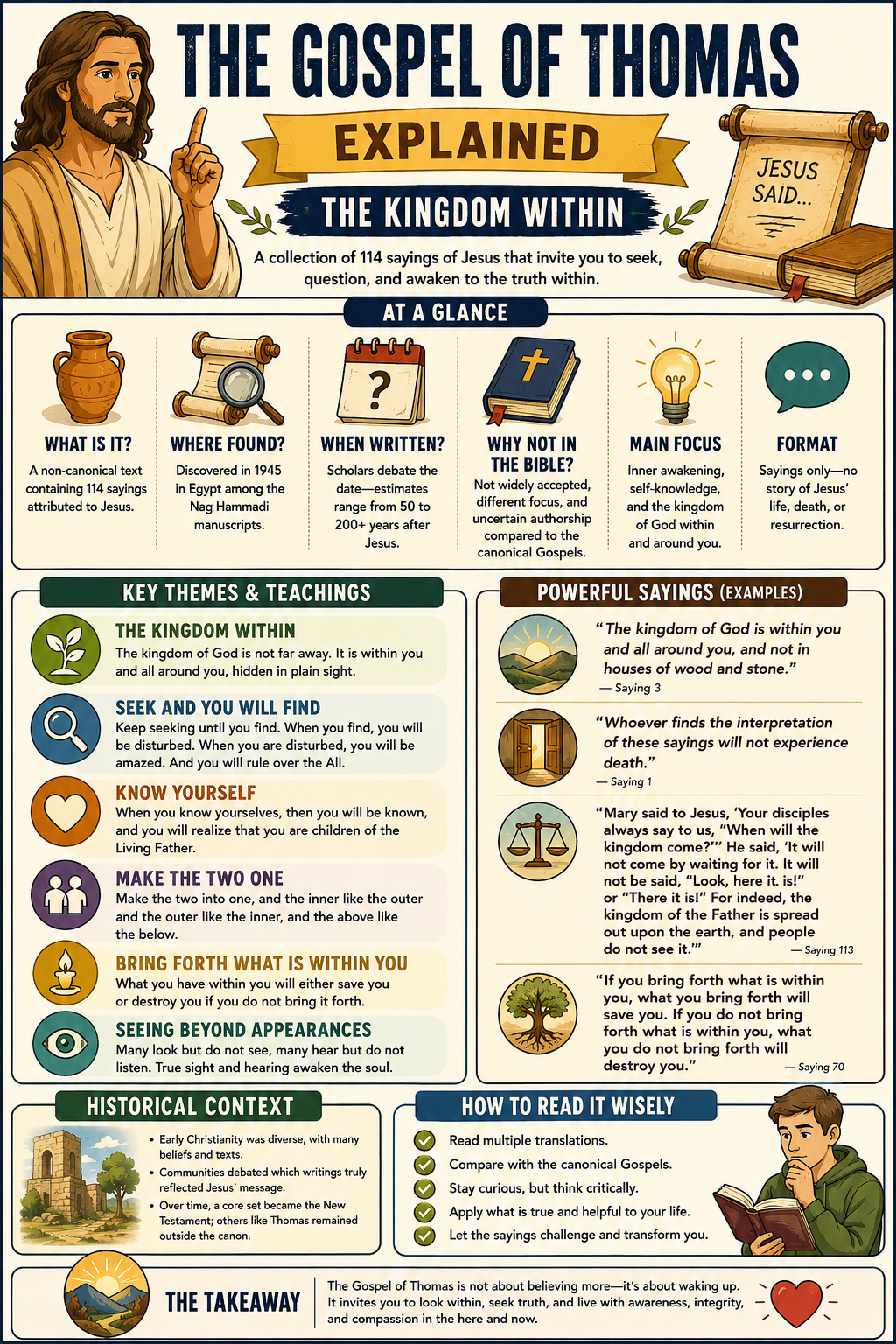
The Gospel of Thomas is a non-canonical collection of 114 sayings attributed to Jesus. It was discovered in Egypt in 1945 among a group of ancient books now known as the Nag Hammadi library. Unlike Matthew, Mark, Luke, and John, it contains almost no storyline, miracles, travel scenes, crucifixion account, or resurrection narrative.
At a glance:
- It is a collection of sayings rather than a biography of Jesus.
- It repeatedly emphasizes seeking, self-knowledge, awakening, and spiritual perception.
- Some sayings resemble passages in the New Testament, while others are unfamiliar and cryptic.
- Scholars still debate when it was written and whether some sayings preserve very early traditions.
- Its discovery does not prove that a hidden “true Christianity” was deliberately concealed from the world.
The text is best approached with curiosity and discipline. Read it neither as automatic proof of a conspiracy nor as something to dismiss without thought. It is a window into how diverse and surprising early Christianity could be.
What Makes the Gospel of Thomas So Different?
The four New Testament Gospels tell a story. Jesus is born, teaches, gathers followers, confronts religious and political authorities, is crucified, and is proclaimed risen. Their power comes partly from narrative: they show people what Jesus did, how others reacted, and why the events mattered.
The Gospel of Thomas removes almost all of that structure. Most sayings simply begin with a version of “Jesus said,” followed by a statement that may sound familiar, puzzling, poetic, or almost like a riddle. The reader is not carried through a plot. The reader is handed a set of doors and expected to open them.
That difference matters. In the New Testament Gospels, a person often learns through events, relationships, parables, and public teaching. In Thomas, the emphasis often falls on interpretation. The words are not treated as simple instructions to be memorized. They are treated as sayings that must work on the reader.
A few major differences stand out:
- The Gospel of Thomas contains sayings but almost no story.
- It gives little attention to Jesus’ death and resurrection.
- It often speaks of the kingdom of God as present, hidden, or discoverable now.
- It repeatedly links spiritual insight with self-knowledge.
- It can sound less like a church sermon and more like a spiritual puzzle.
That last point is exactly why people either love it or distrust it. Thomas does not feel designed to reassure the reader. It feels designed to unsettle the reader.
The Strange History of Its Discovery
The Gospel of Thomas came to wider attention after the discovery of the Nag Hammadi library in Egypt in 1945. The collection included a number of ancient religious and philosophical writings, many of which had been unknown or available only in fragments. The Gospel of Thomas was preserved in Coptic, an ancient Egyptian language used by Christian communities in Egypt.
Before the complete Coptic version was found, scholars already knew that a Thomas tradition existed. Small Greek fragments from Egypt had been discovered decades earlier and appeared related to sayings later found in the Coptic text. This matters because it shows the Gospel of Thomas was not invented in 1945; the discovery gave scholars a much fuller version of a text they had only glimpsed before.
The dramatic discovery story has encouraged a lot of wild claims. People sometimes picture a coordinated effort by powerful church leaders to bury the “real” teachings of Jesus forever. But history is rarely that tidy. Ancient manuscripts were copied, argued over, lost, stored, translated, rejected, protected, and forgotten for many reasons.
There is no solid evidence that the Gospel of Thomas was hidden away as part of one master plan to keep humanity spiritually asleep. What is clear is that early Christianity was far more diverse than many people realize. Different communities argued about who Jesus was, what salvation meant, which texts mattered, and how believers should live.
Why Was the Gospel of Thomas Not Included in the Bible?
The New Testament canon was not created by one dramatic meeting where someone simply threw a pile of books onto the floor and declared winners and losers. It developed over centuries. Christian communities gradually recognized some texts as especially authoritative because they were widely used, considered connected to the apostles, consistent with emerging mainstream doctrine, and valued across different regions.
The Gospel of Thomas did not meet that same level of acceptance. It was not widely received as scripture across the broad Christian movement that eventually became orthodox Christianity. Its focus also differed sharply from the central message found in the New Testament, especially its limited attention to Jesus’ death, resurrection, forgiveness of sins, and public mission.
The main reasons it was not included likely involve a combination of factors:
- Uncertain authorship and uncertain connection to the apostle Thomas.
- Limited use across the wider early Christian church.
- Teachings that could be read as conflicting with mainstream Christian theology.
- A strong focus on hidden insight and interpretation rather than public proclamation.
- The fact that it does not tell the core story found in the canonical Gospels.
That does not mean it is meaningless. It means early Christian leaders did not treat it as equal to Matthew, Mark, Luke, and John. There is a difference between saying, “This book is not part of the Bible,” and saying, “This book has nothing to teach us.”
The Sayings That Make People Stop and Think
The Gospel of Thomas is not famous because it tells a forgotten historical story. It is famous because some of its sayings hit the mind like a stone through a window. They force the reader to slow down and ask whether the problem is the saying itself or the reader’s normal way of looking at life.
Seek Until You Are Disturbed
One early saying encourages people not to stop seeking until they find. But finding does not lead immediately to comfort. It leads first to disturbance, then wonder, and finally rest. That is a surprisingly honest spiritual sequence.
Most people want spiritual growth to feel peaceful from the beginning. They want reassurance, certainty, and a warm sense that everything will work out. But real growth often begins with discomfort. It can mean realizing that your identity has been built around fear, approval, distraction, resentment, or habits you have avoided questioning.
This saying does not promise that seeking will make life easier right away. It suggests that truth may first shake up the person who finds it. That idea is not exclusive to Thomas, but Thomas presents it in a blunt and memorable way.
The Kingdom Is Within and All Around You
One of the most famous ideas in the Gospel of Thomas is that the kingdom is not simply somewhere far away in the future. It is described as being within and outside the person, hidden in plain sight but missed by people who do not truly see.
This can sound like the text is saying, “You are God,” or “Everything you believe becomes true.” That is a sloppy modern reading. A more careful interpretation is that human beings may be blind to the sacred, meaningful, or spiritually urgent dimensions of ordinary life because their attention is scattered and shallow.
Think about how often people live on autopilot. They wake up, scroll, work, react, complain, chase the next reward, and repeat. Thomas pushes against that trance. It asks whether the kingdom is missed not because it is distant, but because people are too distracted to recognize what is directly in front of them.
Bring Forth What Is Within You
Another famous saying warns that what is within a person can either save them or destroy them, depending on whether they bring it forth. This is one of the most psychologically powerful ideas in the entire text.
Read in a practical way, it is about the danger of unlived truth. A person may know they need to apologize, create something, leave a destructive habit, develop discipline, face grief, or stop betraying their own values. When those truths are buried long enough, they do not disappear. They can turn into bitterness, numbness, resentment, self-sabotage, or the feeling that life is somehow slipping away.
This does not mean every inner impulse deserves to be expressed. Plenty of impulses are foolish or destructive. The deeper point is that people cannot build a meaningful life by permanently avoiding the part of themselves that knows what needs to change.
Make the Two One
Several sayings in Thomas play with opposites: inner and outer, male and female, above and below, one and two. These can sound bizarre to modern readers, especially when taken literally. But the underlying idea may be the integration of a divided self.
Most people know what it is like to live split in half. You say you value health but neglect your body. You say you want freedom but avoid the work required to earn it. You say you want peace but feed your mind with outrage all day. You say you want purpose but spend every spare hour escaping from your own thoughts.
Thomas repeatedly challenges this kind of inner division. Its language may be ancient and strange, but the human problem is not. A person becomes stronger when their values, actions, attention, and inner life begin moving in the same direction.
Find the Sacred in Ordinary Life
One saying suggests that the divine can be found in ordinary places, even beneath a stone or within a piece of split wood. The image is not really about hiding spiritual treasure in lumber. It is about the possibility that reality is more charged with meaning than people assume.
That idea can become unhealthy if it turns into paranoia, magical thinking, or the belief that every random event is a coded message. But it can also be deeply grounding. It can remind a person that life is not only made of errands, bills, algorithms, and stress. There are moments of silence, conscience, beauty, responsibility, love, grief, courage, and wonder that cannot be reduced to a productivity score.
The Gospel of Thomas does not ask readers to escape the world. At its best, it asks them to wake up inside it.
Is the Gospel of Thomas Gnostic?
People often call the Gospel of Thomas “Gnostic,” but that label needs some care. Gnosticism is a broad modern term used for several ancient movements that emphasized hidden knowledge, spiritual awakening, and the soul’s relationship to a flawed or deceptive material world. Some ancient Gnostic texts contain elaborate myths about heavenly beings, false creators, secret cosmic rulers, and the soul’s escape from the physical world.
The Gospel of Thomas shares some themes that sound Gnostic, especially its focus on hidden knowledge and self-understanding. But it does not contain the full mythological system found in some other texts from the Nag Hammadi collection. That is why scholars disagree about how strongly the Gnostic label should be applied.
The safer conclusion is that Thomas belongs near the mystical and alternative edges of early Christian thought. It presents Jesus less as a figure moving through public history and more as a revealer whose sayings awaken the listener. That is a very different emphasis, even when some individual sayings resemble passages in the New Testament.
Was It Written Before the New Testament Gospels?
This is one of the biggest arguments surrounding the Gospel of Thomas. Some scholars have suggested that parts of it may preserve very early sayings traditions, perhaps even traditions independent of the New Testament Gospels. Others believe the text was written later and reshaped familiar Christian material for a more mystical audience.
The honest answer is that nobody can prove the exact date with certainty. The surviving manuscript is much later than the original composition of the text, and ancient works were often copied, translated, edited, and expanded. A manuscript’s date is not automatically the same thing as the date when the ideas inside it first appeared.
This is where online arguments often become too confident. Saying “Thomas proves the earliest Christianity was completely different” goes far beyond the evidence. But saying “Thomas is obviously useless because it is not in the Bible” is also lazy. The text may preserve some early material, later interpretations, or a mixture of both.
That uncertainty is not a weakness. It is part of what makes the Gospel of Thomas worth studying. It reminds us that history is not a clean filing cabinet where every document has a perfect label.
How Thomas Differs From the Christian Gospels
The New Testament Gospels tell readers what happened and why Christians believe it matters. They focus on Jesus’ public ministry, teachings, death, and resurrection. They describe a message centered on God’s kingdom, repentance, faith, forgiveness, love, and a transformed way of life.
The Gospel of Thomas is more inward and more cryptic. It is interested in what happens when someone understands the sayings of Jesus at a deeper level. It offers fewer public events and more private challenges. It does not replace the canonical Gospels, but it does reveal another way early Christians imagined Jesus as a teacher.
A simple comparison looks like this:
- Matthew, Mark, Luke, and John: Story, public ministry, miracles, cross, resurrection, community.
- Gospel of Thomas: Sayings, interpretation, self-knowledge, awakening, hidden meaning.
- New Testament emphasis: Good news proclaimed openly.
- Thomas emphasis: Wisdom discovered through insight and inner transformation.
The difference is not minor. It changes the entire spiritual atmosphere of the text.
How to Read the Gospel of Thomas Without Fooling Yourself
The Gospel of Thomas rewards serious reading, but it can also attract projection. Because many sayings are mysterious, readers can easily pour their own beliefs into them and walk away convinced the text supports whatever they already wanted to believe.
A better approach is to read it slowly and keep a few rules in mind:
- Read more than one translation. Small wording differences can change how a saying feels.
- Compare similar sayings in Matthew, Mark, Luke, and John. Notice what stays the same and what changes.
- Separate the ancient text from modern internet claims about it. A dramatic video title is not historical evidence.
- Treat uncertainty honestly. “We do not know” is often more intelligent than a confident guess.
- Ask what the saying demands from your life. A spiritual text is not just a puzzle to solve; it can be a mirror.
That final point is where Thomas becomes practical. It is easy to become obsessed with who hid what, what the church knew, or whether ancient manuscripts contain secret codes. But the text itself keeps returning to the reader. Are you awake? Are you divided against yourself? Are you seeking truth, or merely collecting strange information?
Those questions are much harder than a conspiracy theory. They are also more useful.
What the “Kingdom Within” Could Mean Today
The most valuable modern reading of the Gospel of Thomas may not be that people should abandon tradition, reject Christianity, or chase every mystical claim online. It may be that spiritual life requires attention. A person cannot live wisely while constantly distracted, reactive, dishonest with themselves, and disconnected from what they claim to value.
The “kingdom within” does not have to mean that the answer to every problem is buried somewhere inside your feelings. Sometimes the answer is outside you: in truth, responsibility, wise counsel, hard work, repentance, repair, learning, or service to other people. Inner reflection matters because it can help a person see clearly enough to act better in the real world.
That is the challenge Thomas leaves behind. It does not offer a comfortable escape hatch. It asks whether you are actually awake to your own life.
Final Thoughts: Why the Gospel of Thomas Still Matters
The Gospel of Thomas is not a lost master key that unlocks every secret of religion. It does not prove that Christianity was built on a lie, and it does not give anyone permission to declare themselves spiritually superior because they found an obscure ancient text. Those are shallow uses of something much more challenging.
What it does offer is a strange, demanding collection of sayings that pushes readers beyond passive belief. It asks them to seek, interpret, confront inner division, and notice what they have been missing. Whether you approach it as a Christian, a skeptic, a spiritual seeker, or simply someone curious about ancient history, that challenge still has teeth.
The best way to read the Gospel of Thomas is with an open mind and both feet on the ground. Let it disturb you where it deserves to disturb you. Let it make you wonder. But do not stop at wonder. The real question is whether the insight changes how you live.
- Nag Hammadi Archive – Claremont Colleges Digital Library — Explore archival material and background on the Nag Hammadi manuscripts that included the Gospel of Thomas.
- Yale Open Courses: The Gospel of Thomas — Watch a balanced academic lecture on the text, its discovery, and the debates around its origins.
I feel as though it is my duty as someone raised in the Catholic faith to review the Nag Hammadi archive and check out the Yale course on the gospel of thomas in order to fully comprehend what its intentions are. This I shall do. Lol